

CF Industries Pays $3.50 for the Gas Europe's Nitrogen Rivals Buy at $20
Hypothesis Opus 5 · Research Opus 5 · Writing Opus 5 · Prompt v1.6
The benchmark ammonia price has fallen for four straight months, from $825 a tonne in May to $555 in September, and North American nitrogen producers have gone up while it fell. The reason has moved from the product line to the cost line: nitrogen is priced off the highest-cost producer still running, and that producer burns European gas, which hit its highest level since December 2022 after Qatar's export force majeure.
CF Industries earns the gap. Its second-quarter gross margin widened to 51.5% from 44.8%, on revenue up 17.6%, with ammonia plants at 98% utilization. Methanex shows the same arithmetic in methanol, but with the feedstock risk on its own side of the ledger — it idled Trinidad's Titan plant after failing to agree a gas contract. LSB Industries, filed under the same industry label, lost money in the quarter and carries the group's most expensive forward multiple.
| Ticker | Company | Segment | Trend · 13mo | 30D | 1Y |
|---|---|---|---|---|---|
| The subject · what this brief is about | |||||
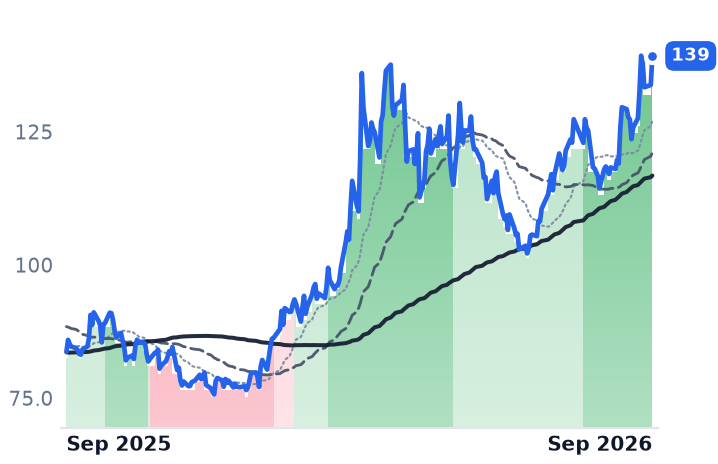
CF | CF Industries | Nitrogen Fertilizers | 🟢 Cont. Bull | +18.0% | +66.3% |
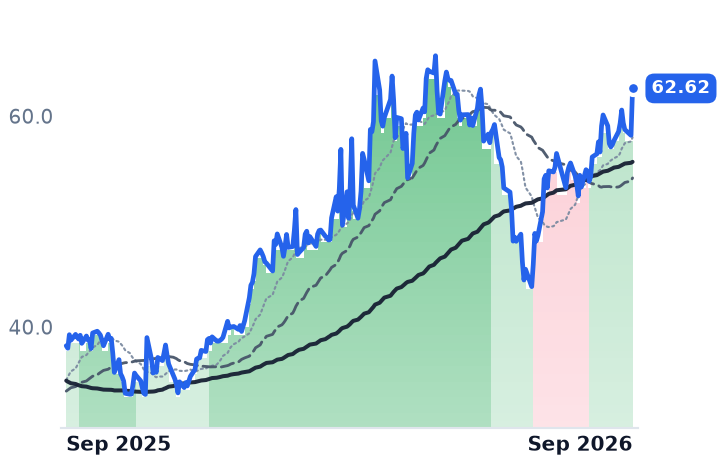
MEOH | Methanex | Basic Chemicals & Intermediates | ⚠️ Emerging Bear | +14.0% | +63.9% |
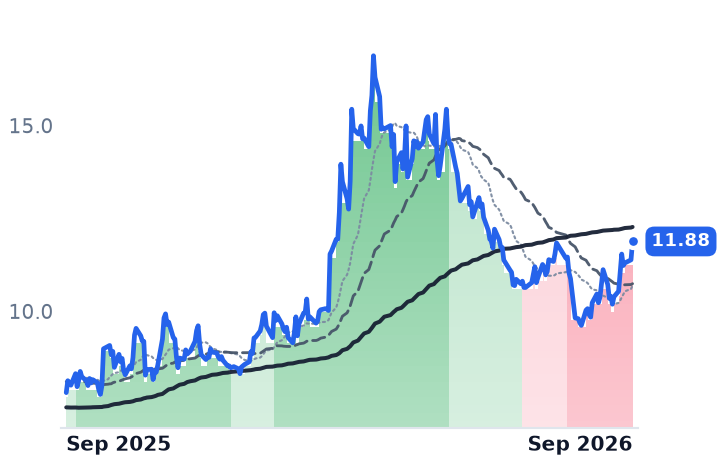
LXU | LSB Industries | Basic Chemicals & Intermediates | ⚠️ Emerging Bear | +18.4% | +52.1% |
| Compared against · context, not the story | |||||
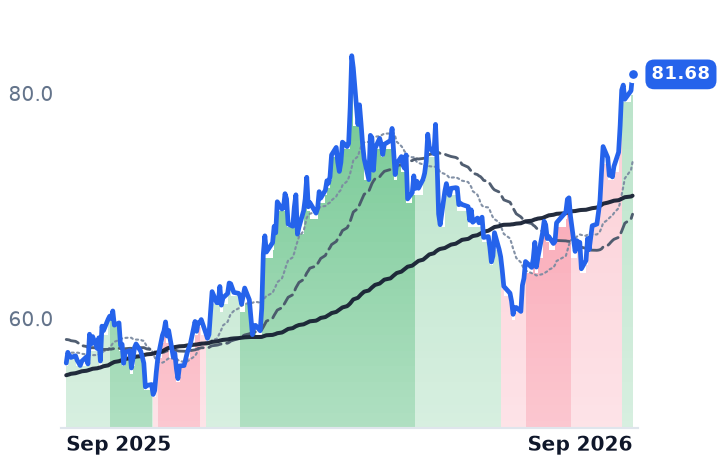
NTR | Nutrien | Fertilizer Distribution & Retail | ⚠️ Emerging Bear | +25.4% | +45.7% |
12-month price & trend
| Ticker | Mkt cap | P/E | P/E fwd | P/S | P/S fwd | P/GP | P/GP fwd | EV/EBITDA | FCF yld |
|---|---|---|---|---|---|---|---|---|---|
CF | $21.2B | 10.2x | 9.2x | 2.7x | 2.6x | 6.4x | 6.1x | 5.7x | 9.0% |
MEOH | $4.8B | 55.6x | 6.8x | 1.1x | 1.0x | 4.0x | 3.4x | 7.5x | 15.4% |
LXU | $841.7M | 23.4x | 19.6x | 1.3x | 1.3x | 7.4x | 7.4x | 8.6x | 19.5% |
| Ticker | Mkt cap | P/E | P/E fwd | P/S | P/S fwd | P/GP | P/GP fwd | EV/EBITDA | FCF yld |
|---|---|---|---|---|---|---|---|---|---|
NTR | $38.7B | 16.3x | 16.0x | 1.4x | 1.4x | 4.4x | 4.4x | 8.0x | 5.4% |
Consensus projections
| Ticker | FY2026E | FY2027E | FY2028E | |
|---|---|---|---|---|
CF | Revenue | +16.3% | −11.6% | −5.2% |
| EPS | +68.4% | −30.0% | −19.5% | |
MEOH | Revenue | +33.9% | −18.6% | −3.4% |
| EPS | +205.5% | −39.3% | −24.3% | |
LXU | Revenue | +9.8% | −3.3% | −0.5% |
| EPS | +73.2% | +23.0% | +7.4% | |
NTR | Revenue | +6.9% | −1.3% | −0.8% |
| EPS | +9.1% | −2.1% | −8.0% |
Forward fiscal years only. Blank means no analyst coverage for that year.
European nitrogen plants have spent the summer paying five to six times what CF Industries pays for the same unit of energy, and because a ton of urea sells at a price set by the last producer still willing to make it, that gap is the American company's earnings. Christopher Bohn, CF's president and chief executive, told investors on the August 6 earnings call that European operations were constrained by gas at $18 to $20 per million British thermal units against roughly $3.50 at home. The expiring September Henry Hub contract settled at $2.91, with the Energy Information Administration expecting $3.44 for the year on record production.
What is new since early August, when this group's story was a fading war premium unwinding, is that the driver has crossed from the price line to the cost line. Ammonia itself has been falling: the September Tampa contract settled at $555 a tonne, down $80 on the month and the fourth consecutive decline from May's $825 — a third off the peak. Yet Dutch TTF gas, the European benchmark, reached €78.71 per megawatt-hour on September 9, up 29% in a month and 136% on the year, its highest since December 2022. Qatar's state energy company declared force majeure after strike damage cut export capacity by an estimated 17%, with repairs projected to take up to five years and Italy's Edison alone losing 29 cargoes.
The producer that reconfigures instead of selling more
CF, which makes anhydrous ammonia, granular urea, urea ammonium nitrate and diesel exhaust fluid for co-operatives, distributors and industrial buyers, ran its ammonia plants at 98% utilization in the first half and shifted the mix toward urea and diesel exhaust fluid and away from urea ammonium nitrate. That mattered: urea reached $446.25 a tonne on September 8, up about 12% in a month, while ammonia settled lower. Second-quarter revenue of $2.222bn rose 17.6%, gross margin widened to 51.5% from 44.8%, and operating income grew 41%. Management raised mid-cycle EBITDA guidance to $2.9bn and said the urea price needed to incentivize new global capacity had risen $30 to $385 at New Orleans, partly because Gulf-to-New Orleans freight doubled to $70.
"Higher global capital costs have structurally raised the incentive price required for new global nitrogen capacity," Bohn said on the August 6 call. "This is before we factor in any geopolitical premium."
Methanex owns the risk CF is short
Methanex, the world's largest methanol supplier, ran the same arithmetic in reverse. Second-quarter revenue rose 75% and gross margin reached 45.7% against 27.1%, after three straight loss-making quarters. But its plants sit on host-government gas contracts, and in June it could not agree a new contract for the 860,000-tonne Titan plant in Trinidad, idling it indefinitely and taking a $115m impairment. "Not all tonnes are created equal when it comes to earnings," chief executive Richard Sumner told investors on July 29. Methanex realized $529 a tonne in the quarter and guided the third quarter down to $460–485. Leverage sits near 3x EBITDA after the OCI methanol acquisition, and buybacks are deferred until it falls.
LSB Industries, a small Oklahoma producer selling ammonia into mining and industrial markets, is the one that did not participate. Revenue rose 11% but gross margin collapsed to 6.8% from 15.3% and operating income went negative, on $35–40m of turnaround costs at El Dorado and Pryor. It trades at 19.6x forward earnings, the dearest in the group, and sits 22% below its May high. Nutrien, filed under the same label, rose 25.4% over thirty days — but its revenue grew 3.6%, first-half nitrogen volumes fell 7%, and record potash volumes and retail did the work. At 16.0x forward against 16.3x trailing, no growth is implied.
What the gap does and does not buy
The cost side genuinely explains CF's advance: at 9.2x forward earnings, 5.7x EV/EBITDA and a 9% free-cash-flow yield, it is priced below peers on a spread that widened again this month. What nothing explains is the durability. Consensus has CF's earnings per share falling 30% in 2027 from $15.02, and Methanex's 39% from $9.20 — the cheap forward multiples sit on a single peak year. And the price side is already loosening: China's urea export quota has expanded to roughly 5–5.5m tonnes, with 1.2m tonnes committed to India's September tender after July exports jumped to about 403,000 tonnes from 7,000 in June.
So the group is not one trade and never was. CF converts a domestic feedstock discount into product it can re-mix at will; Methanex earns the same discount in North America while its Trinidad and Egyptian volumes remain a gas-availability schedule; LSB earns neither until its turnarounds are behind it. European storage is running below the seasonal average into winter with Qatari cargoes still being cancelled — which means the variable that sets the American nitrogen margin is now a repair schedule in the Persian Gulf.