

Salesforce Rose 22% in a Day on 6% Organic Growth as HubSpot, Growing 20%, Stayed Cheapest
Hypothesis Opus 5 · Research Opus 5 · Writing Opus 5 · Prompt v1.6
Five marketing-software companies turned upward together between mid-July and the start of September, and the one that re-rated hardest is the one whose underlying growth halved. Salesforce's reported revenue rose 10.8% last quarter, but $456m of it came from Informatica, an acquisition absent from the year-ago base; without it the business grew roughly 6%, down from 13.3% in the April quarter. HubSpot, over the same stretch, grew 19.8% and swung its operating margin from minus 3.2% to plus 4.8%.
The result is a ranking that reads backwards. Against a year of gross profit, HubSpot is the cheapest name in the group at 4.35x and Salesforce the second-dearest at 6.0x. What lifted all five was the collapse of a narrative about AI destroying per-seat software, not a change in the growth rates underneath it. Salesforce's third-quarter print is where the promised organic re-acceleration either appears without an acquisition attached, or does not.
| Ticker | Company | Segment | Trend · 13mo | 30D | 1Y |
|---|---|---|---|---|---|
| The subject · what this brief is about | |||||
CRM | Salesforce | Customer Experience & CRM | 🔴 Cont. Bear | +26.0% | −0.5% |
HUBS | HubSpot | Customer Experience & CRM | 🔴 Cont. Bear | +13.0% | −51.1% |
| Compared against · context, not the story | |||||
BRZE | Braze | Customer Experience & CRM | 🌱 Emerging Bull | +4.7% | −6.8% |
KVYO | Klaviyo | Marketing Automation | 🔴 Cont. Bear | +5.0% | −45.8% |
SPT | Sprout Social | Software - Application | 🌱 Emerging Bull | +2.6% | −32.1% |
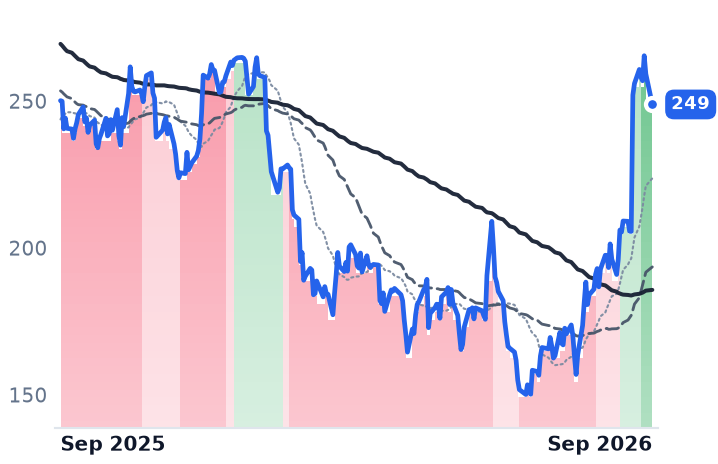
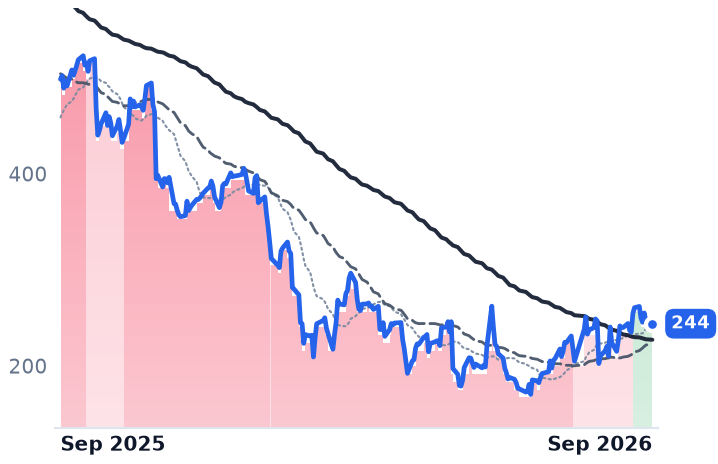
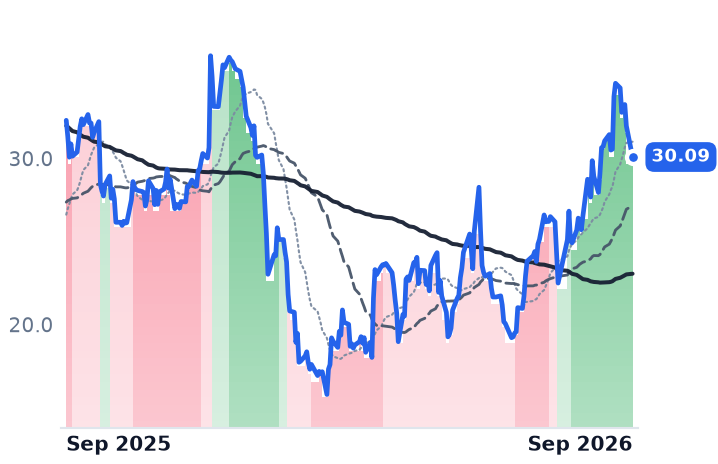
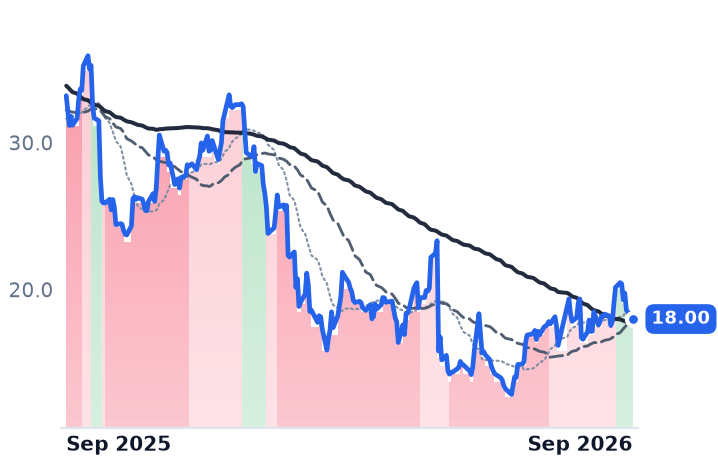
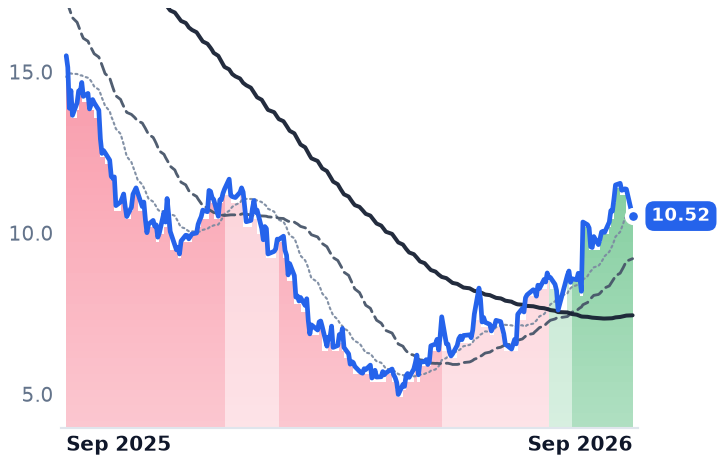
12-month price & trend
| Ticker | Mkt cap | P/E | P/E fwd | P/S | P/S fwd | P/GP | P/GP fwd | EV/EBITDA | FCF yld |
|---|---|---|---|---|---|---|---|---|---|
CRM | $203.8B | 22.6x | 15.0x | 4.6x | 4.4x | 6.0x | 5.7x | 15.0x | 7.4% |
HUBS | $12.5B | 86.2x | 18.4x | 3.6x | 3.4x | 4.4x | 4.1x | 41.5x | 6.1% |
BRZE | $3.4B | n/m | 47.6x | 4.3x | 3.8x | 6.5x | 5.7x | n/m | 2.0% |
| Ticker | Mkt cap | P/E | P/E fwd | P/S | P/S fwd | P/GP | P/GP fwd | EV/EBITDA | FCF yld |
|---|---|---|---|---|---|---|---|---|---|
KVYO | $5.4B | 838.1x | 21.9x | 3.9x | 3.5x | 5.3x | 4.8x | 173.4x | 4.5% |
SPT | $632.9M | n/m | 9.3x | 1.3x | 1.3x | 1.7x | 1.7x | n/m | 8.2% |
Consensus projections
| Ticker | FY2026E | FY2027E | FY2028E | |
|---|---|---|---|---|
CRM | Revenue | +9.3% | +11.5% | +9.9% |
| EPS | +17.4% | +40.9% | −2.9% | |
HUBS | Revenue | +18.3% | +14.1% | +14.1% |
| EPS | +38.2% | +25.9% | +18.4% | |
BRZE | Revenue | +24.3% | +22.8% | +17.1% |
| EPS | +281.2% | +49.6% | +55.0% | |
KVYO | Revenue | +25.7% | +19.6% | +18.9% |
| EPS | +27.3% | +28.3% | +25.3% | |
SPT | Revenue | +8.6% | +5.8% | +9.7% |
| EPS | +43.9% | +39.2% | +20.6% |
Forward fiscal years only. Blank means no analyst coverage for that year.
Salesforce shares had their second-best session on record on 27 August, gaining 22.6%. The quarter behind the move showed revenue of $11.345bn, up 10.8% from a year earlier — of which $456m came from Informatica, the data-cataloguing and integration business Salesforce bought for about $8bn and consolidated from 18 November 2025. Remove revenue that was not in the year-ago base and the underlying company grew roughly 6%, against 13.3% in the April quarter.
The gap did not stop at Salesforce. All five names in marketing and customer-relationship software turned their trends upward between 16 July and 1 September, and all five rose over the following thirty trading days — Salesforce 29.1%, HubSpot 15.9%, Braze 13.4%, Klaviyo 8.3% and Sprout Social 1.8%, an equal-weight gain of 13.7% against a twelve-month equal-weight loss of 27.4%. What reversed was a story rather than a set of growth rates: months of positioning for AI to destroy per-seat software unwound, and Adobe and Autodesk rose alongside Salesforce in the same session. "This SaaSpocalypse narrative has been such nonsense," chief executive Marc Benioff told CNBC on 26 August.
What Salesforce actually reported
Gross margin fell to 76.65% from 78.10%, and GAAP operating income was flat year over year at $2.33bn. The genuinely good number was contracted revenue due within twelve months, which reached $33.5bn and grew 14% in constant currency — three points faster than revenue, and what management called the fastest bookings growth in four years. Free cash flow was $1.1bn, up 81%.
The per-share arithmetic is the loudest part of the story. Diluted shares fell from 962m to 821m over the year, a 14.7% reduction, driven by a $25bn accelerated repurchase that delivered 103m shares upfront. It was funded with $25bn of new debt, which lifted quarterly interest expense from $67m to $473m, and Salesforce told investors in May that full-year operating and free-cash-flow growth would be roughly 4–5%, half the earlier guidance, specifically to absorb that cost. The share count shrinks; the cash flow it concentrates shrinks with it.
Agentforce annual recurring revenue passed $1.5bn, up more than 240% — on a definition widened this quarter to include Slackbot and other AI products, and against a subscription run-rate near $43bn. Two-thirds of the $10.82bn subscription book is still billed per human login, and that seat-billed core grew 8% in constant currency.
The cheapest name grew fastest
HubSpot, which sells a bundled marketing, sales and service platform to mid-market businesses, reported June-quarter revenue of $911.7m, up 19.8%, and swung its GAAP operating margin from minus 3.2% to plus 4.8%. Its shares are down 51% over twelve months. The reason sits in its own release: 7,000 net new customers against guidance of 9,000–10,000, a forward pace cut to 5,000–6,000, net revenue retention of 102%, and third-quarter revenue guided up 14%. Customers reached 306,446, up 14%, while average subscription revenue per customer rose 4% — growth carried almost entirely by logos, and logos are what management cut.
Against a trailing year of gross profit — the comparison that works when HubSpot's GAAP earnings are near zero and its trailing price-to-earnings ratio reads 86x — HubSpot trades at 4.35x, down from roughly 10.9x twelve months ago while its gross profit grew 19%. Salesforce trades at 6.0x, up from 4.47x on 29 July, though a year ago, before the de-rating, it was near 8x. Klaviyo, whose e-commerce messaging business grew 26.4% with retention at 109%, sits at 5.26x; Braze, growing 30.2% but losing money at a minus 13.0% operating margin, at 6.46x. Sprout Social, the slowest at 10.8% growth, is cutting about a fifth of its headcount: "we expect to reduce our overall non-GAAP cost structure by at least $50 million on an annualized go-forward run rate," chief executive Ryan Barretto said on the 6 August call.
What the move earns
Salesforce's re-rating is earned by two things — bookings growth of 14% and a share count 14.7% smaller — and by neither organic revenue nor operating income, which did not grow at all. Its 15.0x forward earnings multiple rests on consensus that embeds $2.53 per share of unrealized gain on the Anthropic stake, with consensus earnings then falling 2.9% the following year. HubSpot's discount, meanwhile, prices a deceleration management has guided to but has not yet printed. Within one category, the name that re-rated hardest is the one whose organic growth halved, and the name left cheapest is the one still compounding near 20%.
Salesforce's sales chief Miguel Milano committed on the August call to organic re-acceleration in the second half. The third-quarter print is where that either arrives unaccompanied by another acquisition, or where a company that bought $456m of growth has to explain why it needed to.