

Domino's Grew Orders at a Lower Average Check as US Same-Store Sales Rose 0.1%
Hypothesis Opus 5 · Research Opus 5 · Writing Opus 5 · Prompt v1.6
Domino's had its weakest comparable-sales quarter in more than a year, and the composition was the opposite of what usually ails a fast-food chain: customers came more often and spent less each time. Most of what the company reports as revenue is not pizza sales at all — $731.7m of its $1,194.4m second-quarter line was food and packaging sold wholesale to its own franchisees, a business whose revenue rises and falls with the cheese market.
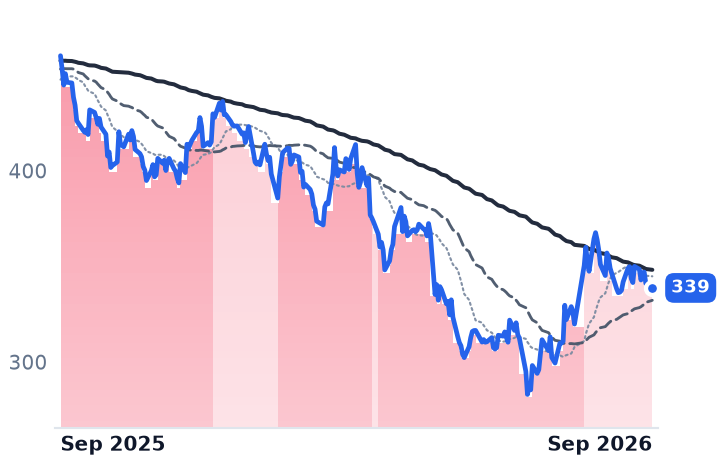
The earnings engine underneath is intact. Net stores grew by 209 in the quarter, the average US franchisee cleared roughly $166,000 of store profit in 2025, and consensus still has earnings up 7.6% this year. Yet the shares have de-rated to about 19 times trailing earnings from 23.7 times at the end of 2025, while Papa John's cut guidance and suspended its dividend and Yum agreed to sell Pizza Hut outright for $2.7bn. Flat comparable sales explain part of that; the market appears to be pricing the category, not the operator.
| Ticker | Company | Segment | Trend · 13mo | 30D | 1Y |
|---|---|---|---|---|---|
| The subject · what this brief is about | |||||
DPZ | Domino's Pizza | Quick Service - Pizza | 🔴 Cont. Bear | −1.9% | −26.4% |
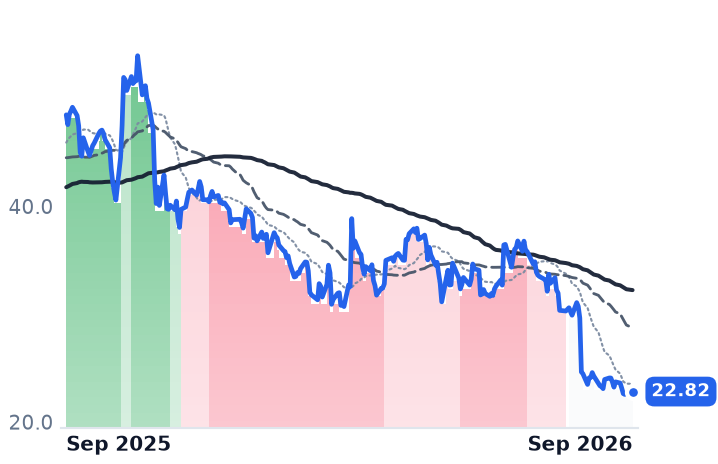
PZZA | Papa John's International | Quick Service - Pizza | 🔴 Cont. Bear | −2.8% | −52.9% |
| Compared against · context, not the story | |||||
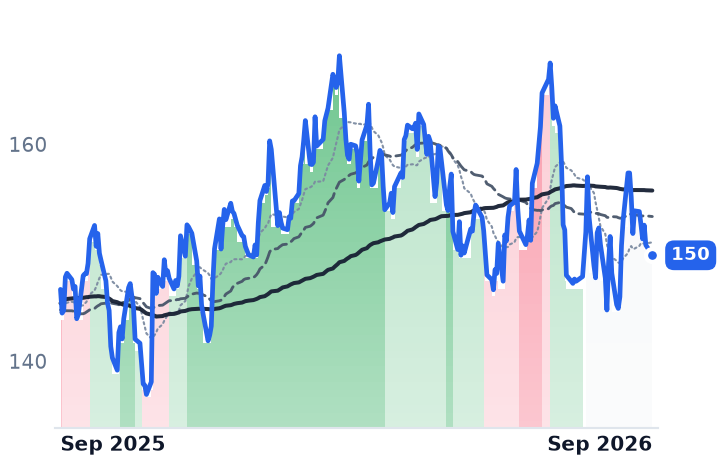
YUM | Yum! Brands | Quick Service - Pizza | 🟢 Cont. Bull | +1.4% | +2.1% |
12-month price & trend
| Ticker | Mkt cap | P/E | P/E fwd | P/S | P/S fwd | P/GP | P/GP fwd | EV/EBITDA | FCF yld |
|---|---|---|---|---|---|---|---|---|---|
DPZ | $11.1B | 18.9x | 17.7x | 2.2x | 2.1x | 5.5x | 5.3x | 16.2x | 5.9% |
PZZA | $748.8M | 28.1x | 19.1x | 0.4x | 0.4x | 1.6x | 1.7x | 6.9x | 4.6% |
YUM | $42.0B | 19.0x | 23.1x | 4.8x | 4.7x | 10.5x | 10.2x | 18.6x | 4.0% |
Consensus projections
| Ticker | FY2026E | FY2027E | FY2028E | |
|---|---|---|---|---|
DPZ | Revenue | +5.4% | +2.4% | +3.9% |
| EPS | +7.6% | +9.8% | +8.0% | |
PZZA | Revenue | −9.2% | −2.1% | +0.1% |
| EPS | −15.1% | +13.1% | +13.9% | |
YUM | Revenue | +10.0% | +3.7% | +5.7% |
| EPS | +8.5% | +10.2% | +10.8% |
Forward fiscal years only. Blank means no analyst coverage for that year.
Domino's Pizza sold more orders in its second quarter and collected less on each one. US same-store sales rose 0.1%, the softest quarter in over a year, and the company attributed the increase to higher customer transaction counts partly offset by a lower average ticket — the reverse of the pattern that has carried most quick-service chains through three years of menu inflation.
That matters because Domino's does not earn its money the way its revenue line reads. The chain runs three segments — US stores, international franchising and supply chain — across more than 22,500 locations, and the supply-chain arm, which mills dough and distributes cheese, meat and cardboard to franchisees at a cost-plus markup, generated $731.7m of the quarter's $1,194.4m in revenue, up 6.5%. The profit is elsewhere: royalties levied on what franchisees ring up. Income from operations rose 2.6% excluding currency, and Domino's credits higher US and international royalties plus supply-chain margin dollars.
The cheese line
Domino's defines its "food basket pricing change" as the cost of what an average US store buys from its distribution centers, and states plainly that as those prices move, supply-chain revenue, cost of sales and gross margin move with them. Last quarter the basket inflated 2.2%, supply-chain gross margin widened 0.2 percentage points and that segment's adjusted operating income rose $11.7m, or 18.1%. The direction is now reversing: CME 40-pound cheddar blocks were quoted at $1.4750 a pound on September 2, against $1.5400 in late May. Cheaper cheese subtracts from reported revenue while leaving franchisee food costs lower — a revenue decline that is good news at store level.
The meters that decide store count
Unit economics are improving, not eroding. Domino's added 209 net stores in the quarter, 26 in the US, and reaffirmed guidance of 175-plus net US openings and roughly 800 international. Average US franchisee store profit reached about $166,000 in 2025, up $4,000. Where closures happened — the master franchisee shutting low-volume restaurants in Japan and France — Japan profits rose 19% on lower revenue. Orders arriving through DoorDash and Uber Eats are priced at a premium on those menus so the economics land roughly neutral for the operator.
"In a quarter where the broader U.S. QSR industry continued to face pressure on consumer demand, Domino's generated order count growth across both our delivery and carryout businesses," chief executive Russell Weiner said in the July 20 release. It was his last quarter in the job; Weiner retires October 1 and chief operating officer Joe Jordan succeeds him.
The category is worse than the operator
Papa John's, which owns roughly 600 of its 5,650 restaurants and therefore carries labor and food cost on its own books, saw North American comparable sales fall 8.3% and revenue drop 8.8% to $482.4m. It suspended the dividend to fund franchisee incentives, is closing about 300 North American restaurants by the end of 2027, and carries $733.5m of debt at 3.3 times leverage against negative book equity of -$432.7m. Its board rejected Irth Capital's $47-a-share approach in March; the stock is $22.82. At about seven times trailing earnings before interest, taxes, depreciation and amortization, it is cheap against a base consensus expects to shrink 9.2% this year. Pizza Hut fared worse still — US system sales down 5% — and Yum agreed to sell the brand for $2.7bn.
So the category is genuinely shrinking, and Domino's is the one taking orders inside it. Its de-rating — to about 19 times trailing and 17.7 times forward earnings, from 23.7 times at the end of 2025 and 28.1 times at the end of 2023 — is earned to the extent that a chain compounding on royalties needs franchisee sales to grow, and they have stopped. What it does not explain is the rest: earnings still rose, units still opened, and consensus models profits up again next year and the year after.
The test arrives with cheese. Third-quarter supply-chain revenue will likely fall on a cheaper basket while franchisee food costs ease — a quarter where the reported line and the underlying business point opposite ways, handed to a chief executive in his first weeks.