

Rush Enterprises Is Sold Out of Trucks and Penske's Class 8 Orders Rose 170%
Hypothesis Opus 5 · Research Opus 5 · Writing Opus 5 · Prompt v1.6
The US heavy-truck market shrank 6.7% last quarter; Rush Enterprises' sales into it fell 0.2%. Its chief executive says the backlog is "basically sold out," and Penske Automotive guided second-half commercial-truck deliveries from 6,000 units to 10,000.
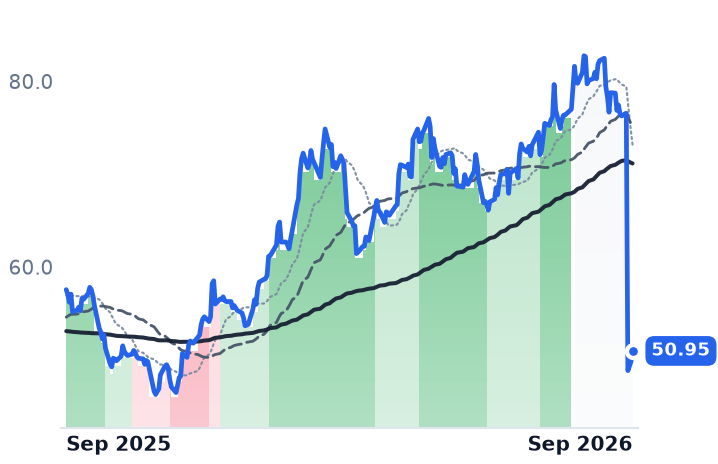
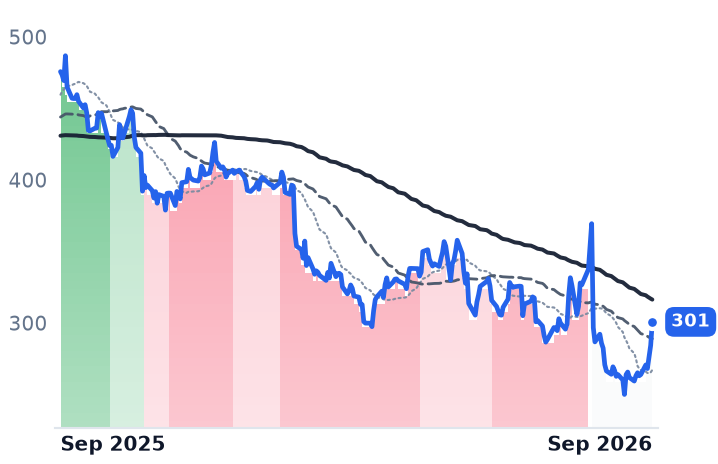
Anyone reading Rush's price history would think the business had broken: the shares fell by more than a third on September 1. That was a three-for-two stock dividend going ex, not a sell-off.
The truck cycle is real, and it decides neither share price. Penske trades above the $210 cash bid its controlling owners made in July, and its trailing and forward earnings multiples are identical — the price is the offer, not a growth judgment. Rush's case is conversion: a sold-out backlog earns nothing until trucks are built and delivered.
| Ticker | Company | Segment | Trend · 13mo | 30D | 1Y |
|---|---|---|---|---|---|
| The subject · what this brief is about | |||||
PAG | Penske Automotive | Traditional Dealership Groups | 🌱 Emerging Bull | +1.2% | +18.4% |
LAD | Lithia Motors | Traditional Dealership Groups | 🌱 Emerging Bull | +2.0% | +13.2% |
| Compared against · context, not the story | |||||
RUSHA | Rush Enterprises | Commercial Truck Dealerships | 🟢 Cont. Bull | −36.6% | −11.5% |
AN | AutoNation | Traditional Dealership Groups | 🟢 Cont. Bull | +2.1% | −6.5% |
GPI | Group 1 Automotive | Traditional Dealership Groups | 🔴 Cont. Bear | +13.9% | −36.8% |
ABG | Asbury Automotive | Traditional Dealership Groups | 🌱 Emerging Bull | +2.7% | −14.6% |
SAH | Sonic Automotive | Traditional Dealership Groups | 🌱 Emerging Bull | +0.5% | −0.8% |
12-month price & trend
| Ticker | Mkt cap | P/E | P/E fwd | P/S | P/S fwd | P/GP | P/GP fwd | EV/EBITDA | FCF yld |
|---|---|---|---|---|---|---|---|---|---|
RUSHA | $5.7B | 14.5x | 19.9x | 0.8x | 0.7x | 4.2x | 3.9x | 13.0x | 2.2% |
PAG | $14.3B | 16.1x | 16.1x | 0.4x | 0.4x | 2.7x | 2.7x | 13.7x | 4.1% |
LAD | $8.3B | 12.4x | 10.4x | 0.2x | 0.2x | 2.0x | 2.0x | 17.4x | -6.1% |
| Ticker | Mkt cap | P/E | P/E fwd | P/S | P/S fwd | P/GP | P/GP fwd | EV/EBITDA | FCF yld |
|---|---|---|---|---|---|---|---|---|---|
AN | $6.9B | 9.4x | 9.5x | 0.3x | 0.2x | 1.4x | 1.4x | 11.1x | 0.2% |
GPI | $3.6B | 12.5x | 7.7x | 0.2x | 0.2x | 1.0x | 1.0x | 11.4x | 3.9% |
ABG | $4.0B | 8.1x | 8.2x | 0.2x | 0.2x | 1.3x | 1.3x | 8.9x | 12.3% |
| Ticker | Mkt cap | P/E | P/E fwd | P/S | P/S fwd | P/GP | P/GP fwd | EV/EBITDA | FCF yld |
|---|---|---|---|---|---|---|---|---|---|
SAH | $2.7B | 12.7x | 11.7x | 0.2x | 0.2x | 1.1x | 1.1x | 11.0x | -2.0% |
Consensus projections
| Ticker | FY2026E | FY2027E | FY2028E | |
|---|---|---|---|---|
RUSHA | Revenue | +5.2% | +10.5% | +5.5% |
| EPS | +18.2% | +23.5% | +21.7% | |
PAG | Revenue | +6.7% | +2.5% | +2.2% |
| EPS | +1.0% | +6.6% | +7.0% | |
LAD | Revenue | +1.8% | +3.6% | +5.0% |
| EPS | +2.6% | +16.7% | +12.2% | |
AN | Revenue | −0.4% | +3.2% | +2.1% |
| EPS | +9.1% | +13.5% | +13.9% | |
GPI | Revenue | −1.4% | +5.4% | +3.6% |
| EPS | −5.3% | +12.2% | +13.9% | |
ABG | Revenue | −2.2% | +4.2% | +7.0% |
| EPS | −5.9% | +14.9% | +9.5% | |
SAH | Revenue | +3.5% | +4.5% | +5.4% |
| EPS | +5.2% | +10.5% | +8.8% |
Forward fiscal years only. Blank means no analyst coverage for that year.
The market shrank; Rush did not
Rush Enterprises, which sells and services heavy trucks through a network of North American dealerships, retailed 3,172 new Class 8 trucks — the heaviest tractor category — in the United States in the June quarter, down 0.2% from a year earlier. The US Class 8 retail market fell 6.7% to 54,718 units over the same stretch on ACT Research's count, which lifted Rush's share of it to 5.8%. Management guided the second half of 2026 to be "considerably stronger" than the first as freight rates improve.
That matters beyond one quarter because heavy trucks are ordered months before they are delivered, so the order book is the forward read on an industrial cycle that has been shrinking for two years. Two listed companies sell into it, and both are describing the same inflection.
"Our backlog is as big as it has been in a couple years, to be honest with you, where we sit right now. And I will tell you, we are basically sold out," W. Marvin Rush, the company's president, chief executive and chairman, told analysts on the July 29 call.
A stock dividend, not a sell-off
Rush's price history says the opposite. The Class A shares closed at $76.55 on August 31 and opened the next morning at $50.99 — precisely the three-for-two ratio of the stock dividend paid that day — before closing at $48.83 on 173,997 shares, ordinary volume. The board declared the split alongside a post-split quarterly dividend of $0.14 a share, taking Class A shares outstanding from roughly 61.1m to roughly 91.7m. What looks like a collapse is arithmetic; the roughly 4% the stock lost beyond the split ratio that session is the whole of the real move.
Penske confirms it, and is priced on something else
Penske Automotive, which runs 320 retail automotive franchises, 23 CarShop used-vehicle centers and 37 commercial-truck dealerships selling Freightliner and Western Star, reported Class 8 orders up 170% year over year in the quarter and up 231% in June alone, against an industry backlog of 186,000 units — about 8.5 months of production. It guided commercial-truck deliveries from 6,000 in the first half to 10,000 in the second. Its stake in Penske Transportation Solutions, the truck-leasing venture, contributed $57m of equity income, up 7%, with fleet utilization above 80% after the fleet was cut from 414,000 units to 380,000.
The truck side is not large enough to carry the company. Quarterly revenue rose 6.0% to $8.51bn while operating income fell 7.6% to $337.6m, and 2025 operating income of $1.28bn was 6.5% below 2024.
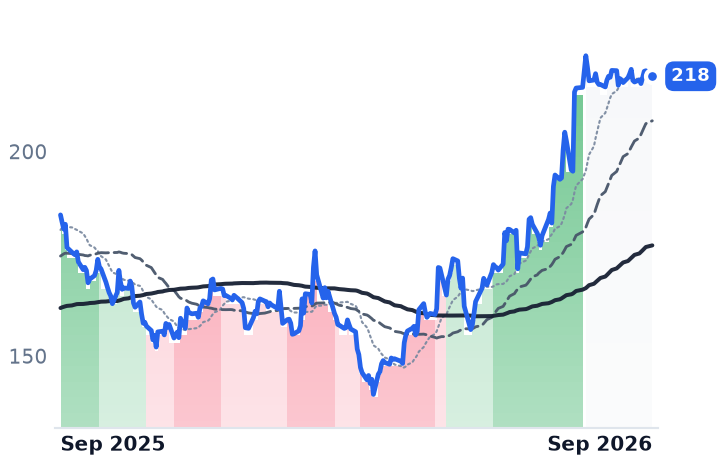
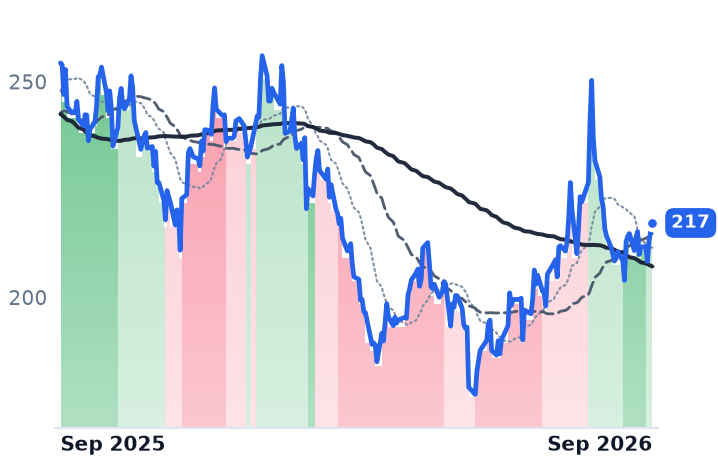
In any case the shareholder outcome no longer turns on operations. On July 22, Penske Corporation and Mitsui & Co., which already beneficially own 72.6% of the company, offered $210 a share in cash for the rest, about $13.8bn of equity value; the special committee of independent directors retained Moelis & Company and Paul, Weiss on August 10 and warned that no transaction is certain. The shares have closed between $216 and $220 every session since August 17 and stand at $218.42, 4.0% above the bid. Trailing earnings of 16.09x and forward earnings of 16.06x are effectively the same multiple, which is what a price set by an offer looks like.
Where the gross profit sits
Rush's parts, service and collision revenue of $605m, up 1.5%, produced 64% of total gross profit at an absorption rate of 130.8% — service gross alone covering fixed overhead one and a third times over. On the car side the same annuity is doing heavier lifting against a weaker vehicle line: Lithia Motors' aftersales gross rose 3.1% last quarter while its same-store gross profit fell 2.7%. Nor is inventory financing about to get cheaper for anyone. The Federal Reserve has held its policy rate at 3.50–3.75%, and after the Jackson Hole speech by Chair Kevin Warsh, futures priced roughly a coin flip on a September hike.
So the evidence for a commercial-truck upturn is unusually concrete — share gained in a falling market, orders up at a second dealer, a backlog measured in months of production — while the evidence for a car-retail recovery remains a service department offsetting a deflating vehicle gross. What the truck cycle does not do is set either share price. Penske's is fixed by a bid its own controlling owners can revise or withdraw, and Rush's, once the split is stripped out, has barely moved on the best order commentary it has given in two years.
A sold-out backlog is a promise about the next two quarters, and Rush has now put its name to it. The trucks still have to be built.