

Valvoline's 8% Same-Store Gain Is Mostly Price It Did Not Choose to Take
Hypothesis Opus 5 · Research Opus 5 · Writing Opus 5 · Prompt v1.6
Valvoline raised its full-year same-store sales guidance in August and the shares fell anyway. The composition explains why: three-quarters of the June-quarter's 8.0% comp was average ticket, and most of that ticket is a base oil cost pass-through forced by the closure of the Strait of Hormuz, which cut Gulf Group III exports by more than 70% between March and May.
Revenue grew 24.1%, but only about two of those twenty-four points came from more cars through the bay. The rest is bays added — 47 net new stores to 2,456, plus the $593m Breeze Autocare deal — and price per car. Gross profit grew 21.0% and operating income 18.5%, both slower than sales.
The forward earnings multiple has compressed to 18.2x from roughly 22.9x at the June high. Some of that cheapening is earned: the comp is running on a cost the company will lose when lubricant prices normalize.
| Ticker | Company | Segment | Trend · 13mo | 30D | 1Y |
|---|---|---|---|---|---|
| The subject · what this brief is about | |||||
VVV | Valvoline | Automotive Lubricants & Services | 🌱 Emerging Bull | −9.4% | −19.9% |
| Compared against · context, not the story | |||||
DRVN | Driven Brands | Automotive Services | 🔴 Cont. Bear | +1.7% | −28.3% |
12-month price & trend
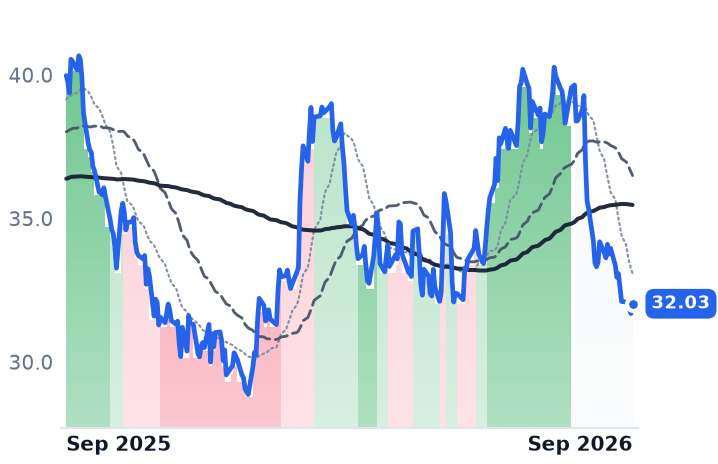
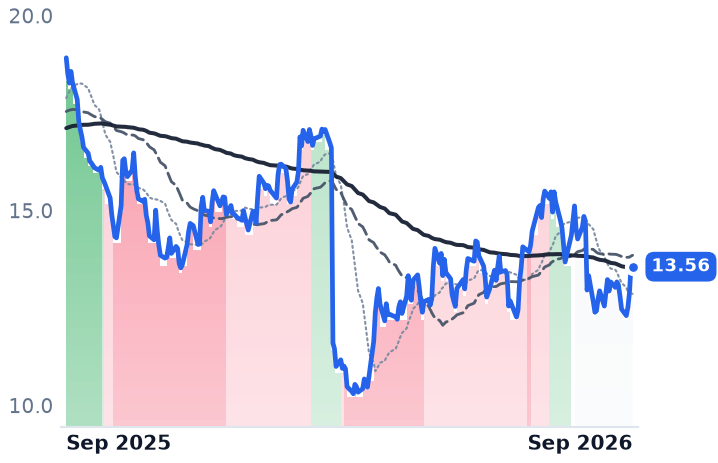
| Ticker | Mkt cap | P/E | P/E fwd | P/S | P/S fwd | P/GP | P/GP fwd | EV/EBITDA | FCF yld |
|---|---|---|---|---|---|---|---|---|---|
VVV | $4.1B | 43.3x | 18.2x | 2.1x | 2.0x | 5.4x | 5.1x | 11.2x | 3.3% |
DRVN | $2.2B | 12.8x | 11.3x | 1.3x | 1.1x | 2.5x | 2.2x | 11.0x | 5.9% |
Consensus projections
| Ticker | FY2026E | FY2027E | FY2028E | |
|---|---|---|---|---|
VVV | Revenue | +21.6% | +11.5% | +9.8% |
| EPS | +8.9% | +13.1% | +24.1% | |
DRVN | Revenue | +5.8% | +8.9% | +8.8% |
| EPS | +1.1% | +20.9% | +11.5% |
Forward fiscal years only. Blank means no analyst coverage for that year.
Valvoline, which runs and franchises 2,456 Valvoline Instant Oil Change quick-lube bays across North America, raised its full-year same-store sales guidance on August 5 and watched its shares fall 5.4% that session and 18.5% over the month that followed. The problem was never the size of the comparable-store number. It was what the number is made of.
Of the 8.0% system-wide same-store sales growth in the quarter ended June 30, management attributed three-quarters to average ticket and one quarter to transactions — roughly six points of price and mix against two points of additional cars through the bay. A quarter earlier the transaction share was about a third. The direction of that split matters more than the headline comp, because the ticket half is now largely a cost the company is passing on rather than demand it is winning.
A blocked strait, priced per oil change
Group III base oil is the key ingredient in full-synthetic motor oil, and the Gulf is the marginal supplier. With the Strait of Hormuz effectively shut since the outbreak of the Iran war in late February, Middle Eastern Group III exports fell more than 70% between March and May, with Shell's Pearl gas-to-liquids plant in Qatar, ADNOC and Bahrain's BAPCO — together 44% of US Group III imports — declaring force majeure or unable to ship.
"Based on the current forecast, we expect finished lubricant costs could be approximately 60% above where they were in March," chief executive Lori Flees told investors on the August 5 call. "That means we expect a total increase of approximately $5 to $7 per oil change depending on the lubricant type relative to the March period." On duration, she was blunt: "Our understanding in working with the supplier is 4 to 6 months at a minimum once the Strait is fully reopened."
Valvoline chose pass-through over absorption, which inflates the comp and compresses the margin at the same time. It guided the September quarter to same-store sales of 8–10% with 300 to 400 basis points of adjusted EBITDA margin compression, driven primarily by product cost. That guidance, not the beat, is what the market traded.
Growth bought with capital
Strip the comp back and the top line looks different again. Revenue rose 24.1% to $544.6m, but only about two of those twenty-four points came from transactions. The remainder is store count: 47 net new units in the quarter, and Breeze Autocare, the Oil Changers chain bought for $593m at a 10.7x EBITDA multiple, closing December 1 with 45 stores divested under an FTC order. It was financed with a $740m term loan. Leverage sits at 2.8x net debt to adjusted EBITDA, buybacks are paused, and roughly $48m separated quarterly operating income of $112.2m from $64.5m of net income. Gross profit grew 21.0% and operating income 18.5% against that 24.1% sales gain — the buildout adds revenue faster than profit.
The control in the next bay
Driven Brands, whose Take 5 Oil Change chain competes for the same trade areas, comped 3.6% in its June quarter and added 50 net units toward a stated 2,500-store runway from about 1,400 today. "There is a select few operators in North America that are taking share in the quick lube space, and Take 5 is certainly one of them," chief executive Danny Rivera said on August 4. Take 5 is taking price on the same base oil shock. Driven Brands' own 29% twelve-month decline is not a read-across: the stock lost 30.2% in a single session on February 25 when its audit committee found material errors in previously issued fiscal 2023 and 2024 statements.
What the business earns and what it doesn't
On reported momentum, the sell-off overshoots. Adjusted EBITDA rose 25% to $162.4m, system-wide store sales crossed $1bn for the first time, earnings beat consensus by 14%, and full-year comp guidance went up, not down. Valvoline's forward earnings multiple has compressed to 18.2x from roughly 22.9x at its June 26 high, and its trailing enterprise value to EBITDA of 11.24x is essentially level with Driven Brands' 11.04x — the same price for a chain comping more than twice as fast.
But part of the de-rating is earned, and it is the part the comp conceals. Six points of price that a shipping blockade handed to Valvoline will leave when the blockade does, and the underlying engine — cars per bay — is contributing two. Manufacturers of 2026 model-year vehicles typically specify oil changes every 7,500 to 10,000 miles, with oil-life monitors stretching some to 15,000, against the 3,000-mile sticker the industry still puts on windshields. Every extension takes a visit out of the base.
The strait will reopen, and lubricant costs will normalize four to six months after it does on the company's own supplier's estimate. When they do, Valvoline's comp will be worth whatever transactions and attach are worth without a war in it.