

Thor Guided to Lose Share in the North American Towable Market It Leads
Hypothesis Opus 5 · Research Opus 5 · Writing Opus 5 · Prompt v1.6
Thor Industries is the largest towable recreational-vehicle maker in North America, and its own fiscal 2026 plan assumes it ships into a mid-teens percentage decline in retail and gives up share on top of that. The June guidance cut moved earnings to $3.30-$3.80 a share from $3.75-$4.25 while leaving revenue guidance intact — the entire cut sits in margin.
The usual explanation for a shipment collapse is a bloated dealer channel working off units. It does not apply here. Dealer inventories are lean at 18 to 20 weeks of supply against a 26-to-30-week norm, floorplan borrowing rates have fallen, and retail registrations are dropping faster than wholesale shipments. The buyer left before the channel filled. Thor's towable gross margin fell 470 basis points to 10.2%; Winnebago held group gross margin roughly flat and trades at 0.71x book, the deepest discount in the complex.
| Ticker | Company | Segment | Trend · 13mo | 30D | 1Y |
|---|---|---|---|---|---|
| The subject · what this brief is about | |||||
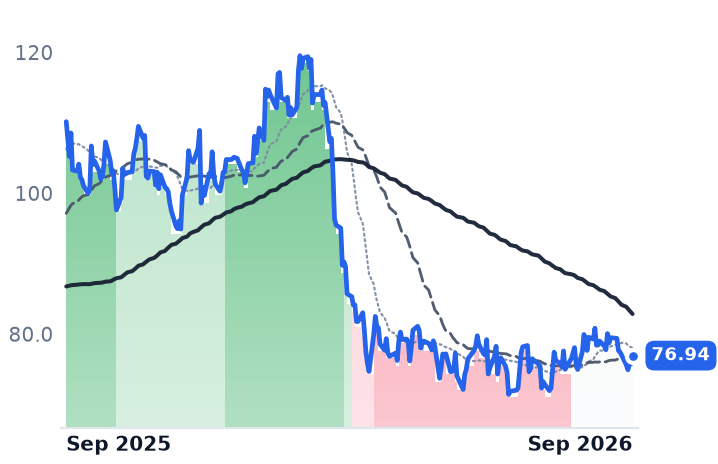
THO | Thor Industries | RV Manufacturers | ⚠️ Emerging Bear | −3.3% | −30.2% |
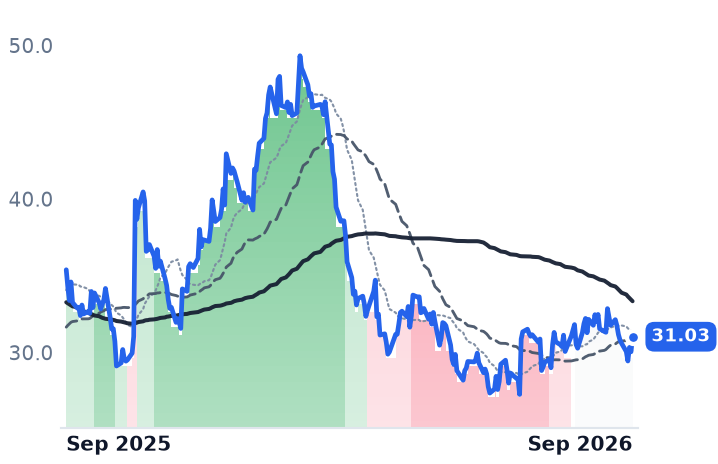
WGO | Winnebago Industries | RV Manufacturers | ⚠️ Emerging Bear | −3.5% | −12.3% |
| Compared against · context, not the story | |||||
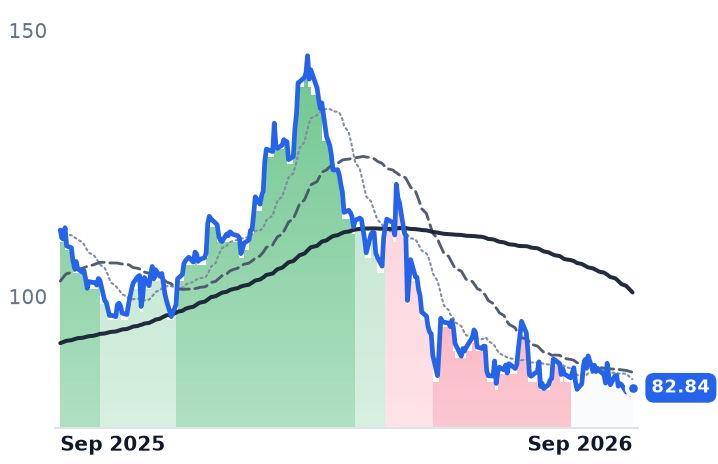
PATK | Patrick Industries | RV & Marine Furnishings | ⚠️ Emerging Bear | −6.8% | −26.4% |
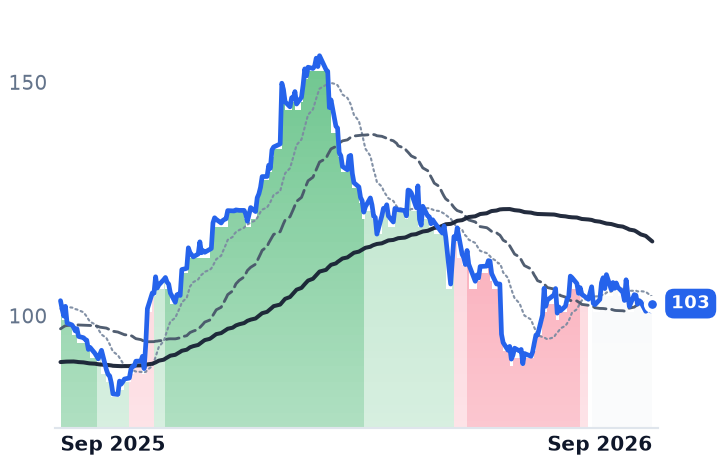
LCII | LCI Industries | RV Components & Suppliers | ⚠️ Emerging Bear | −5.7% | −0.6% |
12-month price & trend
| Ticker | Mkt cap | P/E | P/E fwd | P/S | P/S fwd | P/GP | P/GP fwd | EV/EBITDA | FCF yld |
|---|---|---|---|---|---|---|---|---|---|
THO | $4.0B | 15.4x | 17.4x | 0.4x | 0.4x | 3.3x | 3.3x | 7.3x | 5.0% |
WGO | $877.2M | 22.8x | 13.1x | 0.3x | 0.3x | 2.4x | 2.4x | 10.1x | 20.6% |
PATK | $2.7B | 18.2x | 19.4x | 0.7x | 0.7x | 3.0x | 3.0x | 10.0x | 4.7% |
| Ticker | Mkt cap | P/E | P/E fwd | P/S | P/S fwd | P/GP | P/GP fwd | EV/EBITDA | FCF yld |
|---|---|---|---|---|---|---|---|---|---|
LCII | $2.5B | 11.8x | 12.0x | 0.6x | 0.6x | 2.4x | 2.4x | 7.7x | 11.5% |
Consensus projections
| Ticker | FY2026E | FY2027E | FY2028E | |
|---|---|---|---|---|
THO | Revenue | +0.9% | +3.2% | +4.3% |
| EPS | −6.8% | +25.8% | +14.8% | |
WGO | Revenue | −0.9% | +4.5% | +4.6% |
| EPS | +21.3% | +30.9% | +24.5% | |
PATK | Revenue | +0.2% | +5.5% | +8.2% |
| EPS | −1.5% | +24.5% | +26.7% | |
LCII | Revenue | −2.0% | +5.4% | +1.5% |
| EPS | +17.7% | +11.7% | +24.8% |
Forward fiscal years only. Blank means no analyst coverage for that year.
Thor Industries, which builds conventional travel trailers, luxury fifth wheels and Class A, B and C motorhomes in North America and motorcaravans in Europe, told investors on June 3 that its plan for the year assumes North American retail demand falls by a mid-teens percentage and that it loses a low-single-digit share of the towable market it leads. It cut fiscal 2026 diluted earnings guidance to $3.30-$3.80 a share from $3.75-$4.25 and left revenue guidance at $9.0-9.5bn. The cut is entirely a margin cut.
That matters because of how an RV maker earns revenue. Thor sells nothing to a camper; it books a sale when a unit is wholesaled to an independent dealer who finances it on floorplan credit. Reported sales are therefore dealer restocking decisions, and the honest demand meter is retail registrations. When the two diverge, the usual story is a destock — dealers clearing a channel stuffed in a boom. That is not this cycle.
The channel already cleared
Dealer inventories are lean. Patrick Industries, which supplies components to the RV plants, puts dealer stock at 18 to 20 weeks of supply against a 26-to-30-week historical norm; LCI Industries independently confirms the same range and calls it healthy. The interest bill has eased too: Camping World, the largest RV retailer, reported an average floorplan rate of 5.98% for the June quarter against 6.46% a year earlier.
What has gone is the buyer. Industry wholesale shipments through July ran 13.9% below last year at 183,592 units, but new retail registrations fell 19.0% in May, the ninth consecutive monthly decline. Camping World's own count has new registrations down 16.4% for the year to May while used registrations rose 2.4% — affordability substitution, visible in one line. Retail is falling faster than wholesale, which inverts the destock: there is nothing to work off, and restocking cannot begin until registrations stop sinking.
Where the cost went
Thor's fiscal third quarter, ended April 30, produced revenue of $2.782bn, down 3.9%, on a gross margin of 12.75% against 16.66%. Operating income fell 45.2% to $96.0m. North American Towable sales dropped 24.6% to $881.8m with unit shipments down 25% and segment gross margin down 470 basis points to 10.2%. Motorized went the other way on volume — sales up 7.7% on 9.1% more units — but at a net price per unit 1.4% lower than a year earlier.
A flat sticker is the problem, because the input side did not stay flat. LCI reports steel prices up 20% year over year and aluminum up 80%, with tariffs, freight and energy behind the commodities themselves; a proclamation effective April 6 imposed a flat 50% tariff on articles made almost entirely of steel, aluminum or copper, the exact inputs in RV frames and exterior structures. "Our approach and our philosophy with pricing is not to just pass on pricing for the sake of pricing," LCI chief financial officer Lillian Etzkorn told investors on August 5. Nobody is passing it on, so it lands in gross margin.
Thor's forward book is thinning behind that. North American backlog fell 24.1% to $1.152bn, with towable orders down 39.1% to $386m. "Our North American Towable segment is facing continuing and amplified headwinds," chief executive Bob Martin said on the third-quarter results.
Europe is doing the load-bearing
The Erwin Hymer business Thor bought in 2019 is now the group's ballast: European sales rose 11.8% to $987.6m, roughly 36% of the total, pretax income rose 21.3% to $56.2m, and European dealer inventory fell 11.2%. Roughly a third of Thor's revenue is insulated from the American dealer channel — which is why the group still earns money at all.
Winnebago Industries, a fifth of Thor's size and home to Grand Design, Newmar and Barletta pontoons, is the mirror image. Revenue fell 9.9% to $698.7m in its May quarter and towable revenue fell 26.1% on a mix shift toward lower price points, yet group gross margin barely moved, at 13.58% against 13.68%. "We stayed disciplined, aligning production closely with retail," chief executive Michael Happe said on June 25, the day it cut full-year guidance. Its $1.40 annual dividend is close to all of guided reported earnings.
The verdict
Thor's 31.5% twelve-month decline is earned. Its forward multiple, 17.4x on consensus of $4.43 for fiscal 2027, sits above its 15.4x trailing multiple, because profits are falling faster than the share price — the only cheap readings are asset-based, 0.93x book and 7.3x trailing enterprise value to earnings before interest, tax, depreciation and amortization. Winnebago at 0.71x book is a genuine discount, but its 13.1x forward multiple rests on a 31% earnings rebound that the registration data does not yet support. The suppliers, meanwhile, out-earned their customers: LCI expanded adjusted operating margin 110 basis points to 9.3% on 20% lower RV volume, and it is merging with Patrick.
The shares have stopped falling — 50-day averages that sat below 200-day averages across all four names through the spring had flattened by September 1. Patrick says it can flex production up quickly if retail inflects. The optionality is intact and unarmed; nothing in nine straight months of registration declines dates when the trigger gets pulled.