

Pharma Kept Paying for Trials and Cut Simulation Software: IQVIA Booked a Record $3.15bn
Hypothesis Opus 5 · Research Opus 5 · Writing Opus 5 · Prompt v1.6
Life-sciences software rallied hard over the past month, but the drug industry's spending is not recovering as a whole — it is being reallocated, and the four listed vendors sit on opposite sides of the line.
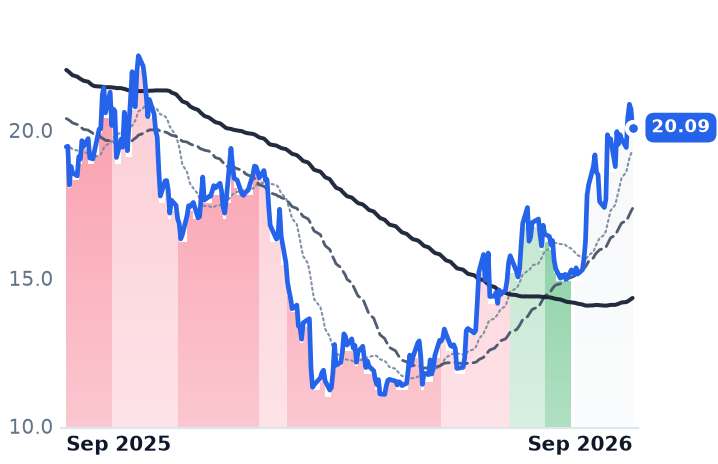
IQVIA, which runs clinical trials for drug makers, booked a record $3.15bn of net new business in the June quarter at a 1.22x book-to-bill and raised its full-year guidance. Certara, which sells biosimulation software into the same customers, saw revenue fall 10.8% and now guides consensus to a 9.1% revenue decline for 2026. Schrödinger's recurring software line shrank 10% to $32.5m; a single $10m milestone carried its quarter.
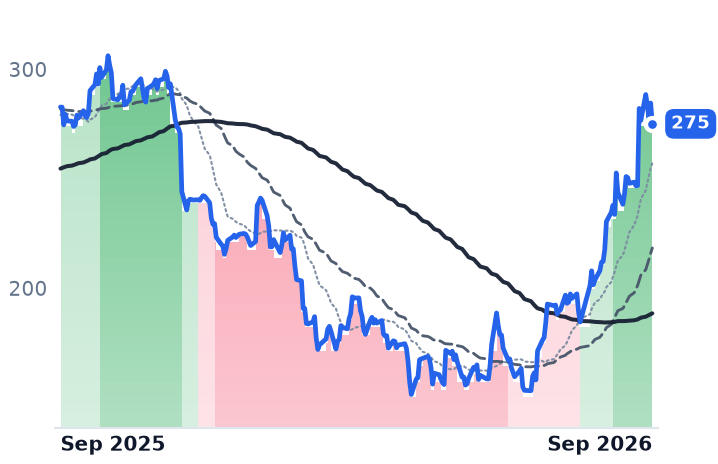
Only Veeva grew, at 17.6%, its fourth straight acceleration. But its trailing earnings multiple went from roughly 31x in May to 44x, and its own raised guide implies second-half growth near 14%. The re-rating has outrun the reallocation.
| Ticker | Company | Segment | Trend · 13mo | 30D | 1Y |
|---|---|---|---|---|---|
| The subject · what this brief is about | |||||
VEEV | Veeva Systems | Life Sciences Software & Data | 🌱 Emerging Bull | +19.4% | −2.7% |
SDGR | Schrödinger | Life Sciences Software & Data | 🌱 Emerging Bull | +10.6% | +3.3% |
| Compared against · context, not the story | |||||
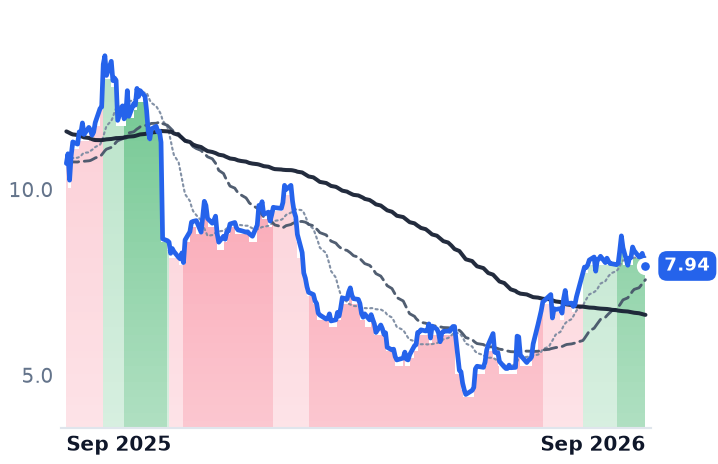
CERT | Certara | Life Sciences Software & Data | 🌱 Emerging Bull | −3.2% | −25.8% |
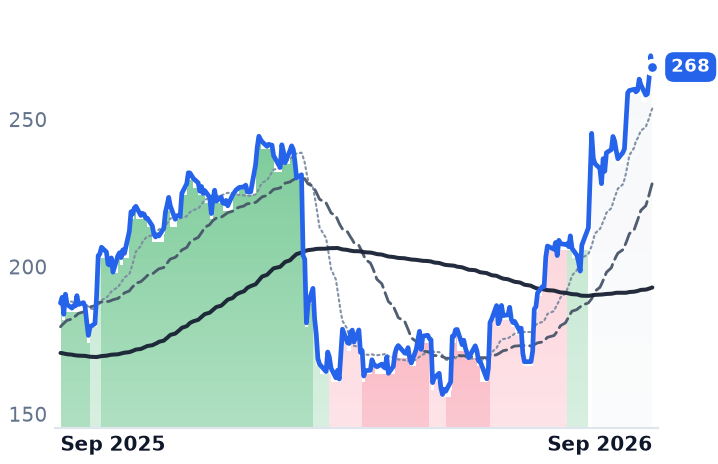
IQV | IQVIA | Contract Research & Development | ⚠️ Emerging Bear | +12.2% | +42.7% |
12-month price & trend
| Ticker | Mkt cap | P/E | P/E fwd | P/S | P/S fwd | P/GP | P/GP fwd | EV/EBITDA | FCF yld |
|---|---|---|---|---|---|---|---|---|---|
VEEV | $44.7B | 44.3x | 29.8x | 12.9x | 12.1x | 17.3x | 16.2x | 31.3x | 3.7% |
SDGR | $1.5B | n/m | — | 5.8x | 6.2x | 10.2x | 10.9x | n/m | -2.2% |
CERT | $1.2B | n/m | 23.2x | 3.0x | 3.2x | 5.2x | 5.6x | 16.1x | 5.0% |
| Ticker | Mkt cap | P/E | P/E fwd | P/S | P/S fwd | P/GP | P/GP fwd | EV/EBITDA | FCF yld |
|---|---|---|---|---|---|---|---|---|---|
IQV | $43.0B | 32.2x | 20.2x | 2.5x | 2.5x | 9.7x | 9.4x | 16.3x | 6.1% |
Consensus projections
| Ticker | FY2026E | FY2027E | FY2028E | |
|---|---|---|---|---|
VEEV | Revenue | +16.3% | +16.4% | +12.2% |
| EPS | +23.1% | +16.2% | +11.0% | |
SDGR | Revenue | −3.8% | +3.1% | +11.9% |
| EPS | −18.2% | −11.6% | −36.1% | |
CERT | Revenue | −9.1% | +2.5% | +6.0% |
| EPS | −25.4% | +14.3% | +12.0% | |
IQV | Revenue | +7.6% | +5.8% | +5.9% |
| EPS | +9.0% | +11.2% | +12.0% |
Forward fiscal years only. Blank means no analyst coverage for that year.
Certara's June-quarter revenue fell to $93.3m. In the same three months, IQVIA signed a record $3.15bn of net new business. They sell to the same customers — the world's drug developers — and they are pointing in opposite directions.
That split is the story underneath a sharp month in life-sciences software, and it matters beyond the quarter because it identifies where the pharmaceutical research dollar is actually going. The industry is staring at a patent cliff that, on one industry tally, puts more than $230bn of US drug revenue at risk between 2025 and 2030. Pfizer, Bristol Myers Squibb and Merck all cut research expense in 2025; Eli Lilly and Novo Nordisk, carried by obesity drugs, raised theirs. Budgets are not moving in one direction. They are moving toward late-stage trials and regulated record-keeping, and away from the software that simulates molecules before anyone doses a patient.
The side that is getting paid
IQVIA, a contract research organization that runs trials and sells prescription data, grew second-quarter revenue 8.7% to $4.368bn, with research-solutions revenue up 8.8% and full-year guidance raised to a range of $17.275bn to $17.475bn, according to its earnings call. Bookings grew 19%, and at 1.22x book-to-bill the forward book is filling faster than revenue is recognized.
Certara, which sells biosimulation software and regulatory-submission services across the development lifecycle, is the mirror image. Revenue fell 10.8% year on year and operating margin swung to -0.2% from a positive 9.1%. The company missed consensus and lost about 16% in premarket trading on August 4, with software revenue up 4% to $48.8m and services down 3%. What improvement exists is cost-side: a May reduction of roughly 5% of headcount targeting $13m of run-rate savings, a completed $100m buyback and a fresh $50m authorization. Consensus now has 2026 revenue falling 9.1% to $380.1m. The shares trade at 23.2x forward earnings on that shrinking base, against 1.27x book value and a 5.0% trailing free-cash-flow yield.
Schrödinger, whose physics-based chemistry software is sold to discovery teams, sits on Certara's side of the line despite a rising share price. Its recurring software revenue fell 10% to $32.5m; total revenue rose 7.5% only because drug-discovery revenue jumped to $23.0m from $13.9m on a $10m milestone triggered when Eli Lilly bought Ajax Therapeutics, a company Schrödinger helped found. The operating loss was $41.5m, and the $6.0m of net income arrived entirely below that line. Hosted licensing reached 47% of software revenue from 31%, pushing software gross margin to 71% from 76%. Cash and securities stand at $419m. "We're very pleased with our momentum across the business in the second quarter," chief executive Ramy Farid told investors on the second-quarter call, citing annual contract value growth of 27% — though full-year contract-value guidance of $218m to $228m implies only 10-15%.
The one that grew
Veeva Systems sells Vault clinical-trial, regulatory-submission, quality and safety systems, plus sales-representative software, exclusively to drug and device makers. Second-quarter revenue rose 17.6% to $928.0m, a fourth consecutive quarterly acceleration, with operating income up 40.4%. Some of that acceleration is bought: subscription revenue grew 16% while professional services grew 24%, and gross margin eased to 75.0%. Commercial subscriptions, the sales-representative franchise, grew about 13% — the slower half. Management raised full-year guidance to $3.682bn-3.687bn on August 26, which implies roughly 13.7% growth in the second half.
Biogen and Regeneron committed in the quarter, taking Veeva to 12 of the top 20 biopharmas signed for Vault CRM. On rivals who chose Salesforce instead, chief executive Peter Gassner told the August 26 call: "Yes, there's a handful of customers, large customers that did select Salesforce, many of them even 2 years ago. Those projects are -- they're having troubles, right?"
What the re-rating earned
The month's gain in this corner is two dated events, not a trend: Veeva added 14.3% in the session after its August 26 release, Schrödinger 9.6% on August 6 after its print and a Bristol Myers Squibb agreement to deploy its Bunsen AI co-scientist across its research organization. Certara, the obvious third beneficiary of any discovery-budget recovery, sat it out and fell 2.1%.
Veeva earns part of its move on growth and operating leverage. It does not obviously earn the multiple: trailing earnings have gone from roughly 31x in May to 44x, while consensus for the January 2028 year has revenue growth of 12.2% and earnings growth of 11.0%. Sixteen analysts carry a median six-month target of $232.50, 16% below the September 4 close. Schrödinger's arithmetic is starker: forward price-to-sales of 6.18x sits above trailing 5.80x, because 2026 revenue is expected to decline 3.8%. A multiple expanding into a shrinking base is not a demand recovery.
One frame worth retiring is Veeva as insurgent against IQVIA's data franchise. The two settled an eight-year antitrust fight in August 2025 with no damages either way, and IQVIA data now flows into Veeva Network and Veeva AI. Veeva's own executives called the partnership "the best thing that happened 12 months ago." IQVIA's shares are up 45.5% over twelve months; Veeva's, 1.9%.
Bristol Myers Squibb signed for Bunsen in August. It also cut its research spending last year. Whether that signature is new money or reallocated money is the question the next two prints have to answer.