

Vulcan Pushed Aggregates Prices Up 5% and Kept 14 Cents of It
Hypothesis Opus 5 · Research Opus 5 · Writing Opus 5 · Prompt v1.6
Vulcan Materials has spent three years proving a quarry is a tollbooth. In the June quarter the toll went up and the take barely moved: cash gross profit on a ton of aggregates reached $12.02 against $11.88 a year earlier, because a $40m energy bill and unit costs up 3% absorbed the increase.
Volume was not the problem. Vulcan shipped 59.9m tons, up 1%, and Martin Marietta posted a fourth consecutive quarter of organic shipment growth. Martin Marietta's reported margin, down 4.6 percentage points, is mostly purchase accounting from the Quikrete and New Frontier deals rather than quarry economics.
Both now trade near 28x forward earnings on consensus that has this year's earnings flat and all the growth deferred to 2027 — while the federal highway program that funds the tons loses its authority on September 30.
| Ticker | Company | Segment | Trend · 13mo | 30D | 1Y |
|---|---|---|---|---|---|
| The subject · what this brief is about | |||||
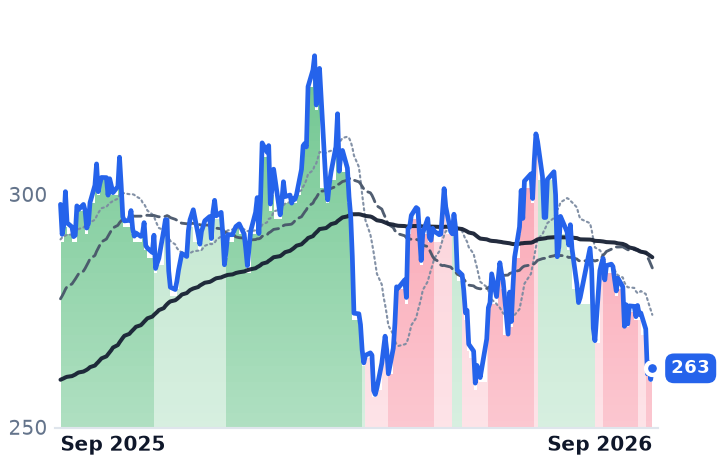
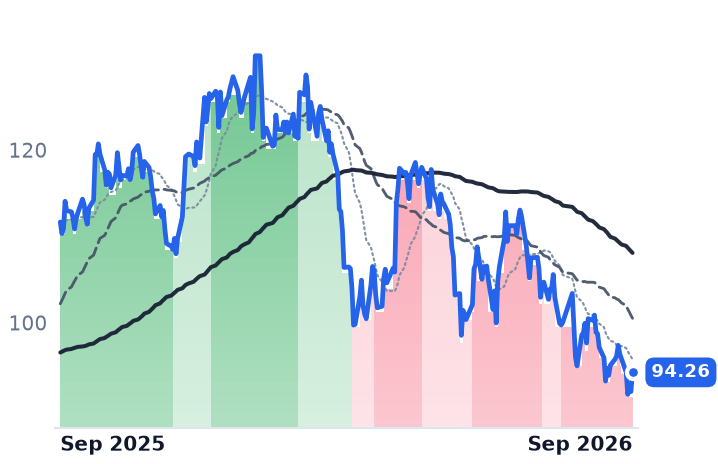
VMC | Vulcan Materials | Aggregates & Concrete | ⚠️ Emerging Bear | −7.7% | −11.8% |
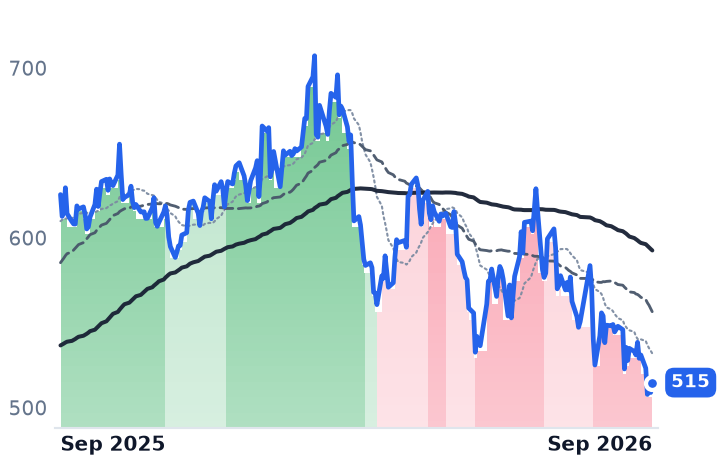
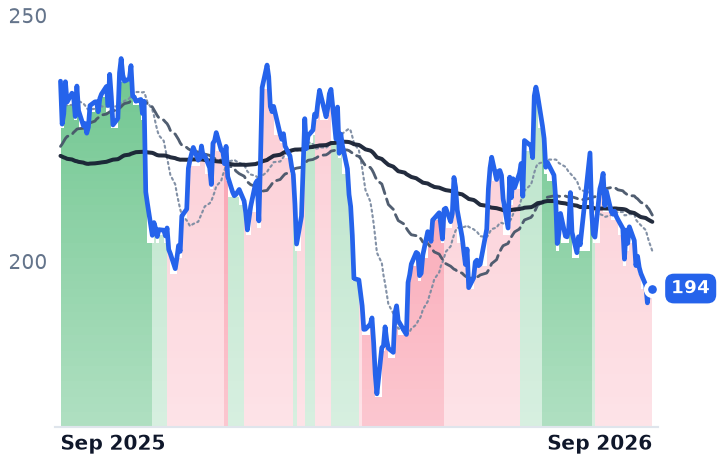
MLM | Martin Marietta Materials | Aggregates & Concrete | ⚠️ Emerging Bear | −6.2% | −17.7% |
| Compared against · context, not the story | |||||
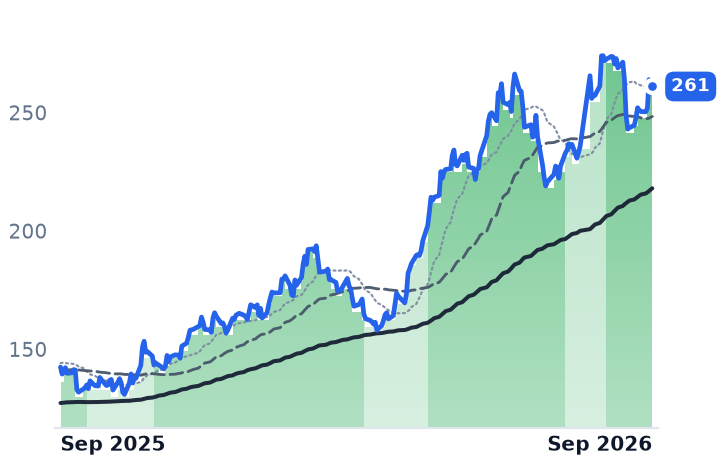
NUE | Nucor | Integrated Steelmakers | 🟢 Cont. Bull | −4.2% | +83.3% |
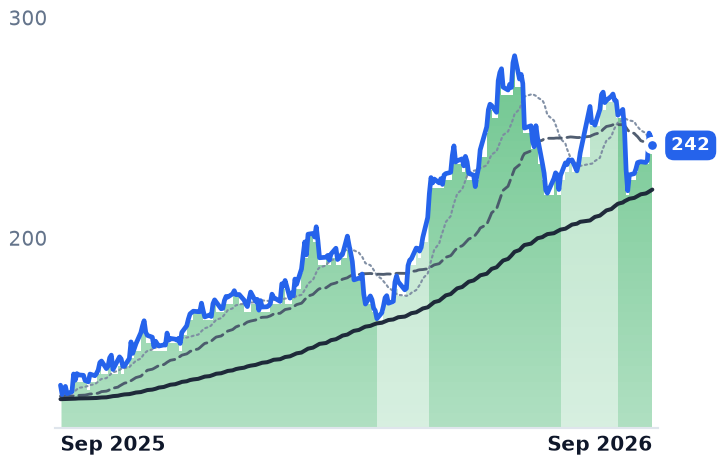
STLD | Steel Dynamics | Long Products & Rebar | 🟢 Cont. Bull | −7.8% | +81.7% |
CRH | CRH | Integrated Cement & Materials | ⚠️ Emerging Bear | −6.2% | −15.6% |
EXP | Eagle Materials | Specialty Building Products | 🔴 Cont. Bear | −9.2% | −17.8% |
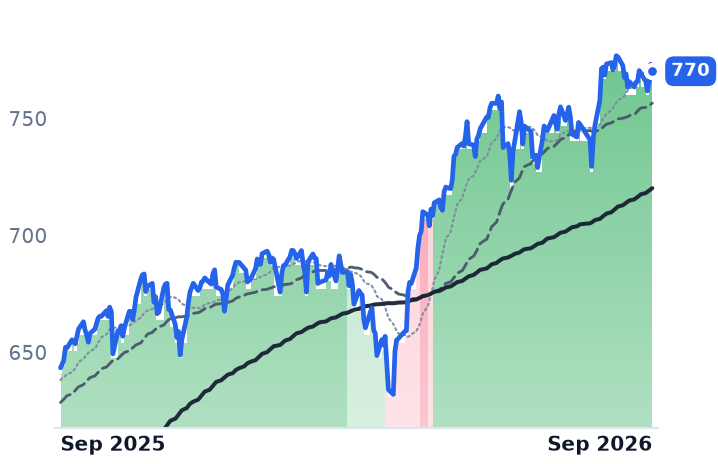
SPY | State Street SPDR S&P 500 ETF Trust | Asset Management | 🟢 Cont. Bull | −0.4% | +19.7% |
12-month price & trend
| Ticker | Mkt cap | P/E | P/E fwd | P/S | P/S fwd | P/GP | P/GP fwd | EV/EBITDA | FCF yld |
|---|---|---|---|---|---|---|---|---|---|
VMC | $34.0B | 30.9x | 28.7x | 4.2x | 4.2x | 15.3x | 15.2x | 15.1x | 3.0% |
MLM | $30.9B | 12.6x | 28.3x | 4.6x | 4.3x | 16.4x | 15.1x | 17.6x | 2.6% |
NUE | $59.5B | 20.8x | 14.0x | 1.6x | 1.5x | 10.6x | 9.6x | 11.4x | 2.7% |
| Ticker | Mkt cap | P/E | P/E fwd | P/S | P/S fwd | P/GP | P/GP fwd | EV/EBITDA | FCF yld |
|---|---|---|---|---|---|---|---|---|---|
STLD | $34.7B | 21.9x | 14.4x | 1.7x | 1.5x | 11.6x | 10.0x | 12.9x | 2.8% |
CRH | $69.0B | 13.7x | 17.3x | 1.2x | 1.7x | 3.5x | 4.9x | 7.9x | 4.2% |
EXP | $6.1B | 14.6x | 15.1x | 2.7x | 2.6x | 9.4x | 9.3x | 9.6x | 3.8% |
| Ticker | Mkt cap | P/E | P/E fwd | P/S | P/S fwd | P/GP | P/GP fwd | EV/EBITDA | FCF yld |
|---|---|---|---|---|---|---|---|---|---|
SPY | $773.0B | — | — | — | — | — | — | — | — |
Consensus projections
| Ticker | FY2026E | FY2027E | FY2028E | |
|---|---|---|---|---|
VMC | Revenue | +2.3% | +6.0% | +6.8% |
| EPS | +8.8% | +17.4% | +16.6% | |
MLM | Revenue | +9.0% | +7.3% | +8.6% |
| EPS | +0.2% | +19.1% | +17.2% | |
NUE | Revenue | +23.0% | +1.5% | +0.6% |
| EPS | +134.2% | +1.9% | −3.2% | |
STLD | Revenue | +29.2% | +0.5% | +0.2% |
| EPS | +111.9% | +15.0% | −5.4% | |
CRH | Revenue | +5.9% | +5.1% | +6.8% |
| EPS | +6.8% | +12.7% | +12.0% | |
EXP | Revenue | +0.5% | +1.9% | +5.8% |
| EPS | −9.4% | −0.1% | +13.5% |
Forward fiscal years only. Blank means no analyst coverage for that year.
The price of crushed stone leaving a Vulcan Materials quarry went up again this spring, and almost none of the increase reached the bottom line. Vulcan — the largest US aggregates producer, selling stone, sand and gravel out of quarries into a freight radius of roughly 30 miles — raised mix-adjusted price about 5% in the June quarter, to a freight-adjusted $22.97 a ton. Cash gross profit per ton went to $12.02 from $11.88. A $40m energy headwind and unit cash costs excluding diesel up 3% took the rest.
That matters because price has been the entire earnings story in aggregates. Vulcan's gross margin widened roughly six percentage points between fiscal 2022 and fiscal 2025, a stretch that included a year when revenue fell outright. If the price lever stops converting into margin, earnings revert to depending on tons — and the biggest single sponsor of those tons, the federal surface transportation program, loses its spending authority on September 30.
Tons are not the problem
The intuitive story — price increases pushed through onto shrinking volume — is not what the quarries reported. Vulcan shipped 59.9m tons in the quarter, up 1% year on year despite rain in Texas and the Southeast. Martin Marietta, the number-two producer, logged its fourth straight quarter of positive organic shipment growth, up 2.3% in the quarter and 4.3% year to date, tracking the high end of its guidance.
What gave way was operating leverage. Vulcan's revenue rose 2.5% to $2,155.8m while operating income fell 9.7% to $425.3m; adjusted EBITDA was flat at $654m and full-year guidance of $2.4bn–$2.6bn was reaffirmed. Revenue growth has decelerated over four quarters from 13.9% to 2.5%. "Our biggest lever to overcome fuel continues to be price," chief executive Ronnie Pruitt told investors on July 29, adding that public infrastructure awards in Vulcan's markets are up 20% year on year. Data centers, despite the label these companies get filed under, are 3–5% of Vulcan's volumes; Martin Marietta reports data-center backlog up 90% and says 70% of US data-center and manufacturing square footage sits within 55 miles of its operations.
Martin Marietta's margin is deal accounting
Martin Marietta's reported figures look far worse and mean something different. Gross margin fell to 25.4% from 30.0% and operating income dropped 17.2% to $379m on revenue up 7.5% — driven principally by a $52m fair-value inventory step-up from purchase accounting on the Quikrete and New Frontier assets. Adjusted cash gross profit rose 15% to $636m. Headline average selling price fell 2% while organic mix-adjusted pricing rose 3.7%, the gap being acquisition dilution and geography.
"When we go into 2027, we're going to be through all the inventory issues on purchase price accounting with Quikrete," chair and chief executive Ward Nye said on July 30, calling 2027 pricing "a pretty compelling story." The reshaping continues: more than $525m of EBITDA in cement and ready-mix divested since 2022, and on August 21 the company closed a $13.5bn combination with Lhoist North America, adding 20 quarries and over 2 billion tons of limestone reserves in lime and specialties.
What the shares have priced
Vulcan trades at 28.7x forward earnings against 30.9x trailing — a spread of about 7%, which is the market declining to underwrite much near-term growth. Consensus agrees: fiscal 2026 EBITDA is modelled down 3.2%, with the acceleration in 2027. In May the shares carried roughly 30–35x forward, so the de-rating has been modest against a business consensus expects to shrink this year. Martin Marietta's trailing price/earnings ratio is unusable — a divestiture gain inflated first-quarter net income — but its forward multiple is 28.3x and trailing enterprise value to EBITDA 17.6x, the richest in the group, on consensus earnings flat this year and up 19% next. JPMorgan's Adrian Huerta cut the stock to Neutral, lowering his target to $560 from $640, and moved the firm's sector preference to Vulcan.
The drawdown arrived in three dated sessions rather than a slow bleed: the days around the July 30 prints, then August 18, when the Census Bureau reported July housing starts at a 1,239,000 annual rate, 12.4% below June with single-family down to 808,000 — though permits rose 5.0% — and then September 1, when a Middle East oil shock and a bond selloff pushing the 10-year yield near 4.8% hit an energy-intensive business valued on distant earnings. Both names sit more than 20% below their 52-week highs; Eagle Materials and CRH are down on the year too, so this is a sub-sector move.
Same shelf, different meter
The two steel producers filed alongside them are running the opposite way and for unrelated reasons. Nucor's quarterly revenue rose 23.0% with gross margin widening to 19.6% from 14.5% on record mill shipments of 7.1m tons; Steel Dynamics' revenue rose 33.4% and operating income doubled. Their meter is the sheet spread: Section 232 tariffs of 50% cut imports' share of the finished-steel market from over 22% to roughly 15% while scrap costs held. Both trade near 14x forward earnings against roughly 21x trailing — the market underwriting growth, the mirror image of Vulcan's flat spread. Nothing about a 30-mile quarry radius connects to any of it.
The verdict
The de-rating in aggregates is largely earned, but not for the reason the price action suggests. Tons are growing; the pricing model still works at the customer. What has stopped working, for now, is the conversion of price into profit per ton, and consensus has responded by taking this year's earnings out and putting next year's in. What nothing in the numbers explains is a 20%-plus drawdown in businesses with double-digit growth in highway awards and permitted reserves nobody can replicate — the likelier reading there is a discount rate applied to earnings that arrive in 2027.
Vulcan's answer to the funding question is that 60% of federal infrastructure money remains unspent and the House successor bill would be more stone-intensive than the program it replaces. That is the forecast of the company selling the stone. The authorizing language expires at the end of this month either way.