

Celsius Shipped 12% Less of Its Namesake Brand While Retailers Rang Up Only 2% Less
Hypothesis Opus 5 · Research Opus 5 · Writing Opus 5 · Prompt v1.6
The energy-drink category did not stop growing; one company stopped shipping. Celsius's namesake brand went backwards in the June quarter after management cut its product lineup too aggressively — retail scans fell far less than shipments did, so the inventory correction has largely been absorbed rather than stored up for later. Monster, which sells into Coca-Cola's bottler system, grew revenue 20.2% to $2.54bn with gross margin edging up to 55.9%.
The two sides split cleanly. Monster's business is accelerating into 37.8x forward earnings, a multiple barely below its trailing one — the market has already paid for the growth analysts model. Celsius is cheaper on forward earnings, but its gross margin fell 340 basis points and operating income halved. Its de-rating is doing rational work; the category-wide demand break the price action implied is not visible in the scanner data.
| Ticker | Company | Segment | Trend · 13mo | 30D | 1Y |
|---|---|---|---|---|---|
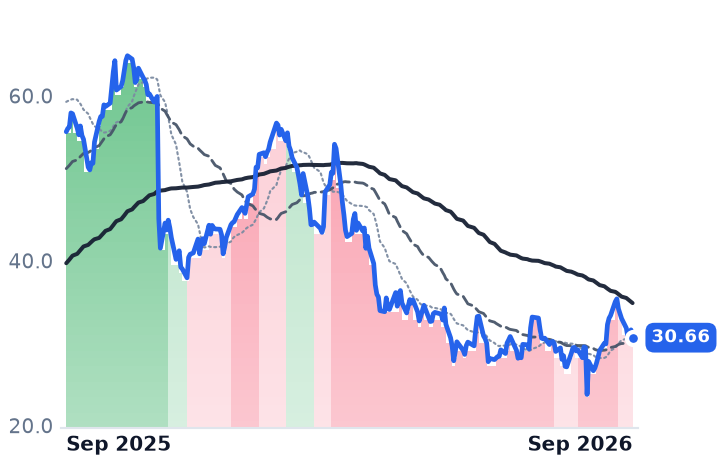
CELH | Celsius | Energy & Functional Drinks | 🔴 Cont. Bear | +10.4% | −44.9% |
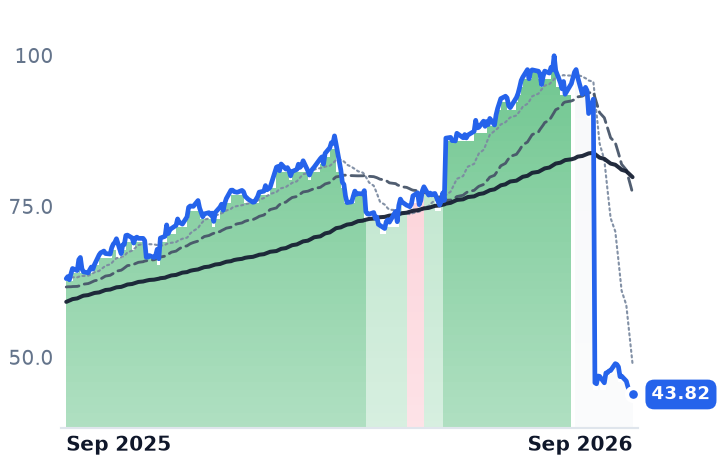
MNST | Monster Beverage | Energy & Functional Drinks | 🟢 Cont. Bull | −51.5% | −30.5% |
12-month price & trend
| Ticker | Mkt cap | P/E | P/E fwd | P/S | P/S fwd | P/GP | P/GP fwd | EV/EBITDA | FCF yld |
|---|---|---|---|---|---|---|---|---|---|
CELH | $7.8B | 146.0x | 21.1x | 2.6x | 2.5x | 5.3x | 5.1x | 33.8x | 5.9% |
MNST | $85.7B | 40.2x | 37.8x | 9.3x | 8.8x | 16.7x | 15.8x | 28.0x | 2.4% |
Consensus projections
| Ticker | FY2026E | FY2027E | FY2028E | |
|---|---|---|---|---|
CELH | Revenue | +29.6% | +8.4% | +7.4% |
| EPS | +16.7% | +20.6% | +14.4% | |
MNST | Revenue | +18.8% | +9.5% | +9.5% |
| EPS | +16.5% | +13.0% | +12.6% |
Forward fiscal years only. Blank means no analyst coverage for that year.
Celsius Holdings told investors on August 6 that it had pulled too many products off the shelf. The evidence sits in the gap between two numbers the company disclosed the same day: shipments of CELSIUS-branded drinks fell 12% from a year earlier, while the same drinks scanned at the register down only 2%.
That gap is the whole mechanism of this category, and it usually runs the other way. Neither large listed energy-drink maker sells a can to a shopper. Monster Beverage, which makes Monster Energy and Reign and licenses concentrate to Coca-Cola's bottling partners, books revenue when concentrate and finished product ship into that system. Celsius, whose portfolio spans the Celsius brand, the acquired Alani Nu and Rockstar, books it when PepsiCo's distributors take delivery. Reported revenue is ordering behavior; consumption is counted separately at the till. When shipments run below consumption, as they now do at both Celsius brands, the destock has already happened rather than waiting to land.
The category kept growing
Monster's own 13-week measurement, stripped of currency effects, put energy-category growth at 7.1% in the United States, 10.4% in Europe, the Middle East and Africa, 11.7% in Asia-Pacific and 23.8% in Latin America. Circana's convenience-store data agrees: US energy-drink dollar sales rose 10% to more than $16bn for the year to December 2025, with units up 8% and energy driving nearly all of 2026's year-to-date growth in non-alcoholic beverages. Alani Nu is the sharpest illustration of the inverted gap: net sales of $364m grew 21% while its tracked retail sales grew 56%, passing $1bn in the first half.
John Fieldly, Celsius's chairman and chief executive, named the cause on the August 6 call: "I think we did. We went too deep on the CELSIUS rationalization." Management also said permanent shelf-space wins slipped to July and September resets because retailers needed capital for fixtures and labor — a timing problem, distinct from lost demand. Velocity supports that reading: dollars per point of distribution rose 16% from the March to the June quarter on 7% fewer distribution points.
What Monster's quarter shows
Monster crossed $2.5bn of quarterly net sales for the first time, up 20.2%, beating consensus on both lines, with gross margin up to 55.9% from 55.7%. Growth has accelerated for three straight quarters, and it has relocated: sales outside the US rose 34.6% to $1.16bn and now make up roughly 46% of the total, with Brazil up 82% in dollars. "Brazil's soon to become one of our very top countries in terms of sales," vice chairman and co-chief executive Hilton Schlosberg told investors. Monster split its stock two-for-one after the close on August 10; unadjusted price histories halve on August 11, but on a like-for-like basis the shares are up about 40% over twelve months.
The shared pressure is aluminum, and it is a tax rather than a commodity cycle. The 50% Section 232 import tariff has pushed the US Midwest premium toward $1 per pound, and although more than 70% of American cansheet comes from domestic scrap exempt from the duty, buyers still pay the tariff-inclusive premium. Monster expects modest sequential increases through year-end and is taking selective US pricing in the fourth quarter. Celsius has no such offset yet: "At current diesel and aluminum levels, margin expansion is largely offset," finance chief Jarrod Langhans said, guiding third-quarter gross margin to stay in the high 40s.
The verdict
The demand break implied by Celsius's 19% one-day fall after missing on revenue and earnings is not in the scanner data. What is real is company-specific and severe: gross margin down 340 basis points to 48.1%, operating income down 47% to $75.3m, and a namesake brand losing shelf while its acquired stablemate carries the group. Monster earns its advance — but at 40.2x trailing and 37.8x forward earnings, the six-percent gap between the two says the market has already banked the coming year's growth. Red Bull and Monster's brands together hold close to 70% of the US market against roughly a fifth for Celsius's three brands, and that asymmetry is why the same tariff lands as a pricing decision at one company and a margin cap at the other.
Celsius has guided the September quarter to look like the June one, which means the restocking that a shipments-below-scans gap implies cannot show up in reported revenue until the fourth quarter. Until then, its top line will keep understating what shoppers are actually buying — the mirror image of the problem the category was supposed to have.