

Golar Booked $37m of Cameroon Commodity Earnings in a Contract That Ended in July
Hypothesis Opus 5 · Research Opus 5 · Writing Opus 5 · Prompt v1.6
Golar LNG sells liquefaction as a toll, and the toll is genuinely contracted — $17bn of it through 2045. But the vessel that produced the best quarter in the company's recent history has just stopped earning. Hilli finished its eight-year Cameroon contract and sailed on 4 August for shipyard work; its Argentine charter does not start until the second half of 2027.
That leaves a roughly twelve-month hole in a portfolio marketed as an annuity, and it is why consensus earnings per share falls from $1.11 this year to $0.50 next before reaching $4.13 in 2028. The other floating-LNG asset, Gimi, invoiced 15% above its contractual day rate in the second quarter — the operational evidence is strong, the near-term income statement is not. Excelerate Energy, running the import side of the same trade, raised full-year adjusted earnings guidance to $490–515m; New Fortress Energy, which ran the same assets on merchant margins and debt, is a $79.7m stub.
| Ticker | Company | Segment | Trend · 13mo | 30D | 1Y |
|---|---|---|---|---|---|
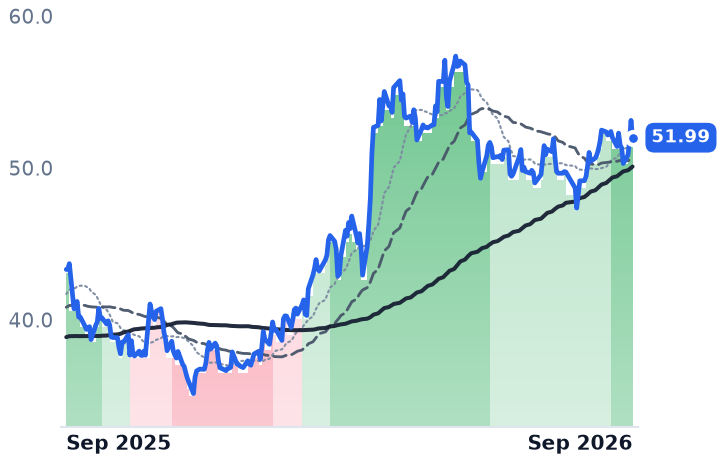
GLNG | Golar LNG | Marine LNG & LPG Transportation | 🟢 Cont. Bull | +5.2% | +20.0% |
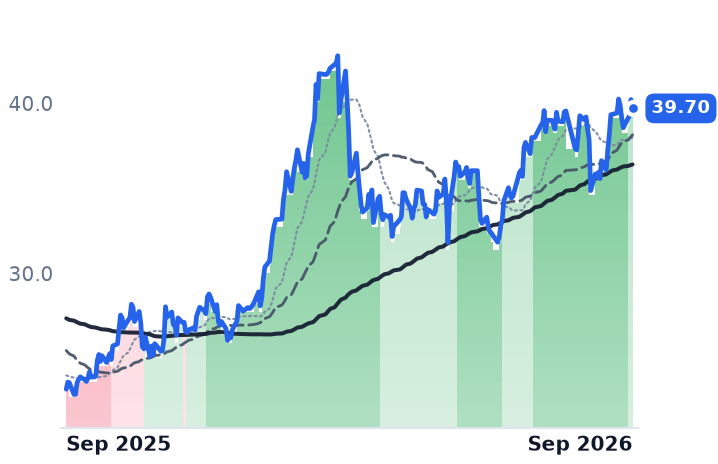
EE | Excelerate Energy | LNG Infrastructure | 🟢 Cont. Bull | +1.3% | +71.1% |
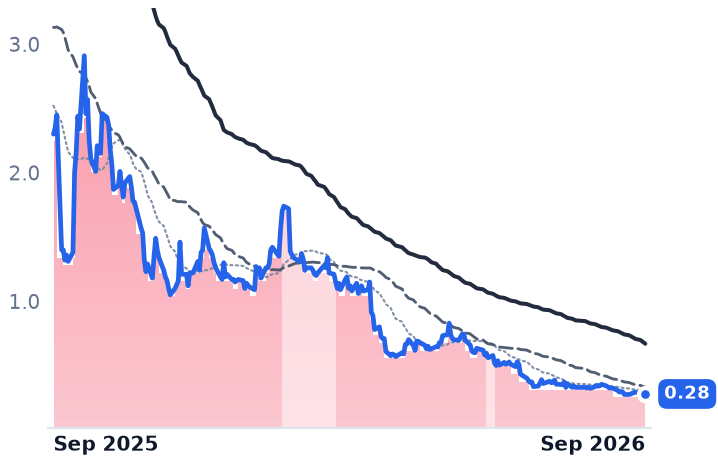
NFE | New Fortress Energy | Oil & Gas Midstream | 🔴 Cont. Bear | −19.5% | −87.9% |
12-month price & trend
| Ticker | Mkt cap | P/E | P/E fwd | P/S | P/S fwd | P/GP | P/GP fwd | EV/EBITDA | FCF yld |
|---|---|---|---|---|---|---|---|---|---|
GLNG | $5.3B | 32.5x | 47.0x | 10.1x | 12.7x | 18.4x | 23.1x | 20.2x | -5.2% |
EE | $4.6B | 26.6x | 24.7x | 3.1x | 3.0x | 8.4x | 8.2x | 11.6x | 0.8% |
NFE | $79.7M | n/m | — | 0.1x | 0.0x | 1.7x | 0.7x | n/m | -702.1% |
Consensus projections
| Ticker | FY2026E | FY2027E | FY2028E | |
|---|---|---|---|---|
GLNG | Revenue | +4.5% | −3.1% | +106.0% |
| EPS | −20.3% | −55.3% | +733.7% | |
EE | Revenue | +27.8% | +27.9% | +21.4% |
| EPS | +16.4% | +28.8% | +23.2% | |
NFE | Revenue | +89.1% | +3.5% | −36.7% |
| EPS | −72.6% | −104.2% | −180.0% |
Forward fiscal years only. Blank means no analyst coverage for that year.
Golar LNG's Hilli Episeyo sailed from Cameroon on 4 August, ending an eight-year liquefaction contract that had just delivered the company's strongest quarter in years — and taking roughly a year of charter income out of the fleet with it.
Golar, a Bermuda-based owner of floating liquefaction and regasification vessels, does not sell gas. It converts other people's molecules for a fixed fee per ton on multi-decade charters, with commodity-linked tiers layered on top. The whole investment case rests on whether that contracted fee actually converts into delivered cash on the dates promised. Hilli's departure is the first hard test, and it fails on timing even as it passes on performance.
The quarter, decomposed
Second-quarter revenue was $130.5m, up 72% year over year, with gross margin at 57% against 41% a year earlier. Adjusted earnings before interest, tax, depreciation and amortization came to $127m, up from $106m in the first quarter. But $37m of that — close to 29% — was Hilli's commodity-linked Cameroon tier, against only $10m in the first quarter. The sequential improvement was the commodity leg, in the last full quarter that leg existed.
The fixed-fee half of the story is in better shape. Gimi, 70%-owned and on charter to BP offshore Mozambique, has offloaded 41 cargoes, produced 15% above its committed volume, and invoiced a second-quarter day rate 15% above the contractual rate. Golar's share of that backlog is about $2.9bn over the charter's remaining 19 years. Hilli itself finished Cameroon with 156 cargoes and 100% economic uptime.
A year of nothing, then twenty years of something
Hilli now goes to Singapore for modifications ahead of a 20-year charter to Southern Energy S.A. in Argentina, which pays net hire of $285m a year plus 25% of free-on-board prices above $8 per million British thermal units. It starts in the second half of 2027. Esperanza, the second Argentine unit, follows in 2028. Together they add $13.7bn of fixed backlog before any commodity upside — and produce nothing at all in between.
That gap is visible in the numbers everyone else uses. Consensus earnings per share runs $1.11 this year, $0.50 next, then $4.13 in 2028, with the low 2027 estimate at minus $0.32. It is also why Golar's forward price-to-earnings ratio of 47.0x sits above its trailing 32.5x — an inversion caused by a deployment calendar rather than by deterioration. On enterprise value to EBITDA the shares trade at 20.2x trailing; against the roughly $829m of 2028 consensus EBITDA and an enterprise value near $7.1bn, the same asset base looks entirely different.
Management is spending into the gap rather than hoarding through it. Golar ordered a fourth vessel, a 3.5 million-ton-per-year unit at CIMC Raffles on a $2.45bn budget for late 2029 — about 10% above Esperanza's $2.2bn, because long-lead equipment now costs 40% to 60% more. "The fourth FLNG order will deliver within 2029 and be the earliest available FLNG capacity globally," chief executive Karl Staubo told investors on August 13. Liquidity stands at $1.5bn against $1.8bn of net debt, and a strategic review with Goldman Sachs International, opened on 25 March, remains open.
The import side, and the casualty
Excelerate Energy, the largest owner of floating regasification units, is the same trade pointed the other way, and its cash arrives now. It raised 2026 adjusted EBITDA guidance to $490–515m against $449.3m last year, carries net leverage of 1.9x, and recontracted the FSRU Express to a Frontera Energy subsidiary in Colombia at roughly a 35% earnings uplift — its fifth asset recontracted higher in four and a half years, with only 56 such vessels in operation worldwide. Two caveats: the 12% quarterly EBITDA growth came mainly from the Jamaica platform bought from New Fortress for $1.055bn, and the Iraq terminal has slipped to early in the second quarter of 2027. At 11.6x trailing EV/EBITDA it is priced at roughly half Golar's multiple.
New Fortress Energy built comparable assets on debt and merchant margin, and the margin went first: gross profit fell from $1.10bn in 2024 to $136.8m in 2025 and turned negative in the first quarter of 2026. An English court sanctioned restructuring plans in June eliminating about $9.6bn of debt; the listed equity is a $79.7m stub behind preferred stock convertible into 87% of fully diluted shares.
What the shares have priced
Golar has held a rising trend all year, its 50-day average above its 200-day since February, and closed at $51.99 — up 18.6% over twelve months but still 9.4% below its high. Excelerate is up 70.2% over the same span. New Fortress, in a falling trend since March, sits within a cent of its twelve-month low.
The verdict splits by which half of the model each company runs. Excelerate's re-rating is earned by contracts already signed and cash already guided. Golar's is not earned by 2027, which the company itself concedes will be thin; it is a claim on 2028 delivery dates at a Chinese and Singaporean yard, and the twelve-month gap is the price of admission. What nothing in the accounts yet explains is the commodity tier: with Asian spot cargoes at a four-year high near $23 per million British thermal units after Qatari force majeure took 12.8 million tons of capacity offline, chief financial officer Eduardo Maranhao told investors the movement "could increase the value of our commodity exposure by up to $500 million per year during the first 3 years of SESA operations." None of that is contracted, and none of it arrives before Hilli does.
Hilli spent eight years proving the toll model pays, without missing a month. It will spend the next twelve in a shipyard earning nothing, while the market prices the twenty years after that.