

Containerboard's Third 2026 Price Increase Hit Mills Paying 70% More for Recycled Fiber
Hypothesis Opus 5 · Research Opus 5 · Writing Opus 5 · Prompt v1.6
Containerboard producers have spent eighteen months manufacturing their own price: roughly 3.9m tons, about a tenth of US capacity, has been permanently retired since February 2025, lifting the second-quarter operating rate to about 95% even as production fell 2%. Three price rounds followed, the latest effective September 1.
The money has not arrived. Old corrugated containers — the fiber those same mills now buy more of — are up about 70% since January, and International Paper's second-quarter operating margin fell to 0.7% from 3.0% while it cut its North American profit guidance. Packaging Corp grew revenue 14.7% on the Greif mills it bought and earned flat operating income on it.
Both companies date the payoff to 2027. The shares have already been asked to pay for it.
| Ticker | Company | Segment | Trend · 13mo | 30D | 1Y |
|---|---|---|---|---|---|
| The subject · what this brief is about | |||||
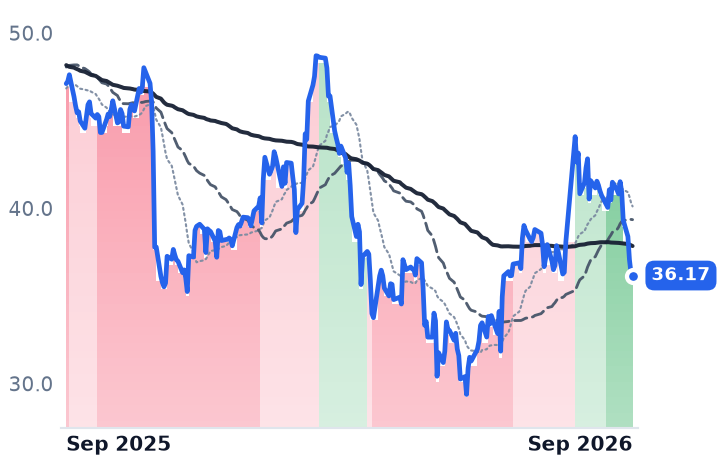
IP | International Paper | Corrugated & Containerboard | 🌱 Emerging Bull | −14.5% | −23.2% |
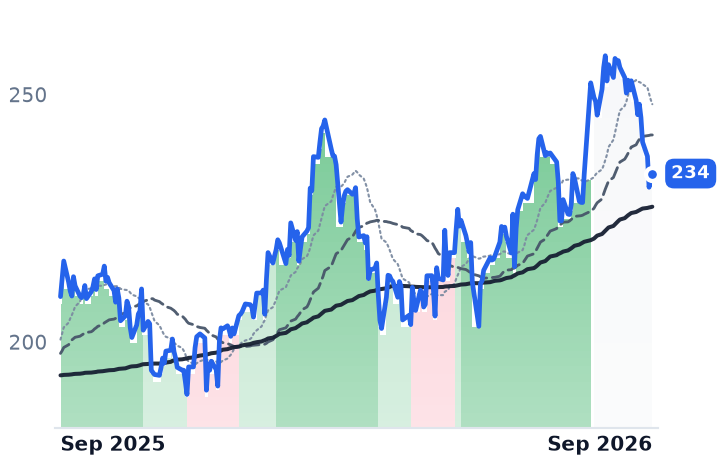
PKG | Packaging Corporation of America | Corrugated & Containerboard | 🟢 Cont. Bull | −8.4% | +11.9% |
| Compared against · context, not the story | |||||
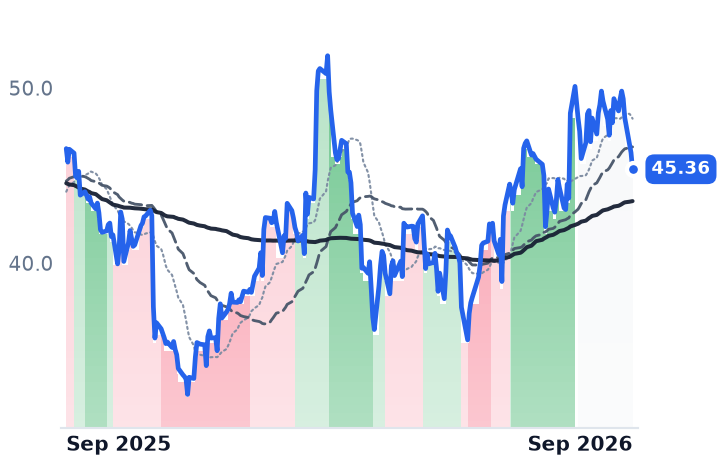
SW | Smurfit Westrock | Corrugated & Containerboard | 🌱 Emerging Bull | −6.5% | −2.5% |
12-month price & trend
| Ticker | Mkt cap | P/E | P/E fwd | P/S | P/S fwd | P/GP | P/GP fwd | EV/EBITDA | FCF yld |
|---|---|---|---|---|---|---|---|---|---|
IP | $19.1B | n/m | 26.4x | 0.8x | 0.8x | 2.9x | 2.8x | n/m | 2.6% |
PKG | $20.9B | 30.3x | 22.3x | 2.2x | 2.1x | 10.9x | 10.3x | 13.4x | 3.6% |
SW | $23.8B | 48.4x | 20.2x | 0.8x | 0.7x | 4.2x | 4.1x | 8.7x | 4.3% |
Consensus projections
| Ticker | FY2026E | FY2027E | FY2028E | |
|---|---|---|---|---|
IP | Revenue | +0.3% | +5.6% | +1.1% |
| EPS | +470.4% | +119.1% | +16.1% | |
PKG | Revenue | +10.9% | +7.1% | +3.1% |
| EPS | +5.8% | +27.6% | +6.1% | |
SW | Revenue | +3.2% | +5.6% | +2.1% |
| EPS | −6.7% | +54.2% | +14.3% |
Forward fiscal years only. Blank means no analyst coverage for that year.
Packaging Corporation of America, which makes containerboard and converts it into boxes, opened a third price round of 2026 on July 24: $140 a ton on containerboard, effective September 1. International Paper followed at $80, Smurfit Westrock at $100 and Cascades at $110 to $140, within days. Three increases in seven months would add $240 a ton to linerboard if fully implemented.
That sequence is the whole business model stated plainly. A containerboard producer's revenue is tons multiplied by a published index price, and the industry has been manufacturing the index by taking mills out permanently. Fastmarkets counts roughly 3.9m tons — about 10% of US capacity — retired between February 2025 and March 2026, with International Paper's Red River, Riceboro and Savannah mills a large share of it. It worked mechanically: the American Forest & Paper Association's second-quarter data has the operating rate near 95%, up from about 93%, on production down 2% year over year, domestic demand up 1% and exports down nearly 19%. Supply left faster than demand did.
The input the closures tightened
The closures concentrated on older virgin-fiber sites while the surviving mills shift toward recycled furnish — which raises demand for old corrugated containers, the input those mills buy. Packaging Corp told investors recycled fiber now runs 30% to 35% of its mix against roughly 20% historically, and that prices for it are up about 70% since the start of 2026. Measured against history that is still cheap: reporting puts old corrugated containers near $100 a ton at mid-year against a five-year average around $140. Measured against last year's cost base, it is a bill.
"The pricing up to now has really been eaten by inflation," International Paper chief executive Andrew Silvernail told investors on July 30. "If you look at what's happened with OCC, energy, diesel, freight, you name it, right, it's unfortunately really eaten every bit of that pricing up until today." The numbers behind that sentence: second-quarter revenue of $6.0bn, down 11.3%, operating income of $45m, and an operating margin of 0.7% against 3.0% a year earlier. IP raised its estimated macro headwind to about $150m from $50m, trimmed the top of its North American adjusted earnings guidance to $2.35–2.45bn, and cut its second-half volume assumption to flat from up 1%. It expects the September publication to show up mainly in the first half of 2027.
Packaging Corp's quarter reads differently and lands in the same place. Revenue rose 14.7% to $2.49bn — corrugated shipments up more than 24% in total, but up 4.1% at the legacy plants, the rest arriving with Greif's containerboard business, bought for $1.8bn and closed on September 2, 2025. Operating income was flat, net income fell 20.5%, and packaging segment margin slipped to 21.1% from 22.6%. Freight alone cost 26 cents a share year over year. "At some point in time, you gotta back that up with price also," chairman and chief executive Mark Kowlzan said on July 23 of the $10bn the company has spent on its mills. It guides third-quarter earnings of $2.91 a share against $2.15 reported.
Smurfit Westrock, the third large North American containerboard producer, cut full-year adjusted earnings guidance to $4.9–5.1bn as its freight headwind ballooned to $300m from a $50m April estimate, with operating income down 44% and North American corrugated volumes deliberately 4.5% lower. Its chief executive Anthony Smurfit called global paper markets "as strong as I have seen in my lifetime within this industry" on July 29 — a market that strong and a guidance cut in the same call is the tension in one sentence.
Who pays, and when
The buyers are objecting. The Association of Independent Corrugated Converters came out against the third round on August 10, saying three increases in five months are not justified by raw material costs and reflect "a small group of producers having market dominance," while conceding the first two were input-driven. The published index has not settled the argument: North American containerboard prices were flat in August for a second straight month, with $100 a ton of net increase recognized so far this year.
So the capacity discipline is real and the price rounds are real, and neither has yet reached the profit line — 2026's announced increases were consumed by fiber, freight and energy on the way through. What the shares carry is 2027. International Paper trades at 26.4 times consensus earnings for this year and 12.0 times next year's $3.00, a figure that requires earnings to more than double; Packaging Corp at 30.3 times trailing profit against 25.2 times at the end of 2024 and 24.0 times at the end of 2025, on lower earnings, and 17.5 times the 2027 estimate — the most expensive of the three on the year the pricing is meant to be fully banked. Smurfit Westrock sits at 13.1 times 2027. The last month took all three down together, International Paper hardest at 14%, in a slide with no day worse than about 4% and no company-specific news beyond the July guidance cut.
International Paper also has a structural event in between: it said on January 29 it will split into two listed companies, spinning off the European packaging business within 12 to 15 months. The 2027 recovery consensus underwrites has to survive that.
Which leaves one monthly publication doing the work of a thesis. If September's index recognizes the third round, the closures paid for themselves and the equities are early. If it prints flat a third time, the industry will have removed a tenth of its capacity and discovered that the customer still sets the price.