

Twilio's Revenue Growth Accelerated to 22%; Salesforce's Operating Income Was Flat
Hypothesis Opus 5 · Research Opus 5 · Writing Opus 5 · Prompt v1.6
The front-office software group that spent a year priced as artificial intelligence's first casualty repriced in August — and the earnings underneath support one of its two biggest names far better than the other.
Twilio, which bills per message and minute, posted a third straight quarter of accelerating growth, lifted its dollar-based net expansion rate to 116% from 108% a year earlier, and raised full-year guidance twice. Salesforce, which bills per seat, grew revenue 10.8% — closer to 6.4% excluding newly consolidated Informatica — while gross margin slipped to 76.7% and operating income finished flat; per-share earnings doubled on a share count cut from 962m to 821m.
The timing matters too: Braze and Freshworks turned three weeks before Salesforce reported, which makes this a category-wide relief trade Salesforce joined late rather than one it led.
| Ticker | Company | Segment | Trend · 13mo | 30D | 1Y |
|---|---|---|---|---|---|
| The subject · what this brief is about | |||||
CRM | Salesforce | Customer Experience & CRM | 🔴 Cont. Bear | +38.2% | +2.5% |
TWLO | Twilio | Communications & Messaging Platforms | 🟢 Cont. Bull | +15.1% | +117.6% |
| Compared against · context, not the story | |||||
HUBS | HubSpot | Customer Experience & CRM | 🔴 Cont. Bear | +2.3% | −47.9% |
BRZE | Braze | Customer Experience & CRM | 🌱 Emerging Bull | +28.2% | +21.8% |
FRSH | Freshworks | Security & Compliance | 🌱 Emerging Bull | +12.1% | +0.2% |
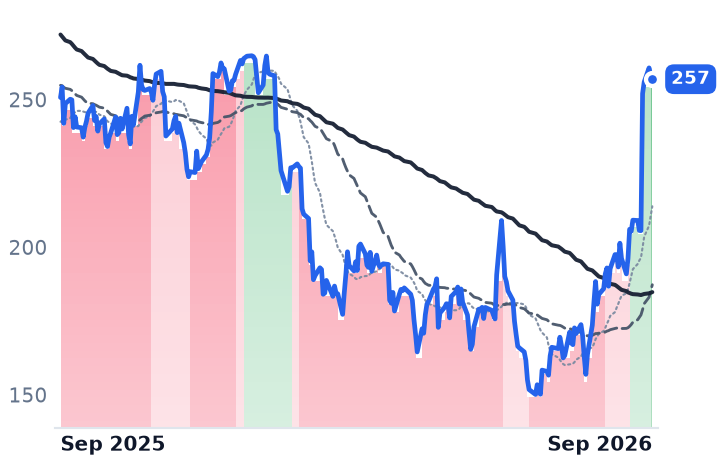
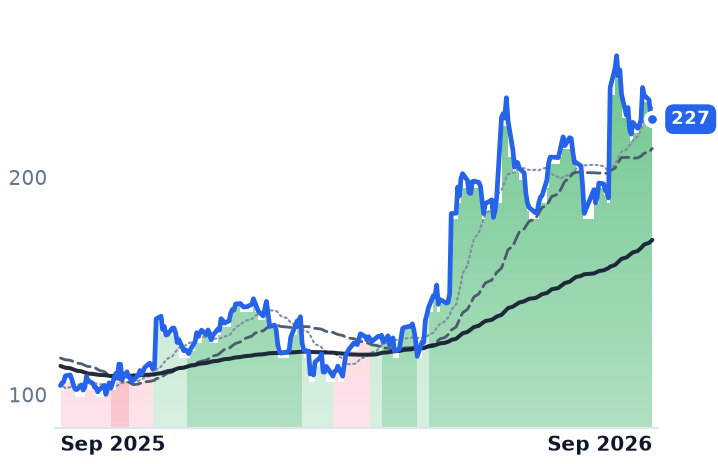
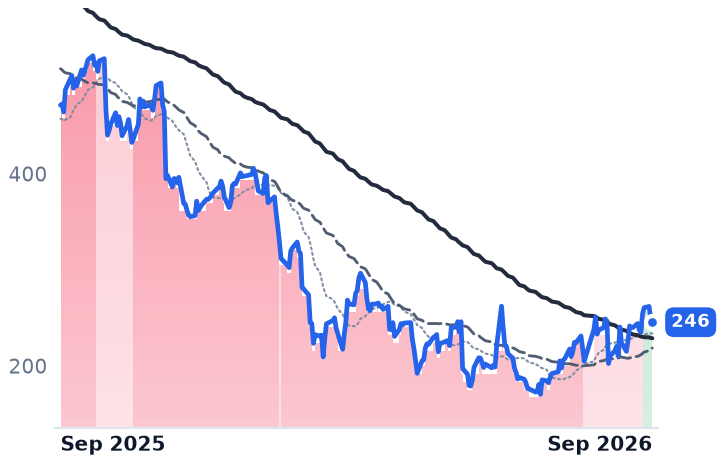
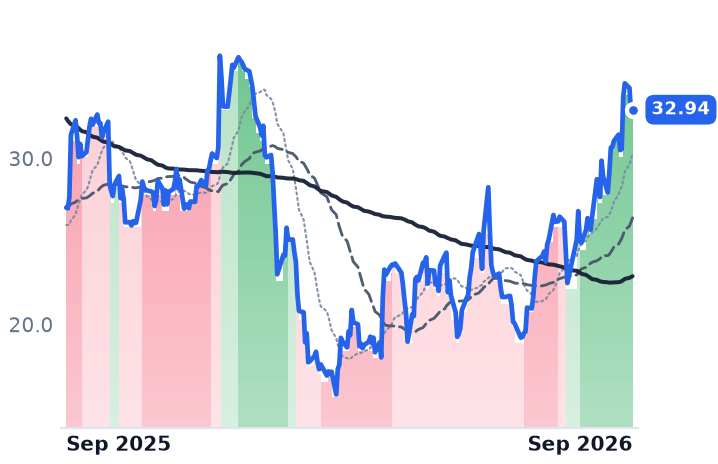
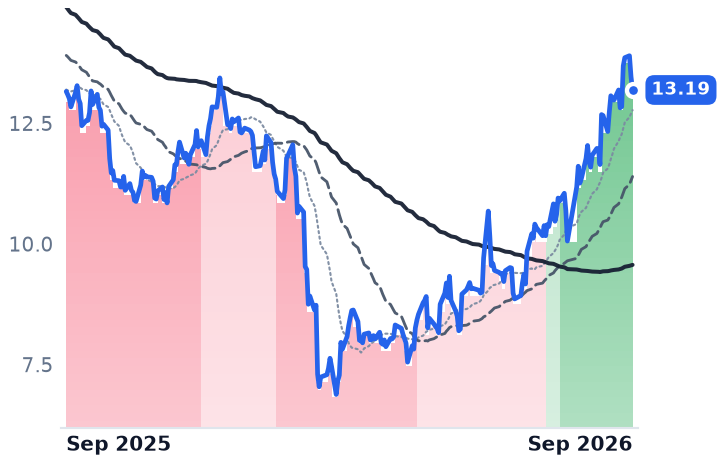
12-month price & trend
| Ticker | Mkt cap | P/E | P/E fwd | P/S | P/S fwd | P/GP | P/GP fwd | EV/EBITDA | FCF yld |
|---|---|---|---|---|---|---|---|---|---|
CRM | $210.4B | 23.4x | 15.6x | 4.8x | 4.5x | 6.2x | 5.9x | 15.4x | 7.2% |
TWLO | $34.4B | 30.2x | 38.3x | 6.2x | 5.7x | 12.7x | 11.8x | 94.5x | 3.2% |
HUBS | $13.4B | 92.2x | 19.6x | 3.9x | 3.6x | 4.7x | 4.4x | 44.5x | 5.7% |
| Ticker | Mkt cap | P/E | P/E fwd | P/S | P/S fwd | P/GP | P/GP fwd | EV/EBITDA | FCF yld |
|---|---|---|---|---|---|---|---|---|---|
BRZE | $3.9B | n/m | 54.5x | 4.9x | 4.3x | 7.4x | 6.5x | n/m | 1.7% |
FRSH | $3.5B | 19.3x | 19.0x | 3.9x | 3.6x | 4.6x | 4.3x | 39.0x | 7.1% |
Consensus projections
| Ticker | FY2026E | FY2027E | FY2028E | |
|---|---|---|---|---|
CRM | Revenue | +9.3% | +11.5% | +9.8% |
| EPS | +17.4% | +39.5% | −2.4% | |
TWLO | Revenue | +19.4% | +11.6% | +10.5% |
| EPS | +23.5% | +14.5% | +14.2% | |
HUBS | Revenue | +18.2% | +14.2% | +14.0% |
| EPS | +38.2% | +25.9% | +18.4% | |
BRZE | Revenue | +24.3% | +22.8% | +16.6% |
| EPS | +281.2% | +50.3% | +52.1% | |
FRSH | Revenue | +15.6% | +14.2% | +15.6% |
| EPS | +4.9% | +23.5% | +20.5% |
Forward fiscal years only. Blank means no analyst coverage for that year.
Salesforce was the last of the front-office software names to turn, not the first. Braze and Freshworks — both selling customer messaging and support software to mid-market and enterprise buyers — had already crossed into uptrends, their 50-day averages above their 200-day, by 3 August. Salesforce was still in a downtrend that day. It reported on 26 August and gapped 22.6% higher the next session, from 205.62 to 252.05 on 55.5m shares against a baseline near 10m a day the week before.
That sequence changes what the move means. The re-rating was not Salesforce dragging a sector behind it; it was a broad unwind of the "SaaSpocalypse" positioning that had priced recurring-revenue software for the moment AI agents replaced the humans holding the licenses. CNBC's account of the 27 August session has Salesforce up alongside CrowdStrike, Adobe and Autodesk on the same day. The interesting question is which of these businesses actually earned it — and the two largest here run opposite meters, which makes them a clean test.
The usage meter delivered
Twilio, whose programming interfaces let developers embed voice, messaging and verification into their own apps, has never sold a seat. June-quarter revenue of $1.499bn grew 22.0%, the third consecutive acceleration from 14.3% and then 20.0%; organic growth, stripping incremental US carrier surcharges, was 17%. Gross profit growth accelerated in step, from 10.4% to 17.7% to 20.4%, so the volume is reaching the gross line. Dollar-based net expansion — what existing customers spend this year against last — reached 116%. Guidance went up twice, with full-year organic growth now 13-13.5% against 9.5-10.5% before.
The one blemish is a non-GAAP gross margin of 49.1%, down 160 basis points, which management attributes entirely to roughly $71m of incremental US carrier pass-through fees billed on at cost; absent them margin would have risen, and operating margin gained a point anyway. Chief executive Khozema Shipchandler called the quarter "exceptional" and put AI-related demand in "very early innings," most visible so far in voice. There is still no AI revenue line; the disclosure is triple-digit growth in AI-native customer cohorts and an eight-figure deal with one AI company.
The seat meter did not
Salesforce's July quarter grew 10.8%, decelerating from 13.3%, and about four points of that came from Informatica, consolidated this year and absent from the year-ago base — near 6.4% organic. Gross margin fell about a point and a half to 76.7%. Operating income of $2.331bn was flat year over year. Net income rose 86.9% and per-share earnings more than doubled, arithmetic supplied by a diluted share count falling from 962m to 821m under a $25bn accelerated repurchase that management expects to shrink the count at least 14%, at an average near $176.
Two lines genuinely confirm demand. Current remaining performance obligation — contracted revenue due within a year — reached $33.5bn, up 14% in constant currency, three points faster than revenue. Agentforce annual recurring revenue passed $1.5bn, up more than 240%. But that is roughly 3.5% of a subscription run-rate near $43bn, and the seat-billed core — Sales, Service, Marketing, Commerce, Slack — was $7.2bn of the quarter's $10.82bn subscription revenue, growing 8% in constant currency. Marc Benioff pointed on the 26 August call to what consumption looks like at scale: "The Army Human Resources Command expects to drive up to 55 million Agentforce conversations every single month." Management's stated near-term lever, though, is a seat upgrade: only 5% of sales and service knowledge workers sit on premium tiers carrying a 60-80% price premium.
What is paid for, and what is not
Salesforce trades at 23.4x trailing and 15.6x forward earnings, but the forward year is the flattering one — consensus has fiscal 2028 earnings of $16.03 a share, below fiscal 2027's $16.43. Twilio's 38.3x forward sits above its 30.2x trailing, because a one-off non-operating gain produced $1.067bn of quarterly net income on $84.5m of operating income; against its own ten-year history it remains cheap on sales. Because Salesforce converts three-quarters of revenue to gross profit and Twilio under half, the comparable measure is what each costs per dollar of gross profit: Twilio costs about twice what Salesforce does. HubSpot, the remaining holdout, only reached an uptrend on 27 August and is down 47.9% over twelve months.
The verdict splits. Twilio's advance is backed by accelerating volume through a meter AI agents make busier, though its own third-quarter guide steps organic growth down to 11-12%. Salesforce's is backed by backlog and a fast-growing consumption tier that is still too small to move the revenue line, sitting on top of an income statement where the operating business stood still and the shareholder gain came from the share count. Buying either one requires believing the relief trade was right about the category before Salesforce's numbers arrived.
Up to 55 million conversations a month, billed by the action rather than by the login — that is the business Salesforce says it is becoming. Its income statement has not shown it yet.