

Alkami Added 2.7m Users, nCino Repriced Four Renewals More Than 10% Higher
Hypothesis Opus 5 · Research Opus 5 · Writing Opus 5 · Prompt v1.6
Three vendors sell software into the same shrinking population of US community banks and credit unions, and they bill it two different ways. Alkami and Q2 Holdings charge by the registered consumer; nCino charges the bank. In the June quarter the consumer meter compounded — Alkami's registered users rose 13% to 23.6 million and revenue per user 7% to $21.69, lifting annual recurring revenue 21% while reported revenue grew 15.9% — and the per-bank meter did not: nCino's revenue grew 8.2%, with growth increasingly coming from renewal price uplift on customers it already has.
The suspicion that one-off implementation and termination fees were doing the work is not supported. Alkami's gross margin fell because termination-fee revenue was lower; Q2's services line shrank to $19.1m. The unresolved part is the market's ranking: nCino, the slowest grower, has re-rated hardest.
| Ticker | Company | Segment | Trend · 13mo | 30D | 1Y |
|---|---|---|---|---|---|
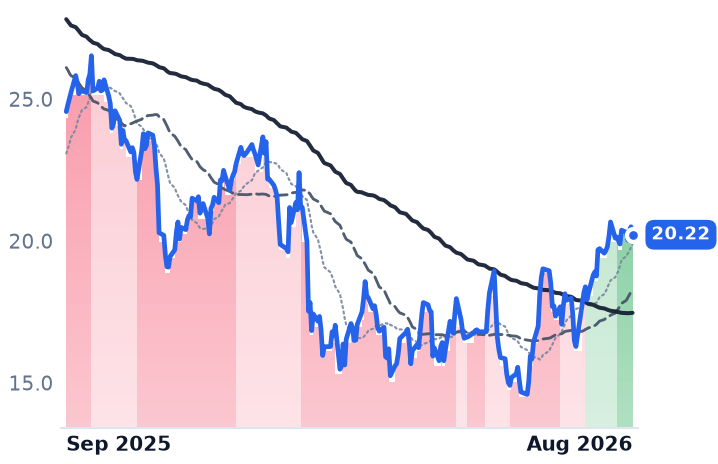
QTWO | Q2 | Financial Services Software | 🌱 Emerging Bull | +7.0% | −15.1% |
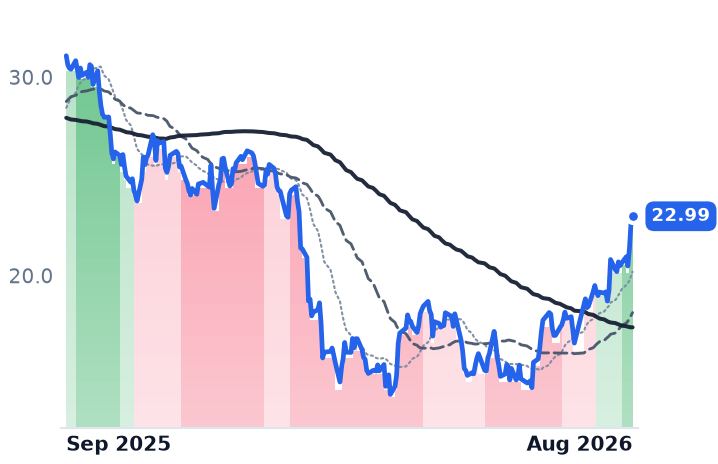
ALKT | Alkami Technology | Financial Services Software | 🌱 Emerging Bull | +11.3% | −17.7% |
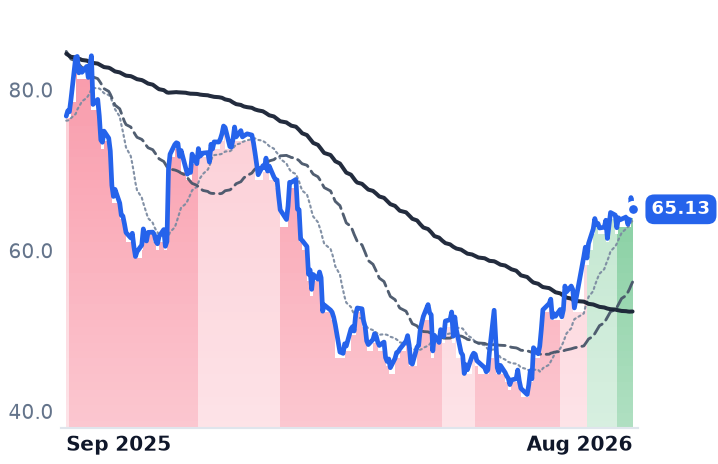
NCNO | nCino | Financial Services Software | 🔴 Cont. Bear | +24.5% | −26.0% |
12-month price & trend
| Ticker | Mkt cap | P/E | P/E fwd | P/S | P/S fwd | P/GP | P/GP fwd | EV/EBITDA | FCF yld |
|---|---|---|---|---|---|---|---|---|---|
QTWO | $4.1B | 44.0x | 22.4x | 4.8x | 4.6x | 8.4x | 8.1x | 27.6x | 5.0% |
ALKT | $2.2B | n/m | 25.7x | 4.4x | 4.1x | 7.7x | 7.2x | n/m | 3.0% |
NCNO | $2.5B | 74.2x | 17.6x | 4.0x | 3.9x | 6.6x | 6.3x | 33.6x | 5.2% |
Consensus projections
| Ticker | FY2026E | FY2027E | FY2028E | |
|---|---|---|---|---|
QTWO | Revenue | +11.8% | +10.1% | +10.5% |
| EPS | +22.5% | +18.8% | +34.2% | |
ALKT | Revenue | +19.6% | +16.7% | +14.5% |
| EPS | +51.0% | +38.2% | +25.0% | |
NCNO | Revenue | +9.8% | +9.0% | +8.5% |
| EPS | +25.2% | +44.5% | +20.0% |
Forward fiscal years only. Blank means no analyst coverage for that year.
Two of the three software companies that sell digital banking to America's community banks and credit unions get paid according to how many consumers log in. The third gets paid by the bank. In the quarters just reported, that difference decided which businesses grew.
It matters because the customers are disappearing. The number of US banks has been shrinking at a 3% compound annual rate, and credit unions fell 16% between the end of 2020 and the end of 2025 — also about 3% a year — even as their assets grew, according to Jack Henry's fiscal 2026 annual report. More than 150 bank deals were announced in 2025, more than in all of 2024. A vendor billing per institution faces a headwind by arithmetic. A vendor billing per end user does not, because the survivors keep the accounts.
The consumer meter
Alkami Technology, which runs a cloud digital banking platform for community and regional banks and credit unions and added account opening through its MANTL acquisition, ended June with 23.6 million registered users, up 2.7 million in twelve months, and revenue per registered user of $21.69, up 7%. Those compound: annual recurring revenue reached $511.7m, up 21%, against reported revenue growth of 15.9%, the company disclosed on July 29. The per-user increase came from product attach — clients now launch with 16 products against 10 in 2021 — rather than price lists. Average recurring revenue per client is $1.6m across 313 clients.
The gross margin went the other way, falling 171 basis points to 56.8%, and the reason cuts against the idea that one-off money is propping this up: Alkami booked less termination-fee revenue from acquired clients than a year earlier, and management says those fees cluster in the fourth quarter. "On my first earnings call in 2022, we reported a little over $42 million in revenue and negative adjusted EBITDA of more than $4 million… goals that seemed extraordinary are now within reach," chief executive Alex Shootman told investors on the July 29 call, referring to an internal target of $500m of revenue and $100m of adjusted EBITDA. Guidance for 2026 is $528–531m.
Q2 Holdings, whose platform spans consumer, small-business and commercial banking plus fraud and lending modules, ended June with 27.8 million registered users and subscription annual recurring revenue of $825.5m, up 15% — faster than total recurring revenue, up 13%, and faster than revenue, up 12.6%. Subscription revenue of $182.8m was 83% of the total; services and other fell to $19.1m from $20.0m. Gross profit grew 24.5% and operating income nearly tripled to $29.3m. Committed backlog of about $2.8bn grew 17%, only modestly ahead of the recurring meter. On Q2's own figures the arithmetic implies roughly $30 of subscription recurring revenue per registered user a year — richer than Alkami's.
The bank meter
nCino, which sells a cloud operating system for onboarding, lending and compliance to banks and credit unions, grew revenue 8.2% to $161.0m in its quarter ended July 31, with subscription revenue up 10% and US mortgage revenue down 1% to $20.6m. Churn runs about $25m a year, roughly $8m of it mortgage, as higher-for-longer rates squeeze independent mortgage banks. Professional services revenue is deliberately shrinking 3%.
What is growing is price. Some 48% of annual contract value now sits on nCino's new platform pricing model, up from 40% a quarter earlier. "We signed multiyear renewals with 4 of our 20 largest U.S. enterprise customers by ACV, representing over $900 billion in assets. All 4 renewed ahead of schedule with an average ACV increase of more than 10%," chief executive Sean Desmond said on the August 25 call. Profitability inflected hard — free cash flow rose 170% to $34m, GAAP operating margin swung from minus 6.2% to plus 8.5% — but the top line is guided to about 9% growth for the year.
What the market paid for
All three shares gapped on July 28, before any of them reported, in a broad software rotation that carried the iShares Expanded Tech-Software ETF about 18% off its July 23 low. Since then the prints have sorted them: nCino is up 45% over three months and Q2 44%, Alkami 15%, and all three remain below where they traded a year ago.
Q2's re-rating is roughly paid for. Its shares fetch 8.42x trailing gross profit against 7.28x in early May, expansion smaller than the 24.5% growth in gross profit itself, and 22.4x forward earnings against 44.0x trailing. Alkami, GAAP loss-making so that its trailing earnings multiple means nothing, is the cheapest of the three per unit of recurring growth at 7.74x trailing gross profit, on 25.7x forward earnings. nCino's price against trailing gross profit went from 5.39x on July 29 to 6.58x — a fifth added in a month, against a business growing 8.2%. Its 17.6x forward earnings is the lowest of the three, and that is the honest counter-argument.
So the businesses earn most of what Q2 Holdings and Alkami have been given, and rather less of what nCino has. A renewal uplift is a step, taken once per contract and then lapped; more users at more products a head is a slope. The distinction will be visible in the numbers within a year.
The complication is that even the good meter is slowing by design: Q2 has told investors to expect subscription revenue growth of 12.5–13% in 2027, below the 15% it just posted. Alkami's Shootman argues more than three-quarters of the bank market still runs legacy digital banking. Both cannot stay true for long.