

The .com Price Has Been Frozen Since 2024; VeriSign Grew on a Record 12.7m New Names
Hypothesis Opus 5 · Research Opus 5 · Writing Opus 5 · Prompt v1.6
VeriSign's revenue is growing because more people are buying domain names — which is not how this business has worked for years. The wholesale price of a .com has been unchanged at $10.26 since September 2024, yet the combined .com/.net base went from 170.5m names a year ago, when it was shrinking, to 179.1m at the end of June, and management doubled its 2026 base-growth guidance to 5.2–6.0%.
Reported revenue growth still decelerated, to 6.0%, because the price contribution ran out. The next 7% increase arrives November 1 and mostly lands in 2027 revenue. GoDaddy, which pays that fee as a cost of goods, is the mirror image: operating margin went from 21.9% to 27.1% on a customer count that added 22,000 in three months, and the shares are down by a third over twelve months.
| Ticker | Company | Segment | Trend · 13mo | 30D | 1Y |
|---|---|---|---|---|---|
| The subject · what this brief is about | |||||
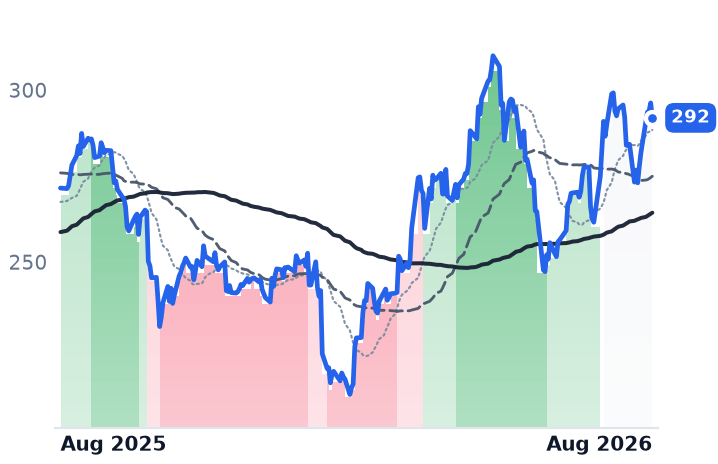
VRSN | VeriSign | Domain & Internet Infrastructure | 🌱 Emerging Bull | +1.9% | +7.5% |
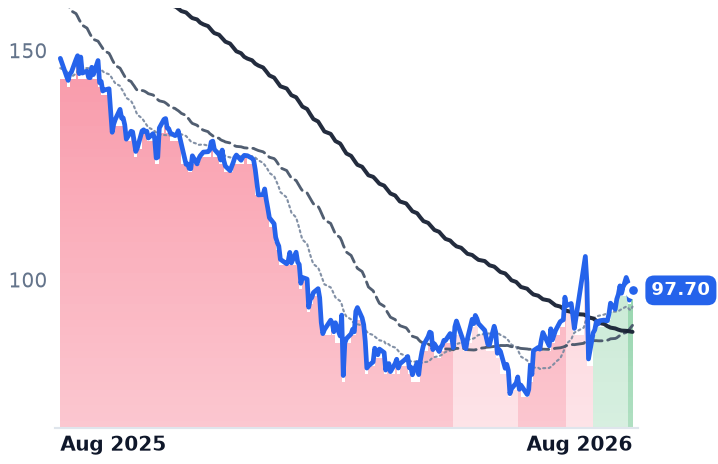
GDDY | GoDaddy | Domain & Internet Infrastructure | 🔴 Cont. Bear | −1.6% | −34.1% |
| Compared against · context, not the story | |||||
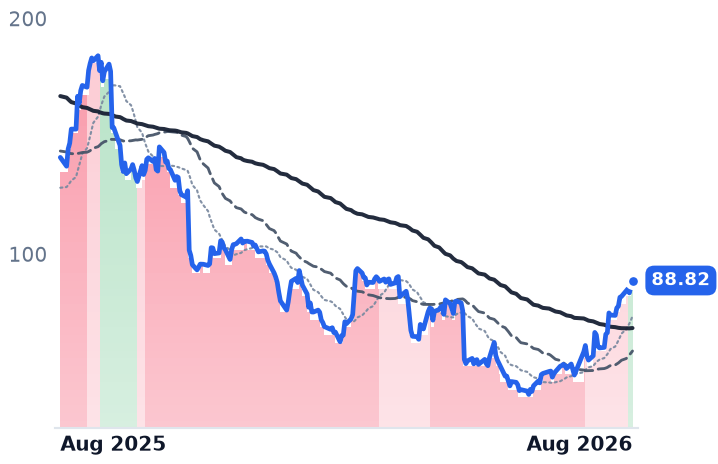
WIX | Wix.com | Website & Commerce Platforms | 🔴 Cont. Bear | +56.7% | −37.0% |
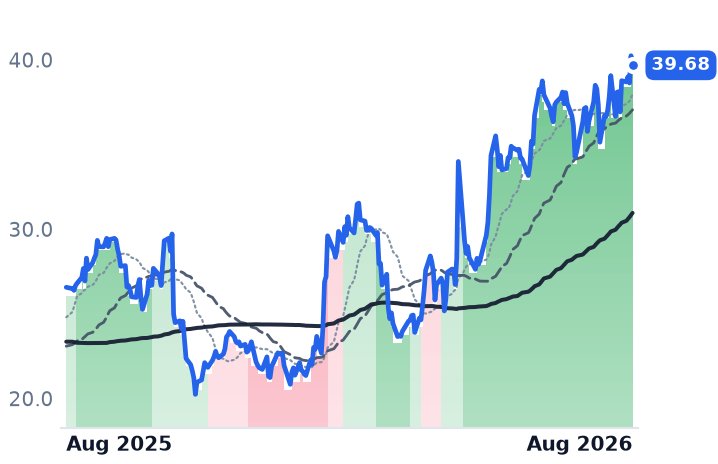
CCSI | Consensus Cloud Solutions | Domain & Internet Infrastructure | 🟢 Cont. Bull | +10.9% | +49.3% |
12-month price & trend
| Ticker | Mkt cap | P/E | P/E fwd | P/S | P/S fwd | P/GP | P/GP fwd | EV/EBITDA | FCF yld |
|---|---|---|---|---|---|---|---|---|---|
VRSN | $26.4B | 31.6x | 29.8x | 15.5x | 15.1x | 17.5x | 17.0x | 23.2x | 4.0% |
GDDY | $12.9B | 14.4x | 13.2x | 2.5x | 2.5x | 4.0x | 3.9x | 11.1x | 13.2% |
WIX | $3.0B | n/m | 11.3x | 1.5x | 1.3x | 2.2x | 2.0x | n/m | 17.9% |
| Ticker | Mkt cap | P/E | P/E fwd | P/S | P/S fwd | P/GP | P/GP fwd | EV/EBITDA | FCF yld |
|---|---|---|---|---|---|---|---|---|---|
CCSI | $521.0M | 6.0x | 4.9x | 1.5x | 1.5x | 1.9x | 1.8x | 5.9x | 21.5% |
Consensus projections
| Ticker | FY2026E | FY2027E | FY2028E | |
|---|---|---|---|---|
VRSN | Revenue | +5.9% | +9.8% | +8.3% |
| EPS | +7.4% | +13.3% | +13.6% | |
GDDY | Revenue | +5.9% | +5.3% | +4.3% |
| EPS | +23.0% | +24.7% | +13.4% | |
WIX | Revenue | +14.1% | +13.2% | +13.7% |
| EPS | −28.8% | +45.4% | +27.2% | |
CCSI | Revenue | +1.9% | +2.9% | −2.4% |
| EPS | +5.2% | +3.1% | +0.7% |
Forward fiscal years only. Blank means no analyst coverage for that year.
The wholesale price of a .com domain has not changed since September 2024. VeriSign — which operates the .com and .net registries, maintains the internet's root zone and runs two of its thirteen root servers — grew revenue anyway, on 12.7 million new registrations in the June quarter, the most in any quarter in its history.
That matters because the standard reading of this company is a toll road that raises its toll. For most of the last decade it was: VeriSign exercised every permitted 7% increase in the prior contract cycle, taking the wholesale price from $7.85 to $10.26 in successive September steps. Then the toll froze, and the meter took over.
Units, while the price sat still
The combined .com/.net base ended June at 179.1 million names, up 3.05 million in the quarter. A year earlier it stood at 170.5 million and was shrinking — down 0.1% from the prior year. That is a swing to roughly 5% annual unit growth from nothing. On average bases across the two periods, revenue per domain per quarter rose from about $2.41 to about $2.45, near 1.6%, against unit growth of about 4.4%; the arithmetic includes .net and non-domain lines, so treat it as an approximation, but three-quarters of the quarter's 6.0% revenue growth is names, not rate.
"The 12.7 million new registrations are the largest we have seen for any quarter in our history," executive chairman and chief executive D. James Bidzos told investors on the July 23 call. Management credits artificial-intelligence tools that make it fast and cheap to find a name and stand up a site, registrars redirecting spend toward customer acquisition, and its own shift to registrar-specific marketing, with strength in the United States and Europe. The company raised 2026 domain-base growth guidance to 5.2–6.0% having guided 1.5–3.5% in February.
Reported revenue growth, meanwhile, decelerated — 7.6% in the fourth quarter of 2025, then 6.6%, then 6.0% — precisely because the price contribution ran out. The renewal rate slipped to 75.2% from 75.5%, and management expects it to drift lower as more first-time names come up.
The toll resumes on November 1, when .com goes to $10.97, the first of four permitted 7% steps running to 2030. "Our own modeling… is we would expect about 50% of November's 7% price increase on .com to be recognized in 2027 revenues," chief financial officer John Calys said on the same call. Consensus has 2027 revenue up 9.8% after 5.9% this year, which is that sentence turned into a number.
Investors have already paid for it. The shares changed hands at 31.6 times trailing earnings, against 25.9x at the end of 2024 and 27.6x at the end of 2025, and 29.8x forward on 2026 earnings-per-share growth of 7.4% — flattered by a 7% cut in the share count, funded by $1.17bn of buybacks and dividends over twelve months, more than the company's free cash flow. Costs are moving too: operating expense rose 14% to $138m on server and chip inflation the company called meaningful.
The registrar pays the toll
GoDaddy, which resells those domains to small businesses alongside hosting, website builders and payments, is the opposite trade. Its shares are down 33.9% over twelve months, in two earnings-day drops — 14.3% on February 25 and 16.7% on July 31, the latter after guidance was narrowed on what Reuters attributed to slower adoption of its AI tools and weaker customer acquisition.
The business did the reverse. Second-quarter operating income rose 31.7% and operating margin went from 21.9% to 27.1%. But customers numbered 20.5 million, up 22,000 in three months, while revenue per customer rose 9% to $250. Applications and commerce grew 11% to $515m at a 46.8% segment margin; the core platform of domains and hosting grew 4% to $783m, with domain revenue up 5% to $470m and the aftermarket up 9% to $129m. The attach is real. The customer base is not growing.
Bookings say the same more sourly: up 6% overall, with applications and commerce moderating to 7% and management flagging about a percentage point of headwind from products it is deliberately winding down. Its Airo AI assistant reached a $50m annualized bookings run rate, five times the prior quarter and about 1% of revenue. "We expect the need for traditional products like do-it-for-you services and template-based website builders to narrow and evolve over time," chief executive Amanpal Bhutani said on July 30 — a concession that part of the legacy base is being disintermediated.
What each side earns
VeriSign's operating result is earned by units; its multiple expansion is a bet on a price cycle that has not yet started billing and on .web, whose launch is expected late this year or early next and whose wholesale price, unlike .com's, nothing caps. GoDaddy's margin expansion is earned in cash — 13.2% trailing free-cash-flow yield at 13.2 times forward earnings, against 30.6x at the end of 2024 — but the de-rating is a verdict on whether a flat customer count can be monetized indefinitely, and peer Wix, down 36% over twelve months, suggests the market is judging the category rather than the company. The squeeze the setup invites — registry fees eating registrar gross margin — has not happened: the $0.71 increase arrives November 1 against a GoDaddy .com renewal list price of $22.99, roughly double the wholesale cost.
So the two ends of the same wire are being priced on opposite assumptions about the same demand. VeriSign is valued as though the new names keep arriving and the toll compounds on top of them; GoDaddy as though the people registering those names never become customers worth more than the ones it already has. The Q3 registration count settles the first question before the price increase settles the second.