

Nutanix Added 3,000 Customers, Most Leaving VMware, and Guided Growth Down to 12%
Hypothesis Opus 5 · Research Opus 5 · Writing Opus 5 · Prompt v1.6
Nutanix retired the metric that would have settled the question — ACV Billings went away with the first quarter of fiscal 2025 — so whether Broadcom's VMware repricing is producing genuinely new money has to be tested on substitutes. They pass. Contracted backlog reached $3.44bn at 31 July, growing more than twice as fast as revenue, while average contract duration lengthened only a tenth of a year, to 3.3. Longer paper is not what built that backlog; customers are.
What decelerates is almost everything else. The quarterly rate of new-logo wins was flat across fiscal 2026, and fiscal 2027 is guided to roughly 12% revenue growth with free cash flow whose low end is barely above what was just delivered. The shares trade at 7.62x trailing gross profit, against 4.68x in early May.
| Ticker | Company | Segment | Trend · 13mo | 30D | 1Y |
|---|---|---|---|---|---|
| The subject · what this brief is about | |||||
NTNX | Nutanix | Cloud Infrastructure & Platforms | 🌱 Emerging Bull | +17.2% | +5.7% |
| Compared against · context, not the story | |||||
DOCN | DigitalOcean | Cloud Infrastructure & Platforms | 🟢 Cont. Bull | +14.0% | +264.7% |
RXT | Rackspace Technology | Cloud Infrastructure & Platforms | 🌱 Emerging Bull | −8.3% | +166.5% |
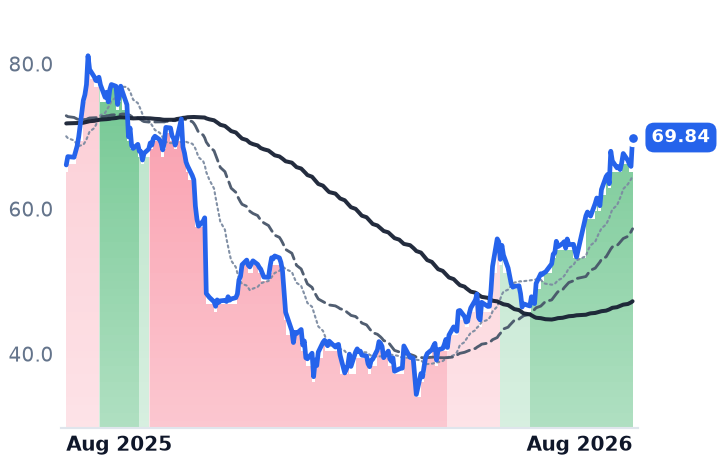
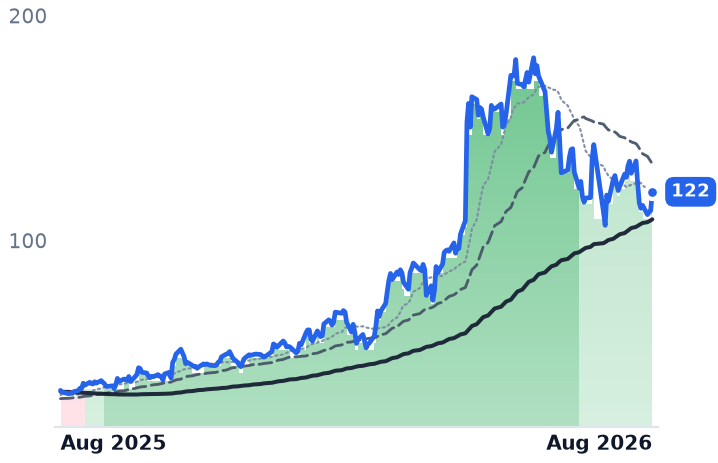
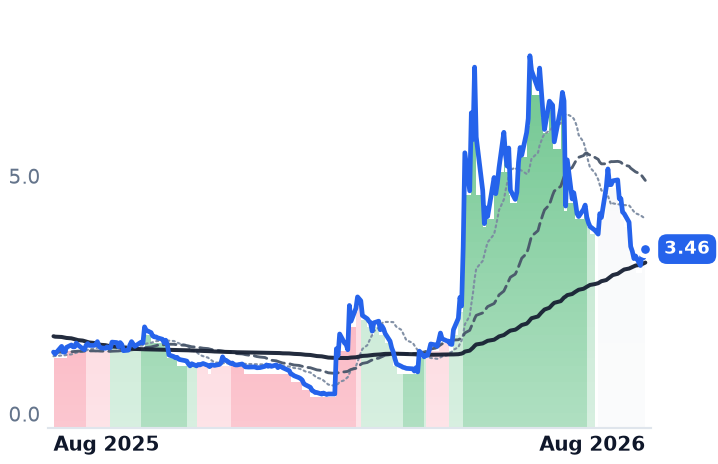
12-month price & trend
| Ticker | Mkt cap | P/E | P/E fwd | P/S | P/S fwd | P/GP | P/GP fwd | EV/EBITDA | FCF yld |
|---|---|---|---|---|---|---|---|---|---|
NTNX | $18.9B | 12.5x | 31.7x | 6.6x | 5.9x | 7.6x | 6.8x | 49.0x | 4.5% |
DOCN | $13.4B | 45.6x | 79.1x | 13.3x | 11.4x | 23.2x | 20.0x | 37.9x | 0.1% |
RXT | $850.6M | n/m | — | 0.3x | 0.3x | 2.3x | 2.5x | 13.8x | 4.8% |
Consensus projections
| Ticker | FY2026E | FY2027E | FY2028E | |
|---|---|---|---|---|
NTNX | Revenue | +12.2% | +13.0% | +12.7% |
| EPS | +11.0% | +14.3% | +16.8% | |
DOCN | Revenue | +31.2% | +53.5% | +43.7% |
| EPS | −29.0% | +23.2% | +60.4% | |
RXT | Revenue | −6.4% | +4.8% | +11.5% |
| EPS | +30.3% | −150.4% | +256.9% |
Forward fiscal years only. Blank means no analyst coverage for that year.
Nutanix closed its fiscal year on 31 July with 32,360 customers running its enterprise cloud platform — the hypervisor, software-defined storage and Kubernetes stack that lets a company run virtual machines on hardware it owns — and more than 3,000 of them were added during the year. Chief executive Rajiv Ramaswami told The Register in a briefing on the fourth-quarter results that most chose Nutanix as an alternative to VMware, and that the migrations have another five years to run.
That claim is the entire investment case, and it is unusually hard to audit, because Nutanix stopped disclosing ACV Billings with its first quarter of fiscal 2025. Billings is where a software company can flatter itself by signing longer contracts; without it, the test of whether Broadcom's post-acquisition repricing of VMware licences is converting into new customers paying new money has to be run on three substitutes — recurring revenue, contracted backlog and average contract duration.
The duration test
Remaining performance obligations — signed business not yet recognized as revenue — reached about $3.44bn at 31 July against roughly $2.69bn a year earlier, growth near 28%. Full-year revenue grew 12.4%, to $2.854bn. Backlog expanding at more than twice the rate of revenue is exactly the pattern a duration game produces, so duration is the thing to check: it came in at 3.3 years, a tenth of a year longer than in fiscal 2025, and down from 3.4 years in the third quarter. Three points of the twenty-eight, roughly. The rest is volume.
Annual recurring revenue, which is duration-neutral by construction because it divides each contract's value by its term, ended the year at $2.549bn, up 16% — 3.6 points ahead of revenue growth, and one point slower than the prior year.
The wins arrive at a steady clip
The new-logo cadence through fiscal 2026 was about 640, then 710, then over 700, then 650. Ramaswami has said Nutanix adds roughly 500 to 1,000 customers a quarter with nearly all coming from VMware. Against a stated target of some 165,000 accounts in Broadcom's installed base, a flat 650-a-quarter clip is a long war rather than a rout — and it is why the headline growth rates keep easing.
The box costs more than the software
The constraint is no longer competitive. AI hardware demand has pushed memory prices up by as much as 70% this year, raising server prices and stretching delivery times; Nutanix licenses software, but the customer must buy the machine. Chief financial officer Rukmini Sivaraman told investors the fiscal 2027 outlook assumes those conditions persist all year, and that a moderately higher share of orders will carry future licence start dates as customers wait for servers — bookings that sit in backlog instead of converting, per the fourth-quarter call. The company's answer is to sever migration from a hardware refresh: expanded support for storage arrays from Dell, Pure Storage, NetApp and Lenovo lets a customer adopt the stack on equipment already owned, and management credited external-storage deals with several seven-figure wins in the quarter. NetApp named the Nutanix platform in its own May results deck as a planned integration.
The July quarter itself was the best of the year: revenue of $757.1m, up 15.9% against 10.0% in the third quarter, GAAP operating income of $70.0m, up 124%, and free cash flow of $277.6m against $207.8m. Gross margin slipped about a point, to 86%. Three weeks before that print, on 4 August, Nutanix cut 5% of its workforce, roughly 400 jobs.
What the price already pays for
Fiscal 2027 is guided to $3.18–3.23bn, about 12% growth, with free cash flow of $850–950m against $841m delivered. The shares rose 6.1% on 27 August on 8.0m shares, roughly triple normal volume, and now sit at 7.62x trailing gross profit against 4.68x in early May — a re-rating of some 63% on a business guiding to slower growth.
The trailing price-to-earnings of 12.5x should be ignored: it rests on a one-time $1.2bn release of a valuation allowance on US deferred tax assets. Excluding it, fiscal 2026 earnings were $1.04 a share, near 67x. Forward earnings are 31.7x. Only cash looks undemanding — the guided free cash flow implies close to a 4.8% yield on a market value of $18.9bn.
Among the neighbours, DigitalOcean, which rents compute to developers and small businesses, is growing at 28.6% and accelerating, but its gross margin has fallen every quarter from 61.4% to 55.0% and it trades at 11.43x forward sales — twice Nutanix's growth at nearly double the multiple. Rackspace, which manages other people's clouds rather than licensing a platform, printed flat revenue of $666.3m at a 19.4% gross margin, carries roughly $2.8bn of debt against a stockholders' deficit, and trades at 0.31x sales. Neither is a hypervisor vendor; both mark the ends of the range Nutanix sits between.
So the displacement is real and the money is new — backlog grew on customer count, not on contract length, and the July quarter's operating leverage was genuine. What the business does not yet explain is the second half of the move. A 63% re-rating since May prices a company compounding faster this year than last, and Nutanix guided the opposite. The swing factor is no longer whether VMware customers want to leave; it is when their servers arrive.
Ramaswami says the migrations have five more years in them. The binding constraint on that arithmetic has quietly changed hands — from Broadcom's price list to the memory market's.