

Okta's Finance Chief Called Agent Revenue 'Still Immaterial' as Bookings Grew 14%
Hypothesis Opus 5 · Research Opus 5 · Writing Opus 5 · Prompt v1.6
Okta's July quarter was supposed to settle whether AI agents are being billed yet. It didn't: no agent revenue, no agent count, no attach rate, and chief financial officer Brett Tighe told investors on the 26 August call that the contribution will not be material in fiscal 2027.
What did improve is broad rather than agentic. Contracted revenue due within a year grew 14% to $2.585bn while total revenue grew 10.6%, and the expansion came from the largest accounts — customers paying more than $1m a year rose 22%. Guidance for that same bookings measure steps back to 11–12% next quarter.
SailPoint rose about 12% the same session on no disclosure of its own. Its last reported numbers date from June, and it reports again on 9 September.
| Ticker | Company | Segment | Trend · 13mo | 30D | 1Y |
|---|---|---|---|---|---|
| The subject · what this brief is about | |||||
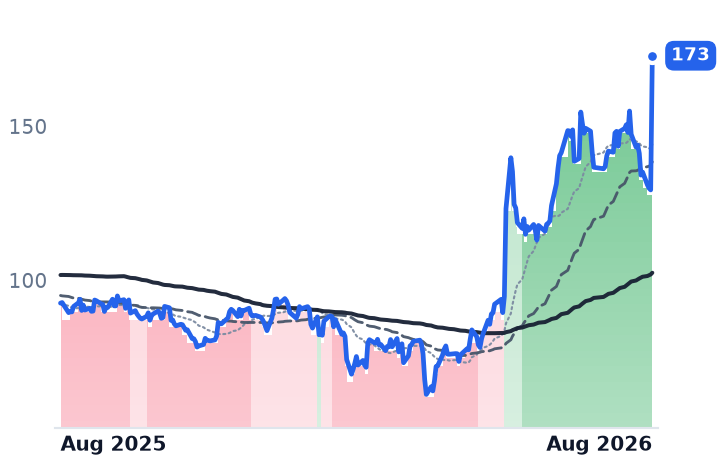
OKTA | Okta | Identity & Access Management | 🌱 Emerging Bull | +26.3% | +86.7% |
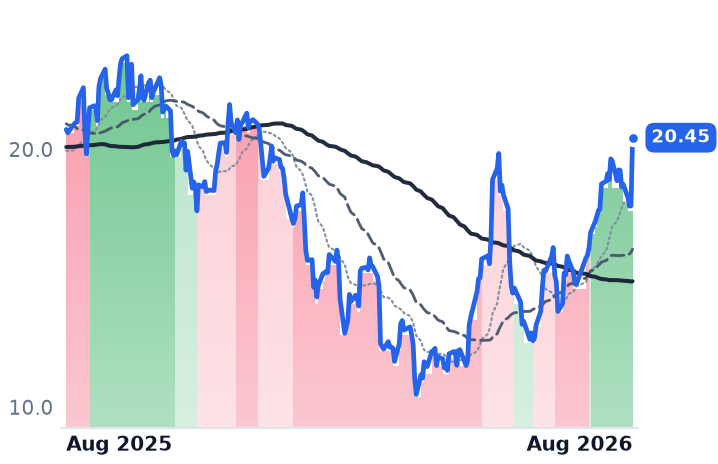
SAIL | SailPoint | Identity & Access Management | 🔴 Cont. Bear | +28.7% | −1.5% |
| Compared against · context, not the story | |||||
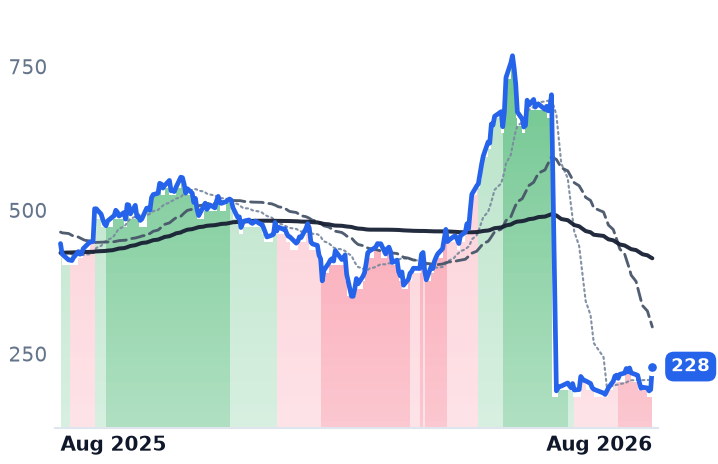
CRWD | CrowdStrike | Cybersecurity & Threat Protection | ⚠️ Emerging Bear | +27.1% | −48.4% |
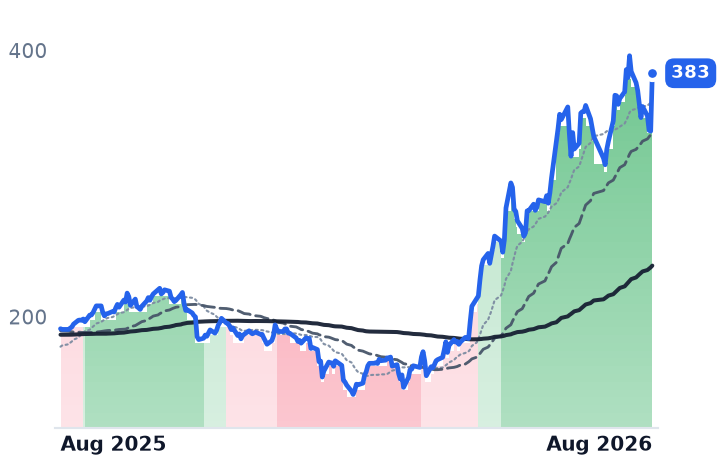
PANW | Palo Alto Networks | Cybersecurity & Threat Protection | 🌱 Emerging Bull | +21.9% | +100.4% |
MSFT | Microsoft | Cloud Infrastructure & Platforms | 🔴 Cont. Bear | +27.7% | −1.7% |
12-month price & trend
| Ticker | Mkt cap | P/E | P/E fwd | P/S | P/S fwd | P/GP | P/GP fwd | EV/EBITDA | FCF yld |
|---|---|---|---|---|---|---|---|---|---|
OKTA | $28.7B | 102.3x | 45.0x | 9.3x | 9.0x | 12.0x | 11.5x | 71.1x | 3.4% |
SAIL | $11.6B | n/m | — | 10.3x | — | 15.6x | — | 890.2x | 1.6% |
CRWD | $232.1B | — | 185.2x | 43.0x | 39.0x | 57.2x | 51.9x | 667.4x | 0.7% |
| Ticker | Mkt cap | P/E | P/E fwd | P/S | P/S fwd | P/GP | P/GP fwd | EV/EBITDA | FCF yld |
|---|---|---|---|---|---|---|---|---|---|
PANW | $312.0B | 321.7x | 93.2x | 29.4x | 22.6x | 40.9x | 31.4x | 136.8x | 1.4% |
MSFT | $3.7T | 27.5x | 25.2x | 11.1x | 9.4x | 16.3x | 13.9x | 18.2x | 1.8% |
Consensus projections
| Ticker | FY2026E | FY2027E | FY2028E | |
|---|---|---|---|---|
OKTA | Revenue | +12.0% | +10.0% | +9.5% |
| EPS | +24.3% | +11.7% | +10.9% | |
CRWD | Revenue | +22.2% | +23.7% | +21.9% |
| EPS | −1.2% | +32.6% | +26.5% | |
PANW | Revenue | +24.3% | +21.2% | +14.2% |
| EPS | +15.3% | +8.9% | +17.6% | |
MSFT | Revenue | +18.0% | +18.2% | +19.6% |
| EPS | +26.7% | +15.4% | +18.5% |
Forward fiscal years only. Blank means no analyst coverage for that year.
Okta, which sells the identity software enterprises use to log their staff into applications — single sign-on, directory, multi-factor authentication, plus the acquired Auth0 developer portfolio — reported its July quarter after the close on 26 August. It was the print the whole August rally in the shares had been pointing at, and it arrived with a genuine bookings beat and not a single quantified figure for machine or agent identity. Current remaining performance obligations, the contracted revenue Okta expects to recognize within a year, grew 14% to $2.585bn against total revenue growth of 10.6%.
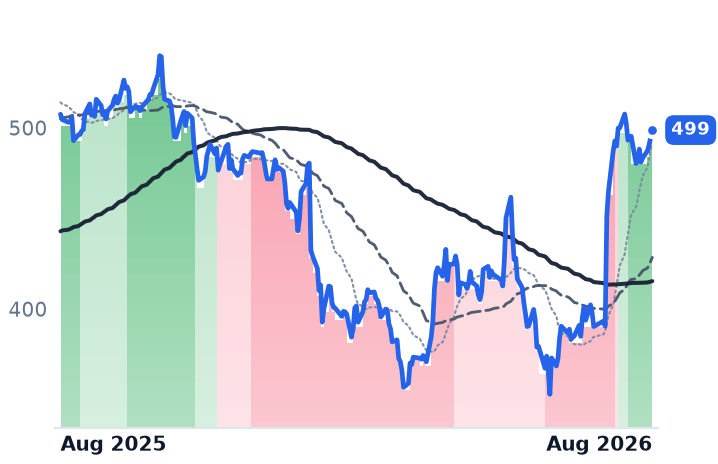
That gap matters because of what the price now embeds. Okta closed 27 August at $172.91, roughly 175% above its 10 April low of $62.93, and it fetches 11.96 times trailing gross profit against 5.97 times on 3 May, while trailing gross-profit dollars grew about 6% over that stretch. At 45 times forward earnings, the shares are priced against consensus revenue growth of 10.0% this fiscal year, 9.5% next and 10.3% after that — no re-acceleration modeled anywhere.
Where the bookings actually came from
Management quantified the new-product portfolio, not the agent one: identity governance, privileged access and identity threat protection together made up 30% of second-quarter bookings and lifted average deal value by roughly 40%. Customers above $1m of annual contract value grew 22% year on year to more than 600, while those paying more than $100,000 a year grew only 6% to 5,255. This is a large-enterprise expansion story. Okta also won Department of Defense Impact Level 5 authorization, the highest unclassified defense cloud clearance, and the public sector — under a tenth of revenue — supplied the quarter's biggest deal.
On agents, the disclosure was verbal. "Still immaterial. Still very small. We're very early innings… for FY '27, we don't think it's going to be material," Tighe said on the call, adding that fiscal 2028 and beyond hold "a real possibility for this to be material." Chief executive Todd McKinnon was warmer — "In the fullness of time, it could be the biggest category of cyber" — and described one customer whose Claude agent instances multiplied roughly thirtyfold within weeks of an evaluation starting. The plumbing is being laid: Agent single sign-on now ships inside the core product with a consumption cap built in but not enforced, the Cross-App Access protocol went generally available with Anthropic, and the Permiso acquisition, closed the same day, adds about 400 post-authentication risk detections to Okta's roughly 90. None of it carries a disclosed revenue line.
Margins improved; the growth rate didn't
Subscription revenue rose 12% to $793m and net retention held at 107%, a point better than a year ago but unchanged sequentially. Non-GAAP subscription gross margin edged up two-tenths of a point to 83.9%, so governance and Auth0 mix is not diluting profitability. Free cash flow was $227m, a 28% margin. But the non-GAAP operating margin of 28.2% improved just half a point — the seven-point jump in the reported operating margin is largely stock compensation and amortization rolling off. And third-quarter bookings guidance of $2.59–2.60bn implies 11–12% growth, below the 14% just printed.
The shares rose about 29% on 27 August, inside the broad security session the day already carried, and the price targets raised afterward by Morgan Stanley, BMO, Jefferies and others top out near $180 — some 4% above the close.
SailPoint moved on Okta's numbers
SailPoint, the identity-governance specialist whose franchise overlaps Okta's governance push directly, gained about 12% the same session having disclosed nothing. Its last operating figures are from 9 June: annual recurring revenue of $1.163bn, up 26% as of 30 April, on a quarter that still ran a $79.8m operating loss. It reports fiscal second-quarter results before the open on 9 September. Because the two run very different gross margins — 79.6% at Okta, 64.7% at SailPoint — gross profit is the comparable denominator, and on it SailPoint is the more expensive at 15.58 times, growing roughly twice as fast.
The verdict
The quarter Okta delivered is real and it is not the quarter the price is discounting. Faster bookings, wider margins, raised guidance and a debt-free balance sheet with $2.3bn of cash justify a business re-rating off April's distressed level. What nothing in the disclosure supports is the leap from roughly five times gross profit to twelve on an unchanged 10% grower whose finance chief just dated agent monetization to next fiscal year at the earliest and whose own bookings guidance steps down. Okta's structural argument — neutrality against Microsoft's bundled Entra ID, with McKinnon saying "I think Microsoft is copying us" — is a five-year argument being paid for in one quarter's session.
One customer's Claude agents multiplied thirtyfold in a few weeks, McKinnon said. Not one of them has yet turned up in a number Okta is willing to print.