

AWS Supplied 77% of Amazon's Operating Profit Growth and Still Grew Slower Than Azure
Hypothesis Opus 5 · Research Opus 5 · Writing Opus 5 · Prompt v1.6
Amazon's June quarter answered a question the market had been pricing on faith: whether AI capital spending is producing cloud profit yet. It is. AWS operating income reached $16.6bn against $10.2bn a year earlier on segment revenue of $42.2bn, a fifth consecutive quarter of accelerating growth, and segment margin hit 39% — even though Amazon shortened the useful life of some servers from six years to five in 2025, a roughly $0.7bn drag on operating income.
What the quarter does not settle is competitive standing. AWS grew slower than Microsoft's Azure and far slower than Google Cloud on the identical three months, and its $496bn backlog is now smaller than Alphabet's cloud backlog despite AWS booking roughly 1.7 times Google Cloud's revenue. Trailing free cash flow has turned negative as $220bn of 2026 capital spending lands ahead of the depreciation line.
| Ticker | Company | Segment | Trend · 13mo | 30D | 1Y |
|---|---|---|---|---|---|
| The subject · what this brief is about | |||||
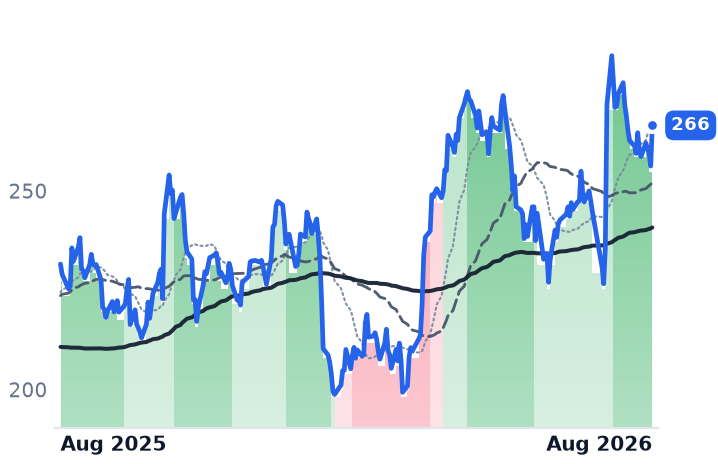
AMZN | Amazon.com | Online Marketplaces | 🟢 Cont. Bull | +17.6% | +15.1% |
| Compared against · context, not the story | |||||
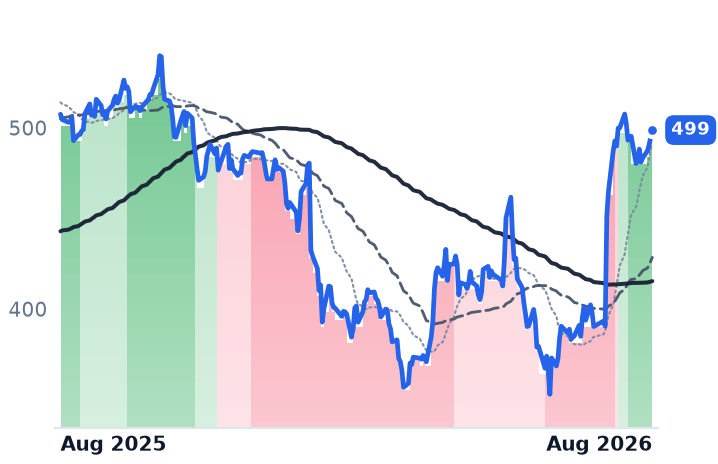
MSFT | Microsoft | Cloud Infrastructure & Platforms | 🔴 Cont. Bear | +27.7% | −1.7% |
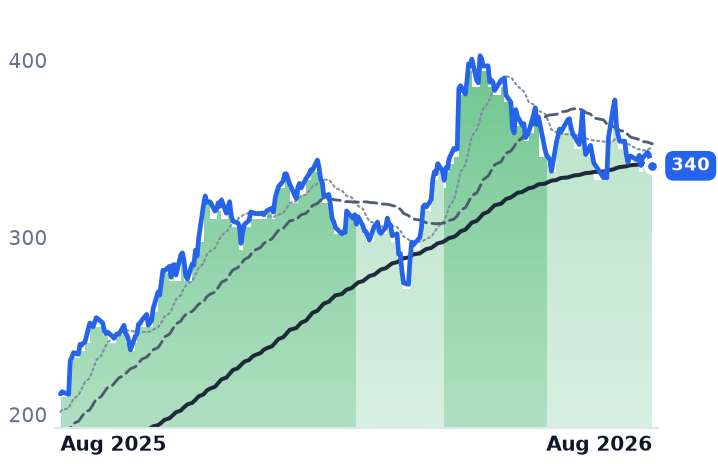
GOOGL | Alphabet | Search & Advertising | 🟢 Cont. Bull | +1.1% | +60.9% |
12-month price & trend
| Ticker | Mkt cap | P/E | P/E fwd | P/S | P/S fwd | P/GP | P/GP fwd | EV/EBITDA | FCF yld |
|---|---|---|---|---|---|---|---|---|---|
AMZN | $2.9T | 21.2x | 21.1x | 3.7x | 3.5x | 7.3x | 6.8x | 11.9x | -0.4% |
MSFT | $3.8T | 28.6x | 26.1x | 11.5x | 9.8x | 17.0x | 14.4x | 19.0x | 1.7% |
GOOGL | $4.2T | 17.3x | 17.0x | 9.5x | 8.5x | 15.6x | 13.9x | 13.1x | 1.3% |
Consensus projections
| Ticker | FY2026E | FY2027E | FY2028E | |
|---|---|---|---|---|
AMZN | Revenue | +15.9% | +14.6% | +16.0% |
| EPS | +76.8% | −16.1% | +30.8% | |
MSFT | Revenue | +18.0% | +18.6% | +19.5% |
| EPS | +26.7% | +16.0% | +19.0% | |
GOOGL | Revenue | +24.3% | +22.9% | +19.1% |
| EPS | +93.4% | −26.6% | +18.2% |
Forward fiscal years only. Blank means no analyst coverage for that year.
Amazon's cloud division supplied roughly three-quarters of the additional operating profit the company earned in the June quarter. AWS operating income rose to $16.6bn from $10.2bn a year earlier — about $6.4bn of the $8.29bn increase in consolidated operating income, against $1.6bn from North America and $0.2bn from International.
That decomposition matters because the case for Amazon's shares this year has rested on an untested premise: that hyperscale AI spending would eventually appear as segment profit rather than as depreciation. In this quarter it did. The unresolved half is that the spending is still accelerating faster than the profit — Amazon raised 2026 cash capital expenditure guidance to about $220bn from about $200bn, blaming memory-chip cost inflation, and trailing free cash flow has turned negative by roughly $7.6bn even as operating cash flow grew 33%.
The cloud line, by itself
AWS revenue of $42.2bn grew 36.7%, the fifth straight quarter of acceleration and the fastest in eighteen quarters, taking the annualized run rate to $169bn. The sequential addition of more than $4.6bn was roughly 80% larger than any previous quarterly increase in AWS history. Segment margin reached 39%; management put the underlying expansion at 520 basis points excluding a one-time derivative gain, which is the figure that describes the business.
Amazon also disclosed what the hypothesis assumed it hid: an AWS artificial-intelligence revenue run rate above $25bn growing at triple-digit rates, and a chips business spanning Trainium and Graviton at a similar scale. Chief executive Andy Jassy told investors on the July 30 call that customers want the silicon on its own: "We do have an increasing number of customers who are interested in us providing the Trainium chips to them, separate from our cloud, and we're actively having those conversations and exploring, and I expect there's a real chance we'll do that in the future," he said. Management said AWS will not have enough capacity to meet 2026 demand, expects the same in 2027, and has already committed significant 2028 capacity. Anthropic and Amazon have agreed to expand to as much as 5 gigawatts of new compute across Trainium generations.
Where the franchise is losing ground
The profit is real; the relative position is not improving. Microsoft's Azure grew 43% on the identical June quarter, passing $100bn of annual revenue, and Google Cloud grew 82% to $24.8bn with segment margin widening from 20.7% to 35.6% — approaching AWS's level from a far smaller base. AWS's backlog of $496bn is now smaller than Alphabet's $514bn cloud backlog, despite AWS booking roughly 1.7 times Google Cloud's quarterly revenue. Alphabet disclosed that just over half of its backlog converts within 24 months; no comparable duration figure for AWS is discoverable, so whether Amazon's number reflects longer contracts cannot be tested.
One suspicion about the earnings quality inverts on inspection. Amazon did not stretch its depreciation schedule to flatter profit: it shortened the estimated useful life of a subset of servers and networking equipment from six years to five, effective January 1, 2025, citing the pace of AI development, at an expected cost of about $0.7bn to 2025 operating income plus roughly $0.6bn from early retirements. The margin expansion came through that, not around it. Net income of $62.6bn is a different matter — it includes $53.4bn of non-operating income, largely a mark-to-market gain on the Anthropic stake, and describes nothing about operations.
What the shares have paid for it
The stock is up 26.9% over 180 days, but the last month's gain was earned in two sessions: a 15.32% move on July 31, the largest in the name in at least a year, following the July 30 release. Shares peaked at $284.02 on August 3 and have given back 6.2% since, a retreat market coverage attributes to capital-spending anxiety rather than any AWS deterioration, alongside a New Jersey attorney general suit filed August 4 and a Jeff Bezos filing to sell more than $4bn of stock.
Against that, the price per dollar of Amazon's annual gross profit — what a share costs relative to trailing gross profit — has fallen to 7.28x from 7.75x in early May, even as market value rose to about $2.87tn. Trailing enterprise value to earnings before interest, taxes, depreciation and amortization of 11.9x sits below Alphabet's 13.1x and Microsoft's 19.0x. The headline 21.2x trailing earnings is an artifact of the Anthropic mark; consensus FY2027 earnings of $10.61 a share, which assumes it does not repeat, implies about 25x.
So the re-rating is paid for. The business earned the move: accelerating revenue, expanding margin, and the majority of incremental profit coming from the segment the story is about. What nothing in the quarter settles is share — AWS is compounding profit while growing slower than both rivals and carrying a smaller order book than one of them.
The next test is arithmetic, not narrative. Amazon guided September-quarter operating income to $22.5bn–$26.5bn, below the June quarter, with a Prime Day timing shift blamed for most of the apparent slowdown. Capacity Jassy says he cannot build fast enough eventually becomes depreciation whether or not the demand shows up.