

Bharat Heavy Electricals Swung Its Power Segment to Profit on Coal, Not Gas Turbines
Hypothesis Opus 5 · Research Opus 5 · Writing Opus 5 · Prompt v1.6
India's incumbent heavy power-equipment maker is filed by many investors alongside the gas-turbine challengers. Its own accounts say the recovery is coal: the power division — boilers, steam-turbine islands, hydro — turned a ₹510 crore quarterly loss into ₹563 crore of profit before interest and tax, and about ₹59,000 crore of last year's ₹75,916 crore of orders was power work dominated by supercritical coal.
The business is genuinely converting: FY26 revenue rose 23.5% and net income tripled to ₹1,600 crore, while working capital fell to 164 days from 241. The price has gone further. At 45.5x forward earnings with a negative trailing free-cash-flow yield, consensus needs profit to double this year and again next. Hindustan Aeronautics' smaller advance, by contrast, tracked its earnings.
| Ticker | Company | Segment | Trend · 13mo | 30D | 1Y |
|---|---|---|---|---|---|
| The subject · what this brief is about | |||||
BHEL.NS | Bharat Heavy Electricals | Industrial - Machinery | 🟢 Cont. Bull | — | — |
HAL.NS | Hindustan Aeronautics | Aerospace & Defense | 🌱 Emerging Bull | — | — |
| Compared against · context, not the story | |||||
GEV | GE Vernova | GE Vernova Integrated | 🟢 Cont. Bull | +1.3% | +44.2% |
ENR.DE | Siemens Energy | Industrial - Machinery | ⚠️ Emerging Bear | — | — |
7011.T | Mitsubishi Heavy Industries | Industrial - Machinery | ⚠️ Emerging Bear | +7.6% | +6.5% |
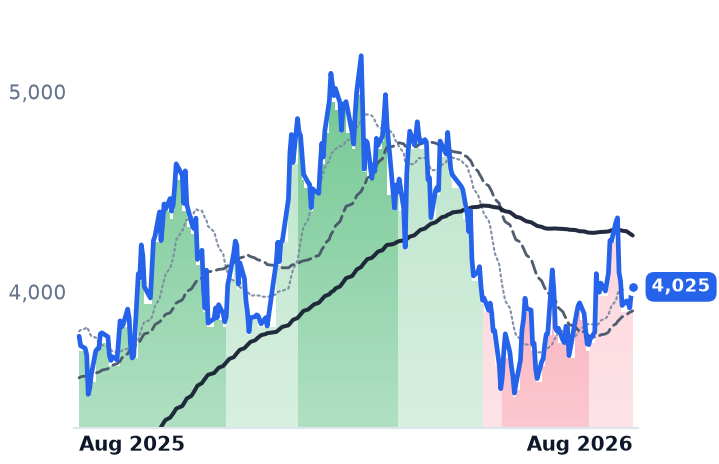
12-month price & trend
| Ticker | Mkt cap | P/E | P/E fwd | P/S | P/S fwd | P/GP | P/GP fwd | EV/EBITDA | FCF yld |
|---|---|---|---|---|---|---|---|---|---|
BHEL.NS | $1.5T | 61.6x | 45.5x | 4.2x | 3.5x | 18.8x | 15.6x | 35.1x | -0.9% |
HAL.NS | $3.3T | 34.9x | 32.7x | 9.6x | 8.6x | 25.7x | 23.1x | 21.7x | 2.0% |
GEV | $242.9B | 25.9x | 29.7x | 5.9x | 5.2x | 29.0x | 26.0x | 27.0x | 5.1% |
| Ticker | Mkt cap | P/E | P/E fwd | P/S | P/S fwd | P/GP | P/GP fwd | EV/EBITDA | FCF yld |
|---|---|---|---|---|---|---|---|---|---|
ENR.DE | $128.0B | 47.5x | 33.6x | 3.1x | 2.9x | 14.7x | 14.0x | 21.2x | 6.0% |
7011.T | $13.5T | 33.9x | 31.3x | 2.7x | 2.4x | 12.3x | 11.0x | 18.2x | 7.1% |
Consensus projections
| Ticker | FY2026E | FY2027E | FY2028E | |
|---|---|---|---|---|
BHEL.NS | Revenue | +10.8% | +28.8% | +21.5% |
| EPS | +53.3% | +156.4% | +42.2% | |
HAL.NS | Revenue | +4.4% | +12.9% | +19.4% |
| EPS | +20.1% | +13.0% | +15.6% | |
GEV | Revenue | +23.9% | +14.8% | +15.0% |
| EPS | +321.7% | −19.5% | +40.7% | |
ENR.DE | Revenue | +13.1% | +14.3% | +12.7% |
| EPS | +173.1% | +40.2% | +29.7% | |
7011.T | Revenue | −2.5% | +13.6% | +8.1% |
| EPS | +5.1% | +52.4% | +16.9% |
Forward fiscal years only. Blank means no analyst coverage for that year.
Bharat Heavy Electricals' power division — coal boilers, steam-turbine islands and hydro packages — earned ₹562.81 crore before interest and tax in the June quarter, against a loss of ₹510 crore in the same quarter a year earlier. Power revenue rose 51.8% to ₹5,919.50 crore, and the group as a whole swung to a consolidated net profit of ₹376.71 crore from a ₹455.50 crore loss, Business Standard reported.
What produced that swing is a coal cycle, not a gas one. BHEL closed the March year with an order book of roughly ₹2.4 lakh crore — about $27bn, and more than seven times FY26 revenue — split 81% Power, 18% Industry and 1% Export, after ₹75,916 crore of inflows during the year. Roughly ₹59,000 crore of that intake was power work, dominated by supercritical coal boiler-turbine-generator packages: 3x800 MW at Telangana Stage-II, 2x800 MW for Adani at Raipur, 1x800 MW for DVC at Durgapur, 2x660 MW for NTPC at Talcher. India's power ministry has planned an additional 97 GW of coal and lignite capacity, taking thermal installed capacity to 307 GW by 2034-35. The binding question for the equity is no longer order intake. It is conversion.
The licensee
BHEL's heavy-duty gas capability is borrowed. It builds advanced-class frames under a technical assistance and licence agreement with GE dating to 1986, and its most defensible gas asset is aftermarket service on more than 190 installed machines through BGGTS, its joint venture with GE running since 1997. The disclosed frame wins are historical and modest: the largest, a 726.6 MW combined-cycle plant for ONGC Tripura Power, was worth about ₹2,200 crore. Against a ₹2.4 lakh crore book that is a rounding error, and no sizeable new combined-cycle or data-center award was discoverable this year. The gas supercycle that has occupied this page — GE Vernova's $176bn backlog, Siemens Energy's 14.2% quarterly margin — passes BHEL by.
Conversion is working; cash has not arrived
The execution evidence is good. FY26 revenue rose 23.5% to ₹33,782 crore, net income tripled to ₹1,600 crore from ₹534 crore, and operating margin doubled to 6.0% from 3.0%. Net working capital fell to 164 days from 241, which sell-side coverage paired with warnings on valuation, execution capacity and whether the margin gain holds. One line is going the other way: the Industry segment grew revenue 12% in the June quarter while its segment result fell 20.9% to ₹242.61 crore.
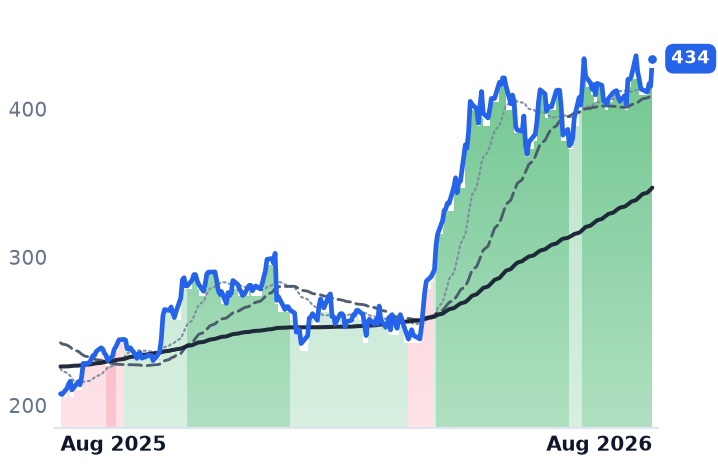
The shares have more than doubled over twelve months and are up 63.8% in six. They trade at 61.6x trailing and 45.5x forward earnings and 35.1x trailing EV/EBITDA, on a trailing free-cash-flow yield of minus 0.94% — reported profit has not yet become cash. Consensus makes the arithmetic explicit: net income near ₹3,291 crore in FY27 and ₹4,679 crore in FY28, earnings per share going from ₹4.60 to ₹13.45 in two years.
The contrast next door
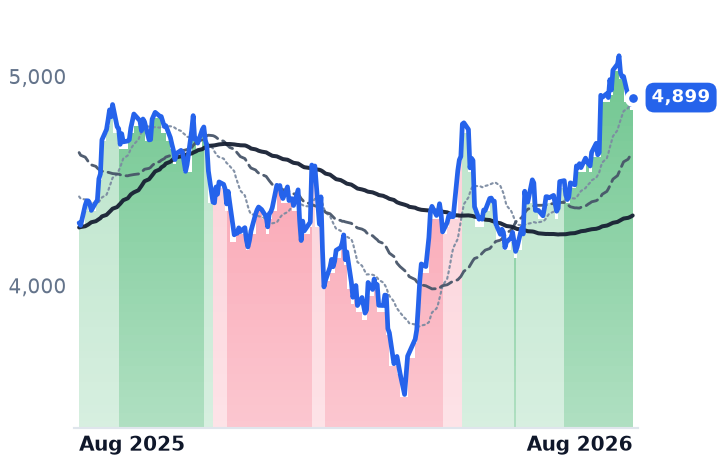
Hindustan Aeronautics, India's sole-source military airframe integrator, rose 25.2% over the same six months on a constraint that is physical rather than financial: only about six of 99 contracted GE F404 engines had arrived against 30 Tejas Mk1A airframes built, flown and tested but undeliverable, until the first jet was handed to the Air Force this month. Management has guided to 10-12% revenue growth in FY27. At ₹4,899.00 against FY26 earnings of ₹136.30 a share it trades near 36x — about where it traded a year ago. That advance was earnings.
BHEL's was not. The direction of the business is real and coal-driven, and the working-capital improvement falsifies the standard complaint that its backlog growth is being eaten by receivables. What the June quarter does not underwrite is a price that already assumes several years of flawless execution on fixed-price legacy contracts, at a company whose gross margin last year was 11.9%. Two-thirds of the equity story rests on profits nobody has yet booked.
The boilers now in BHEL's order book will burn coal into the 2040s. Whether the ₹2.4 lakh crore behind them turns into cash is a question the next four quarters answer, and the price has already voted.