

Elastic's Under-Contract Cloud Business Grew 27%. Its Self-Serve Cloud Was Flat.
Hypothesis Opus 5 · Research Opus 5 · Writing Opus 5 · Prompt v1.6
Elastic's cloud line is really two businesses, and only one of them is growing. Committed annual-contract cloud revenue ran roughly twelve points ahead of total company revenue in the July quarter, while the monthly self-serve tier that serves smaller customers added nothing at all.
The committed side shows up in the backlog: revenue under contract and expected within a year rose 21%, against reported revenue growth of 15.1%. Customers paying more than $100,000 a year crossed 1,800 after a record 80 net additions. What is absent is a dollar figure for artificial intelligence work — management quantified it only as a customer count, more than 670.
Serving that demand costs something: gross margin fell to 74.5% from 76.7% a year earlier. The business earns much of the move; the re-rating has run ahead of a growth rate that has not changed.
| Ticker | Company | Segment | Trend · 13mo | 30D | 1Y |
|---|---|---|---|---|---|
| The subject · what this brief is about | |||||
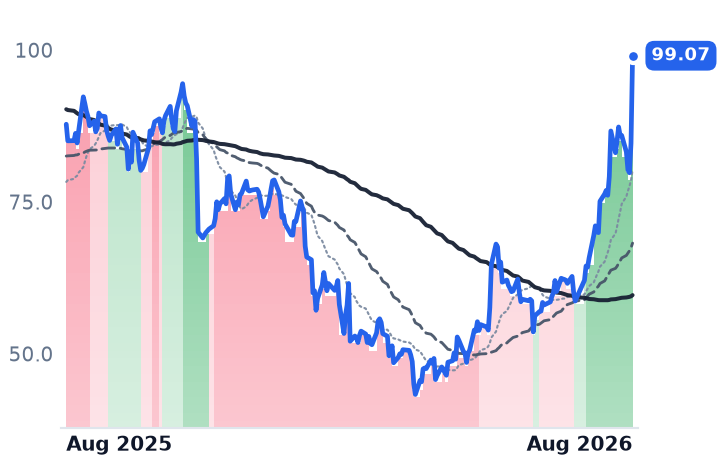
ESTC | Elastic | Data & Analytics Platforms | 🌱 Emerging Bull | +53.7% | +12.8% |
| Compared against · context, not the story | |||||
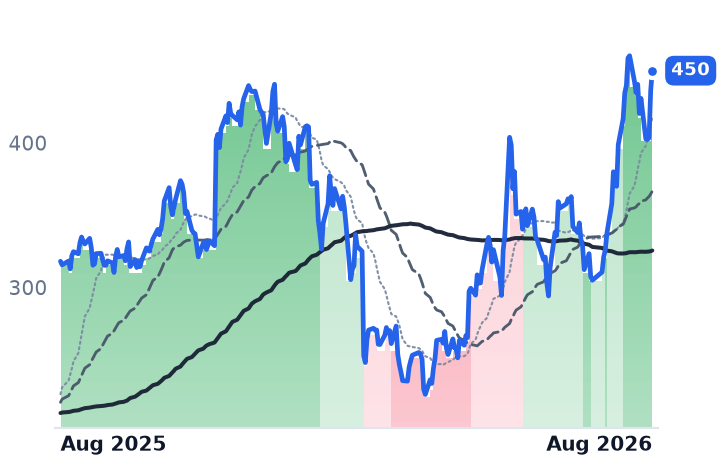
MDB | MongoDB | Data Management & Analytics | 🟢 Cont. Bull | +40.1% | +41.5% |
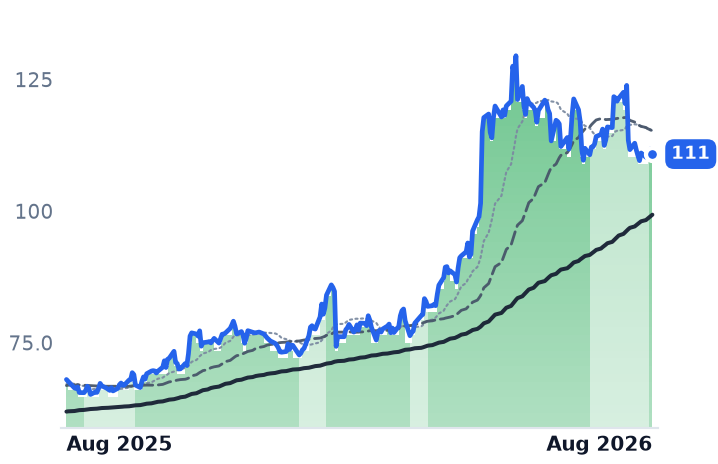
CSCO | Cisco Systems | Enterprise Networking Infrastructure | 🟢 Cont. Bull | −1.5% | +62.9% |
12-month price & trend
| Ticker | Mkt cap | P/E | P/E fwd | P/S | P/S fwd | P/GP | P/GP fwd | EV/EBITDA | FCF yld |
|---|---|---|---|---|---|---|---|---|---|
ESTC | $10.3B | 27.5x | 30.7x | 5.7x | 5.2x | 7.6x | 6.9x | 158.5x | 3.4% |
MDB | $34.7B | n/m | 70.4x | 13.3x | 11.7x | 18.5x | 16.2x | — | 1.7% |
CSCO | $442.9B | 33.4x | 21.9x | 7.0x | 6.1x | 10.8x | 9.4x | 23.2x | 3.1% |
Consensus projections
| Ticker | FY2026E | FY2027E | FY2028E | |
|---|---|---|---|---|
ESTC | Revenue | +17.6% | +15.0% | +14.5% |
| EPS | +30.3% | +28.2% | +18.8% | |
MDB | Revenue | +23.1% | +21.6% | +18.0% |
| EPS | +59.1% | +27.0% | +19.7% | |
CSCO | Revenue | +11.1% | +16.2% | +7.1% |
| EPS | +12.9% | +19.7% | +9.2% |
Forward fiscal years only. Blank means no analyst coverage for that year.
The quarter split in two
Elastic's fiscal first quarter, reported after the close on 27 August, broke the company's cloud revenue into two lines that behaved nothing alike. Elastic Cloud — the hosted version of the Elasticsearch search-and-analytics engine that enterprises use for logging, security monitoring and, increasingly, as the retrieval layer underneath AI applications — grew 20% to $235.2m. Underneath that blended figure, annual committed-contract cloud revenue grew 27% while monthly self-serve cloud was flat, which management attributed to expected softness among smaller businesses.
The distinction carries the argument. Elastic had re-rated steeply into this print — from 3.85x trailing gross profit in early May to 6.75x on 21 August — on a guide that implied only about 13% growth, and the July quarter is the first new disclosure since. It says the money arriving is contracted rather than opportunistic. Remaining performance obligations expected to convert within a year reached $1.15bn, up 21%, and total obligations $1.9bn, up 27% — both well ahead of the 15.1% revenue growth Elastic reported, at $478.1m. That beat the $470.1m analysts expected and the company's own May guide.
The customers are there; the dollars are not disclosed
Elastic ended July with more than 1,800 customers at $100,000 or more of annual contract value, after adding over 80 net new ones, its largest quarterly addition on record. Those customers now supply 90% of sales-led subscription revenue, up from 87% a year ago.
On artificial intelligence, the only quantity offered is a headcount of customers. "37% of our 100,000-plus ACV customers are now using Elastic for AI, up from approximately 21% a year ago," chief executive Ashutosh Kulkarni told analysts on 27 August. "That is more than 670 high-value customers now using Elastic for AI use cases with 70 net additions quarter-over-quarter in Q1." No revenue figure, no annual recurring revenue number and no attach rate was attached to vector search or agentic retrieval; the monetization stays buried inside consumption.
Something is being consumed, though, and it shows up as cost. Gross margin fell to 74.5% from 76.7%, so gross profit grew 11.8% while revenue grew 15.1% — the arithmetic of serverless capacity and inference cost of service. Net expansion slipped to 111% from 112%. The operating loss narrowed to $3.65m from $9.44m, non-GAAP operating margin reached 16.2% despite $13m of restructuring charges, and $40m of buybacks took the diluted share count down about 1.2% year on year.
The raised full-year guide of $1.998–2.010bn implies second-half growth near 15.4% — marginally faster than the quarter just delivered, so no deceleration is embedded. Chief financial officer Navam Welihinda told investors on the call that "the sustained progress we see in CRPO, sales productivity pipeline and operating leverage reinforce our confidence in our revenue growth and margin expansion plans."
Reallocated budget, not new budget
Whether this is fresh spending or somebody else's is testable. Cisco, which owns the Splunk log-analytics and security-information franchise Elastic displaces, grew its observability product line 6% in its own July quarter while total revenue rose 17.6%; it trades near 21.9x forward earnings. MongoDB, the closest rival for retrieval workloads, grew 25% in its April quarter and trades at 18.50x trailing gross profit against Elastic's 7.60x — a gap that no longer looks like a bargain bin.
Elastic closed 17.0% higher on 28 August, the largest gain of the session in enterprise software, against MongoDB's 3.1% and Snowflake's flat close: an idiosyncratic response to disclosure. Shares are up 72% in three months. Brokers moved after the fact — Stifel to $107, Oppenheimer to $119, RBC to $120 — leaving the close already above the lowest of them.
What the business earns
The committed backlog and the record high-value customer adds earn most of this move: demand for retrieval is being signed, not merely sampled. What the business has not earned is the doubling of its gross-profit multiple since May against a growth rate that consensus still models at roughly 15% next year too. The trailing price-to-earnings figure of 27.5x is no help here — it is an artifact of a $435.9m tax valuation-allowance release booked in April.
So the question has narrowed rather than closed. Elastic has proved the contracts exist; it has not yet proved that AI work is worth more per customer than the search and logging it replaces, and the falling gross margin is the first evidence that it may cost more to serve. The next four quarters, on management's own timetable for net expansion recovering, will settle which.