

Baker Hughes' Service Backlog Passed Its Equipment Backlog, $16.7bn to $15.0bn
Hypothesis Opus 5 · Research Opus 5 · Writing Opus 5 · Prompt v1.6
The middle rung of the gas-turbine market was supposed to be facing a squeeze — short-lead equipment sold at fixed prices into rising casting, alloy and tariff costs. It is not happening, and the reason is scarcity.
Baker Hughes' Industrial & Energy Technology revenue was flat in the June quarter while segment profit rose 16% to $678m, and its contracted turbine-service work now outweighs its equipment backlog. Caterpillar widened its power margin to 24.6% while absorbing $400m of quarterly tariff cost. Both legs of the business are earning.
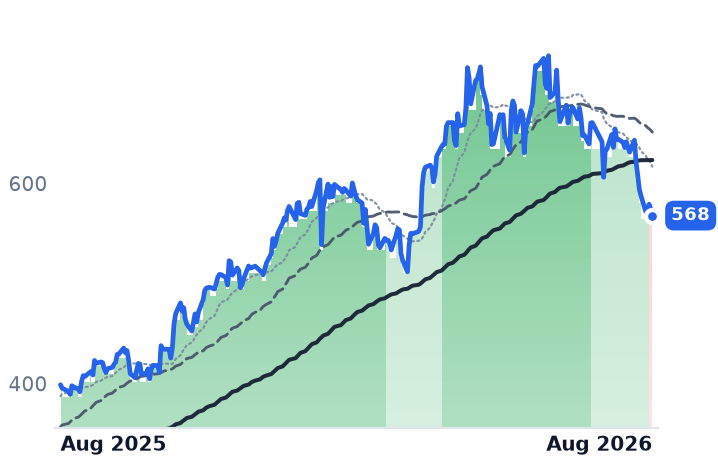
The shares disagree. Caterpillar was cut by Baird in late July over state-level data-center rules, and Baker Hughes has drifted lower for six months, leaving it at roughly two-thirds of Caterpillar's price-to-gross-profit. Sulzer's advance came from margin: its order intake fell.
| Ticker | Company | Segment | Trend · 13mo | 30D | 1Y |
|---|---|---|---|---|---|
| The subject · what this brief is about | |||||
BKR | Baker Hughes | Well Services & Stimulation | 🟢 Cont. Bull | +5.8% | +37.4% |
CAT | Caterpillar | Heavy Construction & Mining | 🟢 Cont. Bull | +3.0% | +86.6% |
SUN.SW | Sulzer | Industrial - Machinery | ⚠️ Emerging Bear | +10.4% | +8.5% |
| Compared against · context, not the story | |||||
GEV | GE Vernova | GE Vernova Integrated | 🟢 Cont. Bull | +1.3% | +44.2% |
CMI | Cummins | Power & Propulsion Systems | 🟢 Cont. Bull | −6.3% | +42.4% |
12-month price & trend
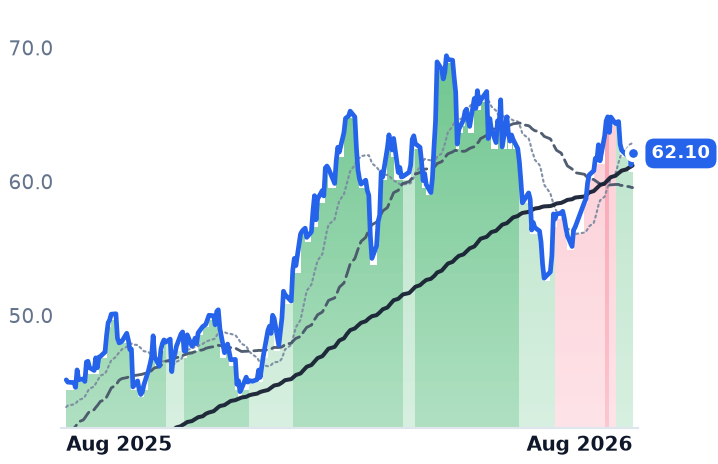
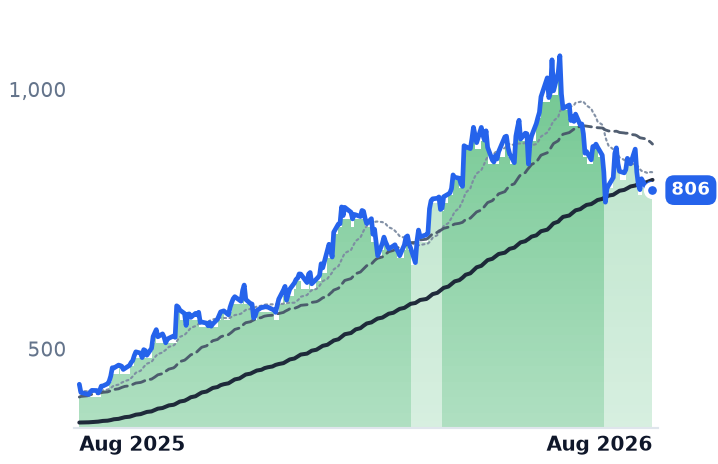
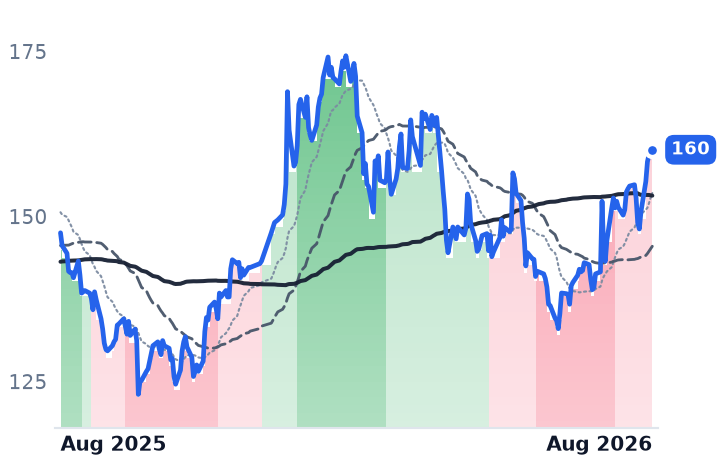
| Ticker | Mkt cap | P/E | P/E fwd | P/S | P/S fwd | P/GP | P/GP fwd | EV/EBITDA | FCF yld |
|---|---|---|---|---|---|---|---|---|---|
BKR | $62.0B | 19.9x | 23.7x | 2.2x | 2.2x | 9.5x | 9.4x | 13.2x | 5.0% |
CAT | $368.6B | 34.3x | 29.4x | 4.9x | 4.6x | 14.6x | 13.7x | 23.4x | 2.4% |
SUN.SW | $5.4B | 17.8x | 16.5x | 1.6x | 1.5x | 4.4x | 4.3x | 10.2x | 3.4% |
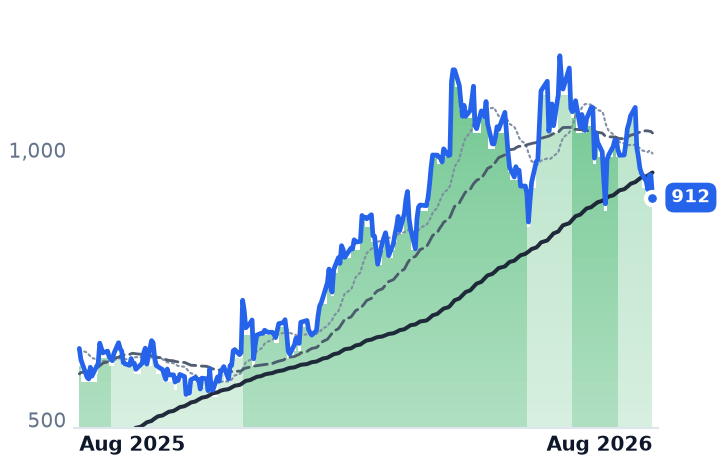
| Ticker | Mkt cap | P/E | P/E fwd | P/S | P/S fwd | P/GP | P/GP fwd | EV/EBITDA | FCF yld |
|---|---|---|---|---|---|---|---|---|---|
GEV | $242.9B | 25.9x | 29.7x | 5.9x | 5.2x | 29.0x | 26.0x | 27.0x | 5.1% |
CMI | $81.1B | 29.9x | 19.9x | 2.3x | 2.2x | 9.2x | 8.5x | 17.4x | 4.2% |
Consensus projections
| Ticker | FY2026E | FY2027E | FY2028E | |
|---|---|---|---|---|
BKR | Revenue | +2.3% | +10.9% | +7.5% |
| EPS | +6.7% | +14.6% | +20.0% | |
CAT | Revenue | +19.8% | +11.1% | +11.0% |
| EPS | +46.0% | +18.8% | +19.6% | |
SUN.SW | Revenue | −0.3% | +4.0% | +4.3% |
| EPS | +10.8% | +11.0% | +8.5% | |
GEV | Revenue | +23.9% | +14.8% | +15.0% |
| EPS | +321.7% | −19.5% | +40.7% | |
CMI | Revenue | +13.1% | +8.9% | +8.0% |
| EPS | +29.6% | +16.9% | +16.9% |
Forward fiscal years only. Blank means no analyst coverage for that year.
Baker Hughes shipped no more equipment and services out of its turbine business in the June quarter than a year earlier, and made a sixth more money doing it. Industrial & Energy Technology revenue was $3.29bn, flat year on year, while segment earnings before interest, tax, depreciation and amortization rose $93m to $678m — attributed in the company's second-quarter release to price, productivity, cost-out and currency, partly offset by lower volume and inflation.
That is the answer to the question hanging over the middle rung of the turbine economy — the aeroderivative units and packaged power islands bought by liquefied natural gas trains, pipelines and, newly, data centers that cannot wait for a heavy-duty frame slot. The worry was that equipment sold at fixed prices into rising casting and alloy costs would be the loss leader, with the profit sitting in the installed-base annuity of parts and overhauls. Baker Hughes' own backlog says both legs are paying. Contracted Gas Technology Services work stood at $16.7bn against $15.0bn for Gas Technology Equipment; the annuity book is now the bigger one. And the equipment leg is not being squeezed, because supply is the binding constraint. Wood Mackenzie expects turbine prices to reach $600 per kilowatt by the end of 2027, up 195% since 2019, and a turbine ordered today on average does not begin operating until 2031.
The order book is running years ahead of the revenue
Baker Hughes' quarterly IET orders doubled to a record $7.1bn, taking remaining performance obligations to $40.1bn with backlog up 19%. Power Systems orders were $2.6bn covering 2.7 gigawatts of generation, of which management put $2.2bn down to data centers; LNG equipment added $1.8bn across three projects. Chief executive Lorenzo Simonelli told the Bernstein conference on May 27 that replacement lead times have stretched to three-to-five years and that off-grid AI power is pulling demand toward modular 150-to-300 megawatt gas-turbine blocks, committing to more than $40bn of IET orders across 2026 to 2028. The company plans to double turbine capacity by 2028 and targets roughly $5bn of annualized Power Systems revenue at full utilization, against about $1bn in 2025.
The clocks differ, and management said so: services growth moderates in the second half on planned outages, and equipment booked this year converts to revenue materially only after 2027. Meanwhile the shares are down 4.8% over six months, and Baker Hughes trades at 9.5 times trailing gross profit and 13.2 times EBITDA — about two-thirds of Caterpillar's 14.6 times gross profit.
Caterpillar priced through the tariff bill
Caterpillar, which sells reciprocating gensets and Solar Turbines industrial units alongside its machines, reported Power & Energy sales of $8.24bn, up 17% at a 24.6% segment margin, 250 basis points wider, with power generation up 72% and total backlog at $72bn — close to double a year earlier. It did that while absorbing $400m of tariff cost in the quarter against a full-year headwind of roughly $2.2bn, offset in part by $392m of recoveries. Chief executive Joe Creed said on the August 4 call that customer enthusiasm for AI-era power showed "no one is slowing down", with turbine orders extending into 2029 and 2030. The company is restarting a 10-megawatt medium-speed engine platform mothballed in 2022, 1.5 gigawatts of it, with shipments from the fourth quarter.
The de-rating came from elsewhere. On July 29 Baird cut Caterpillar to Neutral and its target to $900 from $1,200, citing New York State's moratorium on data-center construction and a wave of state-level bills, while saying near-term fundamentals remain robust. The shares fell 6.9% that session; GE Vernova and Cummins fell with them. Caterpillar trades at 34.3 times trailing and 29.4 times forward earnings, against roughly 16 times over the past decade — the anchor David Giroux used in Barron's midyear roundtable. Solar Turbines itself is not broken out, so the fastest-growing turbine franchise in the group has no visible split between machines and service.
Sulzer sells the aftermarket without the machine
Sulzer, the Winterthur pump, mixer and separation group, is the independent servicer in the picture. Its Services division grew sales 4.4% and lifted its EBITDA margin to 17.7% from 16.7%, against 13.3% at Flow Equipment, and booked new work at a 40.6% order-intake margin while the group's slipped to 35.7%. It has raised capacity at its Houston gas turbine service shop by 20%, with skilled labor the limit. But that US turbine-service line is about CHF 150m of a CHF 3.55bn group — an option on the annuity rather than the engine of it. The drag is Chemtech, where order intake fell 22.7%; executive chair Suzanne Thoma said on the July 28 call that for the core of that business, "that should be, according to everything that we know, the bottom." Sulzer is the cheapest of the three at 17.8 times trailing and 16.5 times forward earnings, 10.2 times EBITDA.
What the businesses earn and what they do not
The annuity thesis is half right and the useful half is the other one: these companies are being paid for the queue. Flat volume producing 16% more segment profit at Baker Hughes, and a wider power margin at Caterpillar after a $400m tariff bill, are both pricing outcomes, and pricing holds only while lead times do. Caterpillar's slide is a multiple compressing off a decade-high reading on a dated worry about the 2027-28 order rate, with nothing in the reported numbers to match it. Baker Hughes' six-month drift has no counterpart at all in its disclosures. Sulzer's gain was margin: group order intake fell 3.9%.
The orders that decide 2028 revenue are being written now, while states argue about whether the data centers get built. A turbine bought in that argument still does not run until 2031.