

Accenture Cut Guidance and Retired Its AI Bookings Line. It Rallied 32% Anyway.
Hypothesis Opus 5 · Research Opus 5 · Writing Opus 5 · Prompt v1.5
Accenture's shares have risen roughly a third since late July and nothing the company has disclosed explains it. Its most recent quarter, reported 18 June, carried new bookings of $19.3bn — down 2% year on year — a book-to-bill of exactly 1.0, and full-year growth guidance cut to 3–4% in local currency. Six months earlier it had retired the one metric that would have settled the AI argument: disclosed advanced-AI bookings, last printed at $2.2bn.
Cognizant, its offshore-heavy rival, rose further and has more to show for it — raised full-year adjusted earnings guidance to $5.70–5.82 a share, a sixth straight quarter of operating-margin expansion, operating profit up 7% on revenue up 4.5%. It also added 12,900 people to get there. Infosys, up single digits, is the one naming outright price deflation on renewals. The market re-rated these three as one trade; they are three different businesses.
| Ticker | Company | Segment | Trend · 13mo | 30D | 1Y |
|---|---|---|---|---|---|
| The subject · what this brief is about | |||||
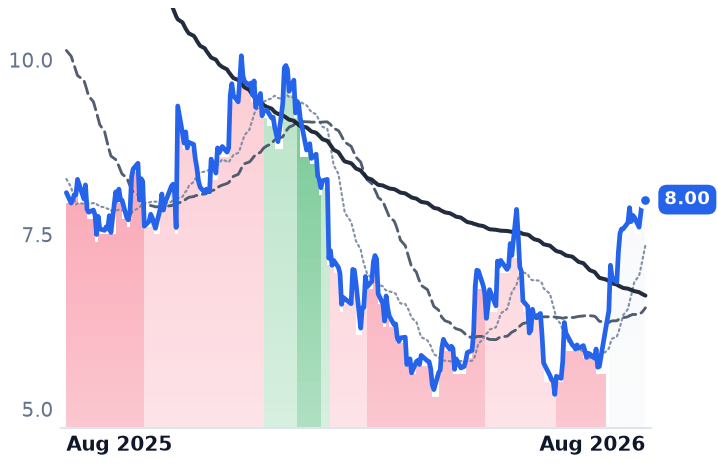
ACN | Accenture | Enterprise Consulting & Systems Integration | 🔴 Cont. Bear | +33.5% | −27.1% |
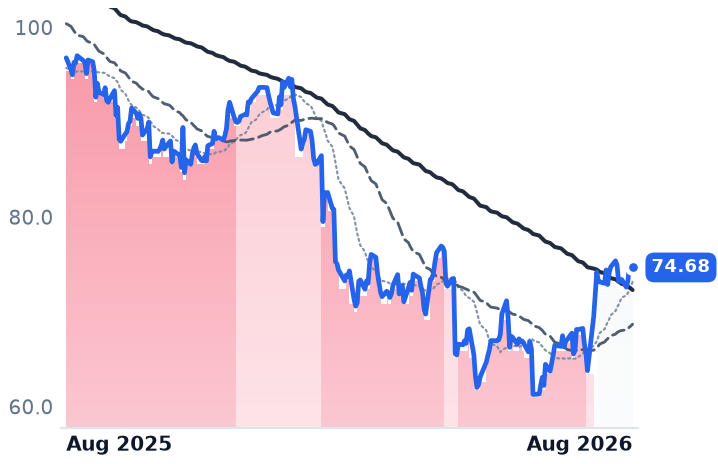
CTSH | Cognizant Technology Solutions | Enterprise Consulting & Systems Integration | 🔴 Cont. Bear | +23.0% | −13.7% |
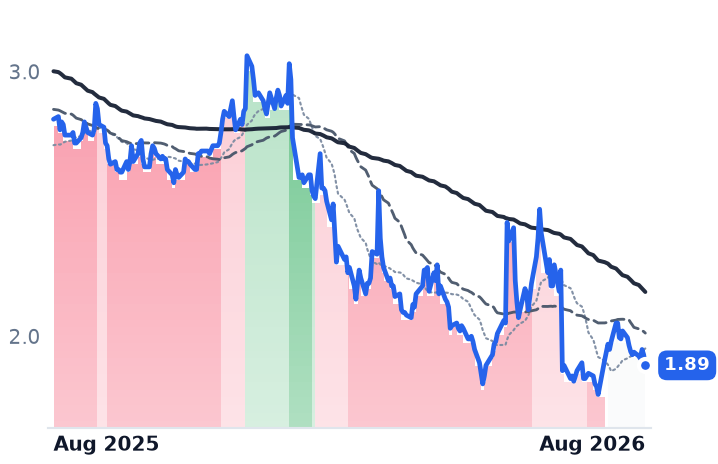
INFY | Infosys | Enterprise Consulting & Systems Integration | 🔴 Cont. Bear | −3.3% | −30.1% |
| Compared against · context, not the story | |||||
EPAM | EPAM Systems | Enterprise Consulting & Systems Integration | 🔴 Cont. Bear | +28.1% | −36.9% |
GLOB | Globant | Enterprise Consulting & Systems Integration | 🔴 Cont. Bear | +29.1% | −43.5% |
GDYN | Grid Dynamics | Enterprise Consulting & Systems Integration | 🔴 Cont. Bear | +42.6% | −1.2% |
GIB | CGI | Enterprise Consulting & Systems Integration | 🔴 Cont. Bear | +17.1% | −22.8% |
WIT | Wipro | Enterprise Consulting & Systems Integration | 🔴 Cont. Bear | +6.2% | −33.0% |
NVDA | NVIDIA | AI & Data Center GPUs | 🟢 Cont. Bull | +9.0% | +20.6% |
SPY | State Street SPDR S&P 500 ETF Trust | Asset Management | 🟢 Cont. Bull | +3.2% | +19.5% |
12-month price & trend


| Ticker | Mkt cap | P/E | P/E fwd | P/S | P/S fwd | P/GP | P/GP fwd | EV/EBITDA | FCF yld |
|---|---|---|---|---|---|---|---|---|---|
ACN | $113.4B | 14.7x | 13.4x | 1.6x | 1.5x | 4.9x | 4.8x | 8.8x | 11.1% |
CTSH | $27.9B | 13.3x | 10.8x | 1.3x | 1.3x | 4.0x | 3.9x | 7.3x | 9.3% |
INFY | $48.4B | 14.3x | 15.0x | 2.3x | 2.4x | 7.7x | 7.9x | 9.2x | 8.0% |


| Ticker | Mkt cap | P/E | P/E fwd | P/S | P/S fwd | P/GP | P/GP fwd | EV/EBITDA | FCF yld |
|---|---|---|---|---|---|---|---|---|---|
EPAM | $5.8B | 14.9x | 8.4x | 1.0x | 1.0x | 3.6x | 3.6x | 7.5x | 8.4% |
GLOB | $1.6B | 14.1x | 5.8x | 0.6x | 0.6x | 2.0x | 2.0x | 6.3x | 20.3% |
GDYN | $608.5M | 272.7x | 17.0x | 1.4x | 1.4x | 4.1x | 4.0x | 13.6x | 2.6% |

| Ticker | Mkt cap | P/E | P/E fwd | P/S | P/S fwd | P/GP | P/GP fwd | EV/EBITDA | FCF yld |
|---|---|---|---|---|---|---|---|---|---|
GIB | $15.5B | 12.4x | 8.0x | 1.3x | 0.9x | 6.4x | 4.5x | 8.4x | 11.3% |
WIT | $18.9B | 14.2x | — | 1.9x | — | 6.4x | — | 9.5x | 8.0% |
NVDA | $5.5T | 34.3x | 25.0x | 21.5x | 13.9x | 29.0x | 18.7x | 28.3x | 2.2% |

| Ticker | Mkt cap | P/E | P/E fwd | P/S | P/S fwd | P/GP | P/GP fwd | EV/EBITDA | FCF yld |
|---|---|---|---|---|---|---|---|---|---|
SPY | $773.0B | — | — | — | — | — | — | — | — |
Consensus projections
| Ticker | FY2026E | FY2027E | FY2028E | |
|---|---|---|---|---|
ACN | Revenue | +6.0% | +4.1% | +5.3% |
| EPS | +7.6% | +5.9% | +7.3% | |
CTSH | Revenue | +5.2% | +4.7% | +5.3% |
| EPS | +10.8% | +9.7% | +10.4% | |
INFY | Revenue | +1.6% | +4.2% | +3.6% |
| EPS | +2.3% | +4.4% | +4.4% | |
EPAM | Revenue | +3.9% | +3.5% | +5.0% |
| EPS | +15.1% | +7.3% | +7.6% | |
GLOB | Revenue | +1.0% | +4.4% | +5.2% |
| EPS | +1.6% | +6.1% | +7.3% | |
GDYN | Revenue | +6.5% | +9.2% | +10.6% |
| EPS | +11.3% | +17.7% | +9.6% | |
GIB | Revenue | +5.0% | +2.6% | +2.6% |
| EPS | +9.3% | +9.2% | +8.0% | |
WIT | Revenue | +5.4% | +4.3% | +2.6% |
| EPS | +4.6% | +3.1% | +3.8% | |
NVDA | Revenue | +65.1% | +84.2% | +43.2% |
| EPS | +59.0% | +91.7% | +42.0% |
Forward fiscal years only. Blank means no analyst coverage for that year.
Accenture, the Dublin-headquartered professional services firm that sells strategy work, systems integration and outsourced operations to large enterprises and governments, spent three years telling investors exactly how much generative-AI work it had sold. Then it stopped. The last disclosure put advanced-AI bookings at $2.2bn for the quarter, up 76% year on year, on a cumulative record of roughly $11.5bn booked across 11,000 projects. Management's explanation was that the category had become so pervasive it was no longer meaningful to break out.
What arrived in its place, on 18 June, argued the other way. Revenue of $18.72bn grew 5.6% in dollars and only 3% in local currency, down from 8.3% growth the prior quarter. New bookings of $19.3bn fell 2%, leaving a book-to-bill of exactly 1.0 — one dollar of future work sold for every dollar delivered. The company cut full-year local-currency growth guidance to 3–4%. The shares fell 18% that day.
Since 22 July they have risen 32.3%, to $185.28, with no company disclosure in the interval. The stated drivers are analyst upgrades citing cheap multiples and short covering, and the average price target set over the past month, $189.88, sits barely above where the stock closed.
What the rally is paying for
Accenture trades at 14.7x trailing and 13.4x forward earnings, against 21x to 37x at each of its last five fiscal year-ends. Measured against gross profit — the fitting lens for a business whose cost of revenue is people — the price paid per dollar earned is 4.85x, versus 5.97x six months ago and 7.29x a year ago. It bottomed at 3.69x on 22 July. The re-rating has recovered barely a third of a year's de-rating, which is the strongest thing that can be said for it.
The next print will be the test. Fourth-quarter guidance of $17.75bn–$18.4bn compares with $17.60bn a year earlier: growth of 0.9% to 4.6%, slower again. Meanwhile the firm plans $9bn of acquisitions, including the operational-technology security firms Dragos, RunZero and NetRise — capability bought rather than grown. And in September 2025 it cut 11,000 jobs in an $865m restructuring, with chief executive Julie Sweet saying it was exiting people for whom reskilling "is not a viable path".
Cognizant is repricing the hour
Cognizant, the Teaneck, New Jersey firm that delivers consulting and outsourcing to banks, insurers, healthcare payers and manufacturers largely from offshore centers, is the one name here that raised anything. It lifted full-year adjusted earnings guidance to $5.70–$5.82 a share and held adjusted operating margin guidance at 16.0–16.2%. Second-quarter operating income grew 7.0% on revenue up 4.5% — real operating leverage, a sixth consecutive quarter of margin expansion.
The qualifications matter. Headcount of 356,700 is up 12,900 year on year, so the growth was delivered on about 3.7% more people, not on price. Roughly 150 to 200 basis points of it is inorganic, following $1.3bn of deals including Astreya. And gross margin slipped to 33.37% from 33.67% — where a productivity give-back to clients would first appear.
What distinguishes the company is that it is trying to sever revenue from the billed hour rather than defend it. Its TriZetto healthcare platform now clears $1.1bn a year at higher margins than the firm as a whole. Fixed-price and transaction-based work has grown for three straight years, and some clients now ask for rate cards with inference costs embedded. Management is standing up 5,000 engineers to audit agentic workflows and 10,000 operators to run blended human-machine teams. The stock's 19% trailing-to-forward earnings compression, to 10.8x, is roughly twice Accenture's.
Infosys says the word out loud
Infosys, the Bengaluru outsourcer with 328,062 employees, cut its full-year constant-currency guidance to 1.5–3.0%, which nets to something near 0.5% once acquisitions and mix are stripped out. Management confirmed genuine price deflation on large renewals, increasingly demanded mid-contract, and declined to size it. It is nonetheless hiring 20,000 graduates. Its shares rose 9.2% over the month, the weakest of the group, and the Indian leg of the move began with a Jefferies upgrade of the sector to neutral — a positioning call, not a demand one. At 7.72x trailing gross profit it is the most expensive of the three, and the only one whose forward multiple sits above its trailing.
EPAM, the US-listed engineering-services firm, cut full-year guidance to 3.2–4.2% growth and fell more than 20% on the print, yet is up 27.5% over the month regardless.
All of them now compete with their suppliers. OpenAI has launched a deployment arm with $4bn from 19 firms and bought the consultancy Tomoro; Anthropic has a $1.5bn services venture backed by Blackstone and Goldman Sachs, both selling embedded engineers instead of analysts. Cognizant claims more than 10,000 Claude-certified architects — it is Anthropic's partner and its rival at once.
Strip each name's two best sessions and Accenture is still up 16.8% and Cognizant 10.5% over the month, so this is no longer the two-session rotation it looked like in early August. In the four sessions to 21 August the two added about 8% each while Nvidia fell 4.6%. All three flipped out of a steep downtrend on the same day, 7 August — one signal, not three company turns. Over twelve months Accenture remains down 27.1% and Infosys 30.0%.
The setup
Where it stands — Accenture's shares have recovered a third of a year's de-rating on upgrades and rotation, not on any new demand disclosure. Would confirm — Fourth-quarter bookings returning to year-on-year growth with book-to-bill back above 1.0. Would invalidate — Fourth-quarter revenue near the low end of $17.75bn, or fiscal 2027 local-currency guidance below 3%. Watch next — Accenture's fiscal fourth quarter ends 31 August and reports in late September. Valuation — Accenture at 14.7x trailing and 13.4x forward earnings, against 21x–37x at its last five fiscal year-ends.