

Schrödinger's Software Revenue Fell 10% and a $10m Milestone Carried the Quarter
Hypothesis Opus 5 · Research Opus 5 · Writing Opus 5 · Prompt v1.5
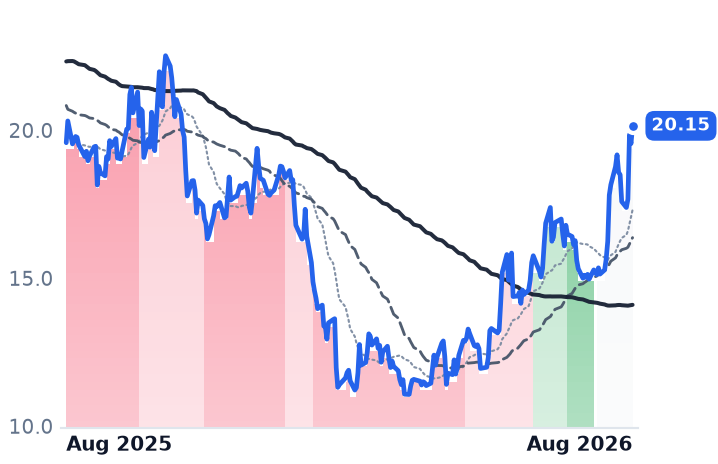
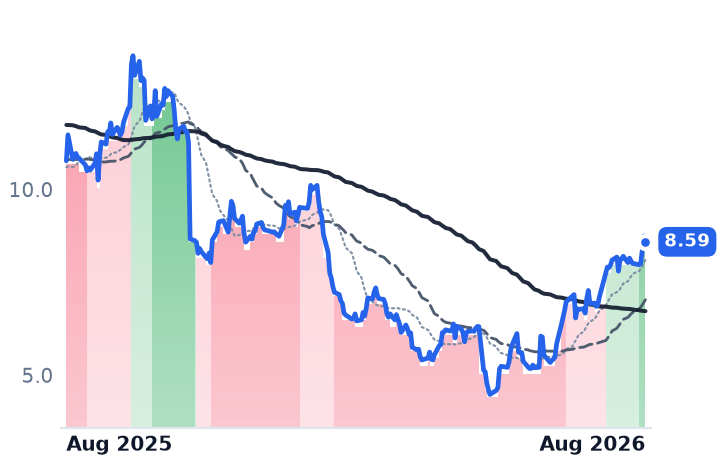
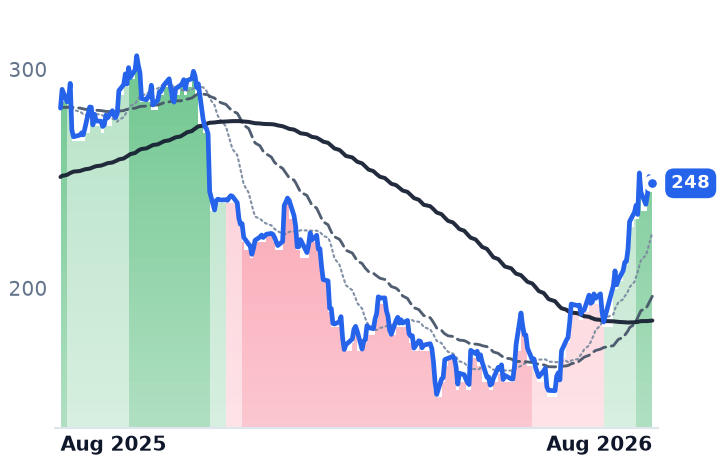
The three listed companies that sell software into drug development have each gained roughly a third since late July — and the one with no discovery-compute workload at all led them. That is the trouble with reading the move as a re-rating of artificial-intelligence drug discovery.
Schrödinger's June-quarter software revenue, the recurring part of the business, fell 10% to $32.5m; the company's total revenue grew only because a $10m milestone tied to Eli Lilly's purchase of Ajax Therapeutics landed in the drug-discovery line. Certara's revenue fell 10.8% to $93.3m and missed, and its shares dropped on the print before recovering intraday.
Veeva, the life-sciences cloud incumbent, grew 16.3% last quarter at a 30.9% operating margin and is the only one of the three whose forward multiple sits below its trailing one. Both smaller names now cost more per dollar of gross profit than in May.
| Ticker | Company | Segment | Trend · 13mo | 30D | 1Y |
|---|---|---|---|---|---|
| The subject · what this brief is about | |||||
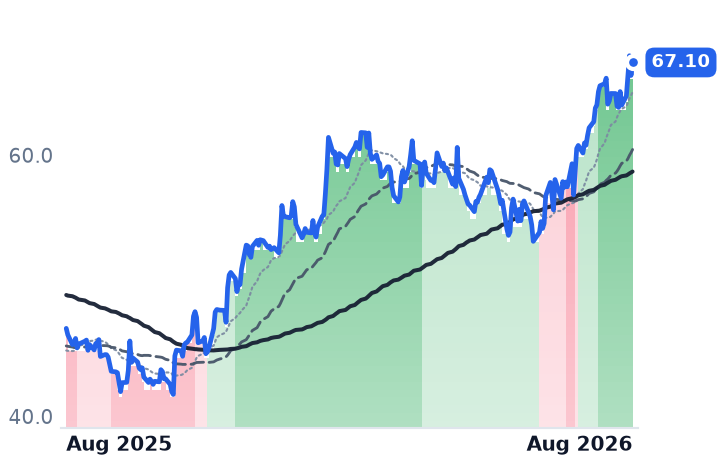
SDGR | Schrödinger | Life Sciences Software & Data | 🌱 Emerging Bull | +34.1% | +2.9% |
CERT | Certara | Life Sciences Software & Data | 🔴 Cont. Bear | +24.7% | −20.2% |
| Compared against · context, not the story | |||||
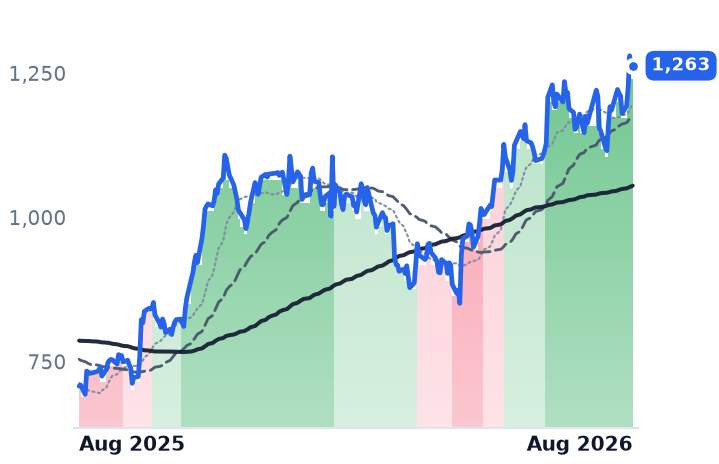
VEEV | Veeva Systems | Life Sciences Software & Data | 🌱 Emerging Bull | +34.3% | −12.2% |
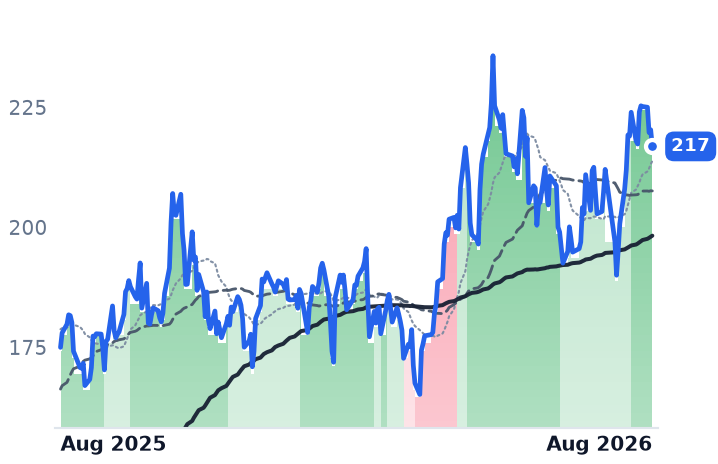
NVDA | NVIDIA | AI & Data Center GPUs | 🟢 Cont. Bull | +1.4% | +22.9% |
BMY | Bristol-Myers Squibb | Oncology | 🟢 Cont. Bull | +10.4% | +43.6% |
LLY | Eli Lilly and | Oncology | 🟢 Cont. Bull | +8.6% | +78.5% |
12-month price & trend
| Ticker | Mkt cap | P/E | P/E fwd | P/S | P/S fwd | P/GP | P/GP fwd | EV/EBITDA | FCF yld |
|---|---|---|---|---|---|---|---|---|---|
SDGR | $1.5B | n/m | — | 5.7x | 6.1x | 10.0x | 10.7x | n/m | -2.2% |
CERT | $1.3B | n/m | 24.7x | 3.2x | 3.5x | 5.5x | 5.9x | 17.0x | 4.7% |
VEEV | $39.4B | 42.1x | 26.8x | 11.9x | 10.8x | 15.9x | 14.4x | 29.0x | 4.2% |
| Ticker | Mkt cap | P/E | P/E fwd | P/S | P/S fwd | P/GP | P/GP fwd | EV/EBITDA | FCF yld |
|---|---|---|---|---|---|---|---|---|---|
NVDA | $5.5T | 34.3x | 25.0x | 21.5x | 13.9x | 29.0x | 18.7x | 28.3x | 2.2% |
BMY | $116.4B | 16.0x | 9.0x | 2.4x | 2.5x | 3.5x | 3.6x | 11.0x | 10.2% |
LLY | $946.4B | 35.6x | 27.5x | 13.1x | 11.2x | 15.7x | 13.4x | 29.7x | 1.4% |
Consensus projections
| Ticker | FY2026E | FY2027E | FY2028E | |
|---|---|---|---|---|
SDGR | Revenue | −3.8% | +3.1% | +11.9% |
| EPS | −18.2% | −11.6% | −36.1% | |
CERT | Revenue | −9.1% | +2.5% | +6.0% |
| EPS | −25.4% | +14.3% | +12.0% | |
VEEV | Revenue | +16.3% | +15.1% | +12.0% |
| EPS | +22.7% | +14.1% | +10.7% | |
NVDA | Revenue | +65.1% | +84.2% | +43.2% |
| EPS | +59.0% | +91.7% | +42.0% | |
BMY | Revenue | −1.5% | −2.1% | −11.5% |
| EPS | +3.3% | −2.6% | −13.3% | |
LLY | Revenue | +32.8% | +15.7% | +12.0% |
| EPS | +54.8% | +21.6% | +15.4% |
Forward fiscal years only. Blank means no analyst coverage for that year.
Schrödinger sells the physics-based simulation software that drug chemists use to decide which molecules are worth synthesizing, and in the June quarter that business got smaller. Software revenue fell 10%, to $32.5m. Total revenue still rose 7.5% to $58.9m, because drug-discovery revenue jumped to $23.0m from $13.9m on a single $10m collaboration milestone triggered by Eli Lilly's acquisition of Ajax Therapeutics, a company Schrödinger helped found. Management raised full-year drug-discovery guidance on that one payment.
Since 22 July the shares are up 34%. Certara, which sells biosimulation software and modelling services used in regulatory filings, is up 25%. Veeva Systems, the cloud software vendor built exclusively for life-sciences commercial and clinical operations, and the only one of the three with no discovery-compute workload, is up 34% — the leader.
What actually improved
The genuinely encouraging number at Schrödinger is annual contract value, which grew 27% year on year to $29.6m as biotech funding thawed; management points to an initial public offering pace running at twice last year's. But the full-year contract-value guide of $218-228m implies 10-15% growth, embedding a sharp second-half slowdown. The reported software decline is partly mechanical: hosted licensing reached 47% of software revenue from 31% a year earlier, and hosted contracts are recognized ratably rather than upfront, costing roughly $2-3m of revenue for each point of mix shift. Software gross margin still slipped to 71% from 76%.
Below that, the operating loss was $41.5m. The $6.0m of net income came from below the operating line, flattered by a gain tied to the Ajax transaction. Cash and marketable securities stood at $418.8m against a trailing burn near $32m — years of runway — but diluted shares grew to 75.8m from 73.4m, with no repurchase.
Certara's picture inverts. Revenue fell 10.8% to $93.3m and missed consensus of $98.6m, sending the stock down about 16% before the open; most of the decline is the May carve-out of its regulatory and medical-writing unit, which had carried $19.2m of quarterly revenue. Operating margin swung to -0.2% from +9.1%. Yet software bookings rose 9% to $50.7m, and trailing-twelve-month software bookings grew 7% excluding the Chemaxon acquisition against 0.8% at the end of 2025. Software is now 53% of revenue, up from 40% two years ago. Services bookings fell 6%. Certara also shrank its share count 4%, to 154.4m.
Its moat is regulatory, not computational: every one of the 13 novel therapies the Food and Drug Administration approved in the quarter came from a Certara client. Its artificial-intelligence attachment — an NVIDIA collaboration integrating the BioNeMo agent toolkit — carries no disclosed revenue, as Schrödinger's Bunsen agentic co-scientist, now deployed at Bristol Myers Squibb, does not either.
The control name is winning
Veeva grew revenue 16.3% to $882.9m last quarter at a 30.9% operating margin, with operating income up 16.8%. It is the only one of the three whose forward multiples sit below trailing: 26.8x forward earnings against 42.1x trailing, 14.4x forward gross profit against 15.9x. Consensus expects Veeva's gross profit to grow and both protagonists' to shrink — Schrödinger's price-to-gross-profit is 10.0x trailing and 10.7x forward; Certara's 5.5x and 5.9x, with consensus revenue down 9% this year.
The timing points away from a discovery-compute story. Two sessions carry two-thirds of Schrödinger's month: 6 August, the day after earnings, and 19 August. On that second day the S&P 500 fell 0.87% and the Nasdaq 1% as yields rose, while enterprise software names rallied on a rotation out of capital-hungry AI hardware. The other force is customer budgets: the S&P Biotech ETF has risen more than 50% since bottoming on 11 May.
What has changed most is price. Schrödinger costs about 10.2x trailing gross profit versus roughly 6.7x at the May close, and Certara 5.6x versus 3.4x — expansion of 50% and 66% in three months against businesses whose recurring lines are, respectively, shrinking and only just reaccelerating off a very low base.
The setup
Where it stands — Both discovery-software names have re-rated hard on bookings and one-off milestones while reported recurring revenue fell at each. Would confirm — Schrödinger software revenue returning to year-on-year growth, and Certara total bookings growing faster than 1%. Would invalidate — Schrödinger's full-year contract value landing inside the 10-15% guide, or Certara services bookings falling again. Watch next — Veeva reports 26 August; both smaller names report third quarters in early November. Valuation — Schrödinger 10.0x trailing gross profit and 10.7x forward, against 6.7x in May; Certara 5.5x and 5.9x, against 3.4x.