

Arm's Data-Center Royalties Doubled and It Still Cut Its Royalty Growth Guidance
Hypothesis Opus 5 · Research Opus 5 · Writing Opus 5 · Prompt v1.5
Arm's data-center royalties more than doubled year on year last quarter, and on the same call the company lowered its full-year royalty growth guidance from about 20% to the high teens. Both are true, and they measure different things: the rate Arm earns per chip is rising while the phone units that still carry most of its royalties are weakening. Royalties reached $715m, up 22%, yet GAAP operating income fell 8.4% as Arm spends to sell its own AI server processors at a gross margin it guides to the high 30s — against roughly 97% on licensing.
CEVA, which licenses signal-processing and neural-network cores into earbuds, modems and cameras, sits at the other end of the same rung: customers shipped 567m chips last quarter and paid it about 1.9 cents of royalty each. Its raised guidance came from licence fees, not royalties. Astera Labs, growing 104%, is the only one of the three with a disclosed dollar figure for its content inside an AI rack.
| Ticker | Company | Segment | Trend · 13mo | 30D | 1Y |
|---|---|---|---|---|---|
| The subject · what this brief is about | |||||
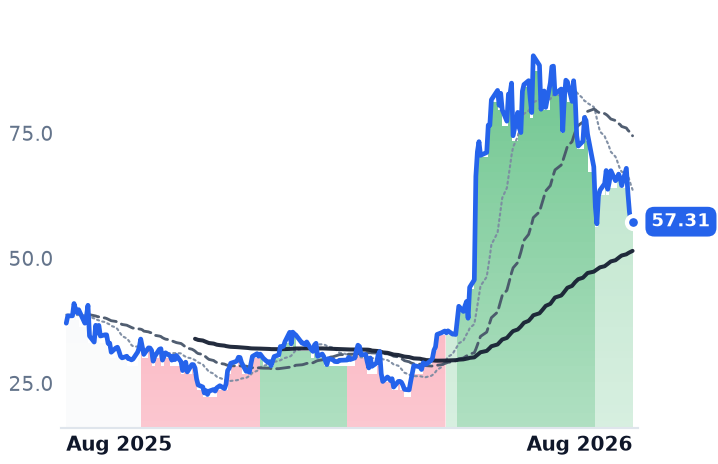
ARM | Arm Holdings plc American Depositary Shares | Specialty Semiconductors | 🟢 Cont. Bull | −13.8% | +83.2% |
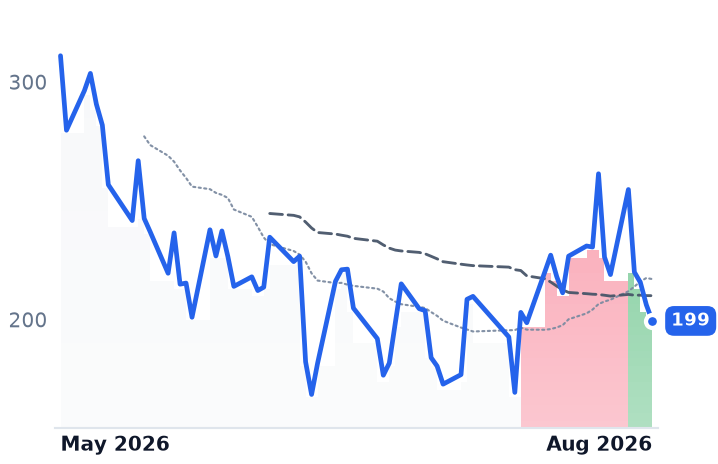
CEVA | CEVA | Specialty Semiconductors | 🌱 Emerging Bull | −30.8% | +24.9% |
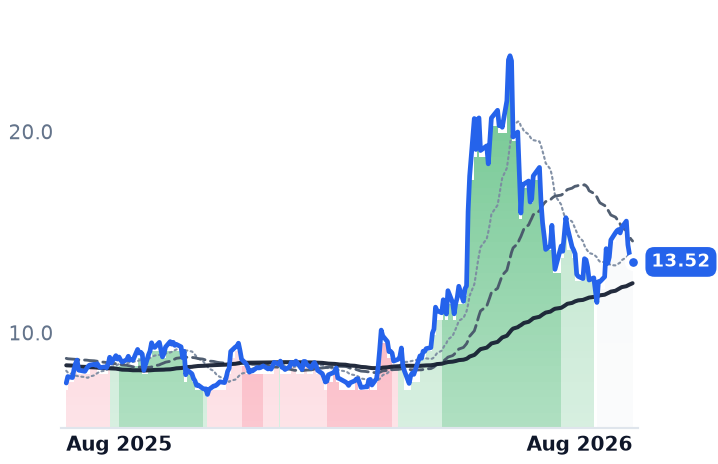
AMBA | Ambarella | Specialty Semiconductors | 🌱 Emerging Bull | +6.2% | +11.0% |
| Compared against · context, not the story | |||||
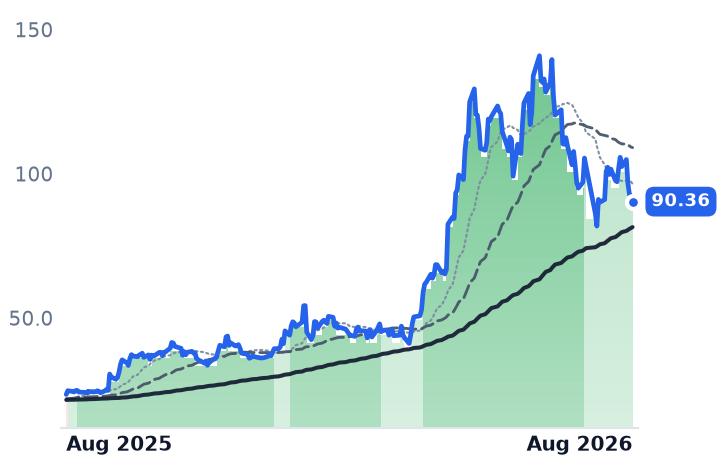
ALAB | Astera Labs | Specialty Semiconductors | 🟢 Cont. Bull | −14.1% | +60.2% |
AMBQ | Ambiq Micro | Specialty Semiconductors | 🌱 Emerging Bull | −26.1% | +54.8% |
CBRS | Cerebras Systems | Specialty Semiconductors | 🌱 Emerging Bull | −4.9% | −35.9% |
HIMX | Himax Technologies | Specialty Semiconductors | 🌱 Emerging Bull | −0.7% | +80.3% |
INTC | Intel | Specialty Semiconductors | 🟢 Cont. Bull | −11.9% | +284.5% |
NXPI | NXP Semiconductors | Analog & Mixed-Signal | 🟢 Cont. Bull | −19.6% | +1.5% |
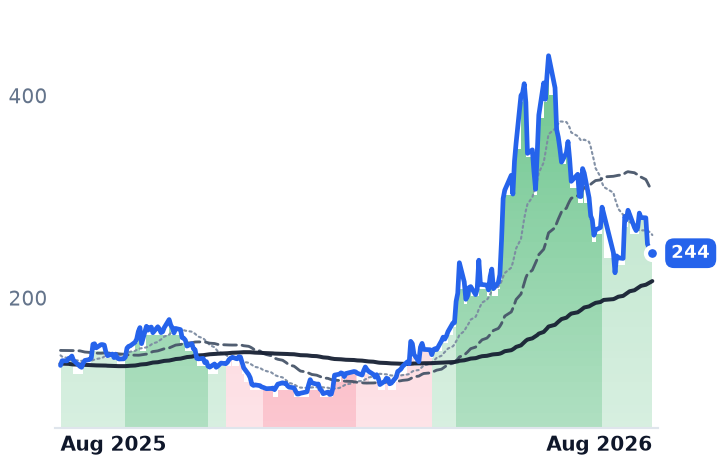
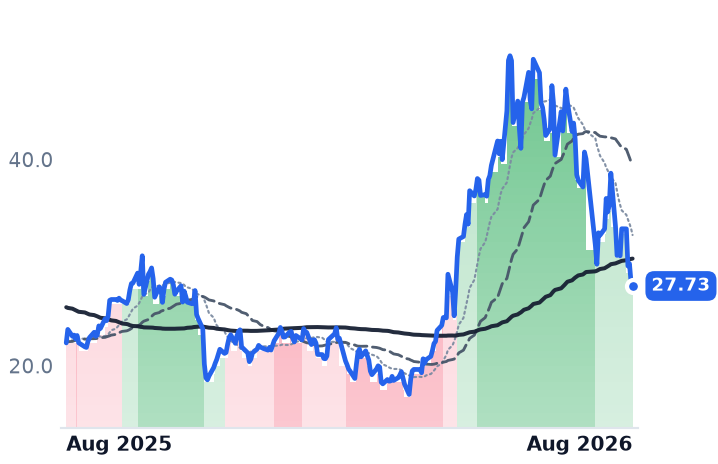
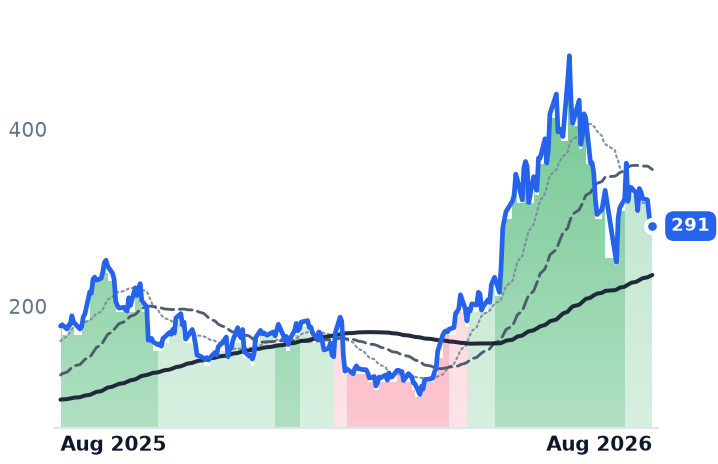
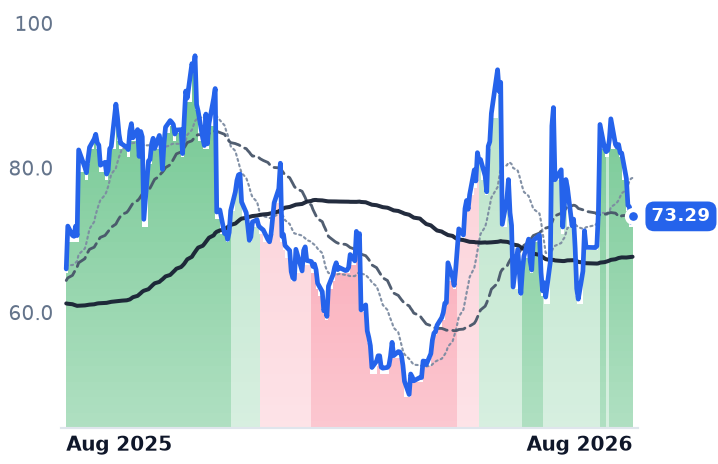
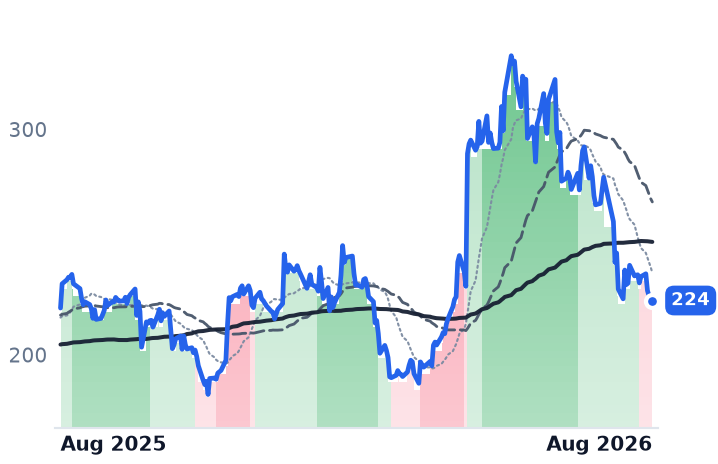
12-month price & trend
| Ticker | Mkt cap | P/E | P/E fwd | P/S | P/S fwd | P/GP | P/GP fwd | EV/EBITDA | FCF yld |
|---|---|---|---|---|---|---|---|---|---|
ARM | $259.9B | 250.8x | 109.3x | 50.4x | 42.9x | 52.9x | 45.0x | 187.4x | 0.6% |
CEVA | $779.8M | n/m | 51.1x | 6.7x | 6.2x | 7.7x | 7.1x | n/m | -0.1% |
ALAB | $49.0B | 131.7x | 72.7x | 40.8x | 26.4x | 54.3x | 35.1x | 146.4x | 0.6% |
| Ticker | Mkt cap | P/E | P/E fwd | P/S | P/S fwd | P/GP | P/GP fwd | EV/EBITDA | FCF yld |
|---|---|---|---|---|---|---|---|---|---|
AMBA | $3.2B | n/m | 93.3x | 8.0x | 7.3x | 13.7x | 12.6x | n/m | 0.8% |
AMBQ | $1.5B | n/m | — | 18.4x | 12.4x | 43.6x | 29.3x | n/m | -2.4% |
CBRS | $15.9B | — | — | — | — | — | — | — | — |
| Ticker | Mkt cap | P/E | P/E fwd | P/S | P/S fwd | P/GP | P/GP fwd | EV/EBITDA | FCF yld |
|---|---|---|---|---|---|---|---|---|---|
HIMX | $3.3B | 104.1x | 47.6x | 4.1x | 3.6x | 13.4x | 11.7x | 49.4x | 2.1% |
INTC | $546.7B | n/m | 101.3x | 10.2x | 9.4x | 28.7x | 26.5x | 50.4x | -0.6% |
NXPI | $57.0B | 19.2x | 15.0x | 4.3x | 4.0x | 7.7x | 7.1x | 13.2x | 5.2% |
Consensus projections
| Ticker | FY2026E | FY2027E | FY2028E | |
|---|---|---|---|---|
ARM | Revenue | +22.5% | +23.7% | +35.6% |
| EPS | +7.9% | +27.0% | +35.7% | |
CEVA | Revenue | +14.3% | +13.0% | +12.8% |
| EPS | +31.8% | +45.2% | +36.4% | |
ALAB | Revenue | +123.4% | +59.4% | +26.8% |
| EPS | +121.0% | +61.4% | +25.0% | |
AMBA | Revenue | +39.8% | +13.2% | +12.9% |
| EPS | −310.8% | +32.6% | +36.5% | |
AMBQ | Revenue | +72.1% | +25.3% | +32.6% |
| EPS | −21.2% | −42.6% | −160.7% | |
HIMX | Revenue | +12.6% | +24.3% | +21.9% |
| EPS | +63.3% | +115.0% | +72.1% | |
INTC | Revenue | +10.8% | +10.5% | +10.1% |
| EPS | +211.5% | +39.0% | +41.2% | |
NXPI | Revenue | +16.6% | +11.5% | +8.2% |
| EPS | +28.0% | +20.6% | +15.7% |
Forward fiscal years only. Blank means no analyst coverage for that year.
Arm Holdings, the Cambridge company whose processor designs sit inside nearly every smartphone and which collects a fee on each chip that ships, told investors in late July that its royalties from data-center silicon had more than doubled in a year. In the same presentation, the finance chief cut the company's full-year royalty growth guidance to the high teens from the roughly 20% described three months earlier, and guided the September quarter's royalty growth to the low teens.
That is the whole argument about the chip intellectual-property business in one quarter. Arm earns a rising rate per chip — Armv9 cores and pre-integrated compute subsystems command a higher royalty than the older designs they replace — on a unit base that is going backwards, because handset makers are raising prices across mid and premium tiers as memory costs climb. Revenue reached $1.289bn, up 22.4%. Royalties were $715m and licensing $574m, up 23%. Cumulative shipments of Neoverse, its server core, passed 1.5 billion; the most recent 500 million took nine months, against six years for the first billion.
Two cents a device
CEVA licenses digital-signal-processor cores, neural-network accelerators and wireless connectivity blocks — Bluetooth, Wi-Fi, ultra-wideband, cellular internet-of-things — to chipmakers who put them in high-volume, low-priced devices. Its June quarter shows what that rung earns. Revenue rose 13.1% to $29.0m, licensing rose 21% to $18.2m — its best in three years — and royalties rose 1% to $10.8m, even though customers shipped 567m units, up 16%. That is roughly 1.9 cents a device, and falling per unit. Bluetooth chips, at 295m units, were down 16%; cellular IoT hit a record 68m.
The company raised full-year growth guidance to 13-15% and doubled its non-GAAP operating margin to 11%. But the growth is licence-fee growth, which is lumpy by nature. Its edge-artificial-intelligence royalty line does not yet exist: the NeuPro-M neural accelerator deal it signed with a large computing-platform company is on the usual one-and-a-half to two-year path to production. Management's stated mechanism for lifting the rate — selling complete subsystems, such as a full Wi-Fi 6 plus Bluetooth chip, rather than component blocks — raises deal size and royalty per unit together. It has not shown up in the royalty line.
What Arm is paying to move up the stack
Arm's other change is that it has started selling finished silicon. Demand for its AI server processor has risen above $2bn from the $1bn indicated a quarter earlier — and management guides that product's gross margin to the high 30s or low 40s, against a licensing business that runs near 97%. Annual gross margin has already slipped to 92.5% from 94.9%, operating margin to 18.5% from 20.6%, and GAAP operating income fell 8.4% year on year even as revenue grew 22%. Arm will break the silicon business out as a segment only once it exceeds 10% of revenue, expected in fiscal 2028. Until then the dilution is visible in the margin line and nowhere else.
The de-rating arrived in four sessions
Arm closed at $244.21 on Friday, down about 14% in a month, and essentially all of that loss landed between 17 and 21 August. On 18 August alone Arm fell 9.3%, the day the 30-year Treasury yield topped 5.33%, a 19-year high and the Philadelphia Semiconductor index dropped 5.4%. Long-dated royalty streams are the most duration-sensitive assets in semiconductors, and they were marked accordingly. CEVA fell 10.8% that session and is down about 31% over the month, thirteen days after its raised guidance.
What the selloff did not do is take the prices back to where they started the year. Arm trades at 53.1x trailing gross profit — the fitter lens, since almost all its revenue is gross profit and its 251x trailing earnings multiple is distorted by tax and investment items — against 68.4x in May but 30.1x in February. Forward earnings are 109x. CEVA is at 7.6x trailing gross profit against 10.9x in May, the cheapest licensor in the group, on 51x forward earnings. Astera Labs, which sells the retimers, cable modules and fabric switches that move data between accelerators inside an AI rack, is the control: revenue grew 104.5% to $392.4m at a 73.3% gross margin, September revenue is guided to $540-560m, and management put content for its Scorpio X switch alone above $1,000 per accelerator. Its multiple fell from 67x trailing gross profit to 54x in the same four sessions. Nothing in its business changed.
The setup
Where it stands — Arm's royalty rate per chip is rising and its unit base is not; the de-rating tracked long yields, not the quarter. Would confirm — September-quarter royalty revenue growing in the mid-teens or better with data-center royalties again up more than 50%. Would invalidate — Royalty growth printing below 10%, or company-wide gross margin falling under 90% as silicon shipments scale. Watch next — Arm's fiscal second-quarter results, guided to $1.38bn of revenue; CEVA's third quarter, guided to $30.5-34.5m. Valuation — 53.1x trailing gross profit, 45x forward, versus 68.4x in May and 30.1x in February; 109x forward earnings.