

Harmonic's Cable Backlog Jumped 71% While Adtran's Rural Access Line Shrank Again
Hypothesis Opus 5 · Research Opus 5 · Writing Opus 5 · Prompt v1.5
"Broadband equipment" sounds like one end-market. The June quarters of three vendors show it is at least three, paid by different customers on different clocks — and the one everybody waited for, federal subsidy money, still has not shipped a box.
Harmonic, now a pure-play cable supplier after selling its video arm, grew broadband revenue 54% and lifted full-year guidance twice, to $505-525m; Wall Street's consensus still sits below management's own floor. Adtran is two opposite cycles inside one ticker: optical gear sold to hyperscalers nearly doubled, while its rural access line fell and the company swung to a $10.1m operating loss. Calix keeps compounding — revenue up 21%, record contracted backlog — but its gross margin has now fallen three quarters running on memory costs, and the third quarter is guided to a 52% midpoint. Harmonic is leading, Calix following, Adtran diverging.
| Ticker | Company | Segment | Trend · 13mo | 30D | 1Y |
|---|---|---|---|---|---|
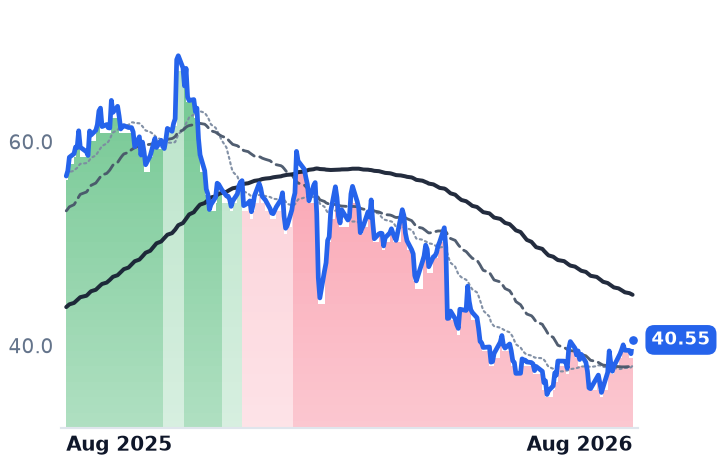
CALX | Calix | Cloud Infrastructure & Platform | 🔴 Cont. Bear | +8.2% | −28.4% |
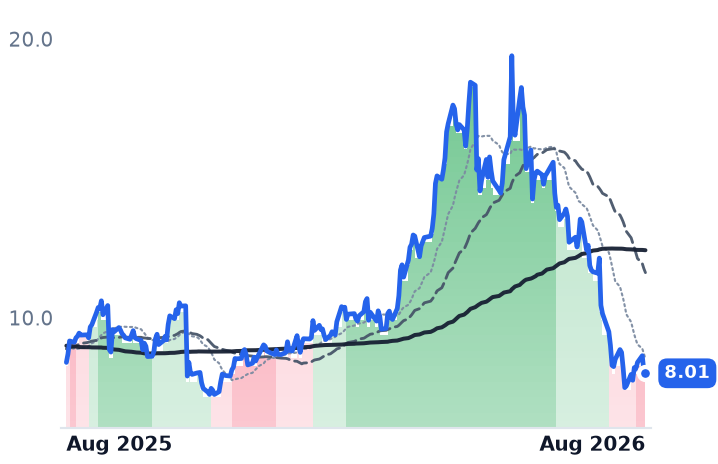
ADTN | ADTRAN | Optical Transport & Switching | 🟢 Cont. Bull | −34.0% | −4.6% |
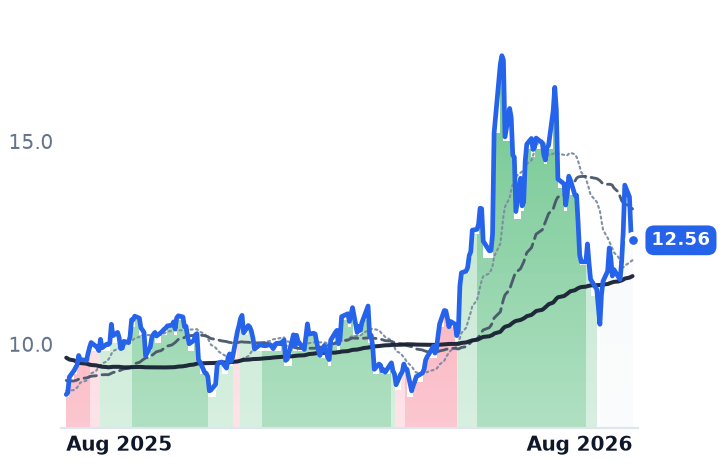
HLIT | Harmonic | Network Testing & Management | 🟢 Cont. Bull | +0.7% | +43.4% |
12-month price & trend
| Ticker | Mkt cap | P/E | P/E fwd | P/S | P/S fwd | P/GP | P/GP fwd | EV/EBITDA | FCF yld |
|---|---|---|---|---|---|---|---|---|---|
CALX | $2.6B | 51.3x | 23.6x | 2.3x | 2.1x | 4.1x | 3.8x | 28.2x | 3.3% |
ADTN | $648.8M | n/m | 25.6x | 0.6x | 0.6x | 1.5x | 1.5x | 7.0x | 8.8% |
HLIT | $1.4B | n/m | 19.6x | 2.7x | 2.8x | 5.4x | 5.5x | 19.4x | 4.0% |
Consensus projections
| Ticker | FY2026E | FY2027E | FY2028E | |
|---|---|---|---|---|
CALX | Revenue | +19.4% | +15.6% | +14.4% |
| EPS | +27.8% | +33.8% | +45.1% | |
ADTN | Revenue | +7.0% | +7.9% | +10.2% |
| EPS | +95.3% | +94.4% | +46.5% | |
HLIT | Revenue | −11.6% | +15.3% | −2.1% |
| EPS | +48.8% | +19.7% | −3.6% |
Forward fiscal years only. Blank means no analyst coverage for that year.
Three companies that sell the electronics sitting at the edge of a broadband network reported June quarters within a month of one another, and the results had almost nothing in common. That is the finding. The industry label implies a shared cycle; in practice each vendor is paid by a different customer — a cable operator, a hyperscale data-center buyer, or a rural telephone company waiting on Washington — and only two of those three are writing checks today.
The one being paid
Harmonic sells CableOS, software that replaces the refrigerator-sized cable modem termination systems in an operator's headend, to companies such as Comcast and Charter. Since selling its video division to MediaKind on 16 June for $137.9m, it is a pure-play broadband vendor. June-quarter broadband revenue was $133.5m, up 54% year on year and above its own guidance. Backlog plus deferred revenue reached $587.6m, up 71%, with 73% due to convert inside a year.
The demand is not subsidy. Charter is spending roughly $11.4bn of capital this year and plans to upgrade 35% of its footprint to the DOCSIS 4.0 standard, work operators deferred in 2025 while waiting on new Broadcom silicon. Harmonic has been named market-share leader in virtual CMTS by Dell'Oro Group, with more than 60 operators deployed against CommScope, Casa Systems and Vecima. Concentration is easing too: revenue from customers outside its two largest operators reached almost $50m, up 44%.
Management raised full-year guidance twice, to $505-525m of revenue and $0.67-0.75 of earnings per share. Consensus still carries $490m and $0.642 — below the floor of the company's own guide. At 19.57x forward earnings and 5.42x trailing gross profit, Harmonic is the most expensive of the three, on the lowest estimates.
The one that is two businesses
Adtran, a Huntsville, Alabama vendor that also controls the German optical maker formerly known as ADVA, contains both cycles at once. In the June quarter optical networking grew 22% to $109.7m, and revenue from hyperscalers buying data-center interconnect gear rose 97%. Meanwhile access and aggregation fell 5% and subscriber solutions dropped 14% sequentially. Total revenue growth decelerated across four quarters from 22.7% to 6.1%.
The good half did not carry the bad. Gross margin slid from 39.5% to 37.0% as supply constraints pushed mix toward cheaper pluggable optics, and operating income swung to -$10.1m. Adtran had already pre-announced revenue of $280-282m against its own $283-303m guide, blaming one large customer's project delay; the shares fell 14% that day. Five sessions since late May account for essentially the entire 45% three-month decline. At 1.48x trailing gross profit it is the cheapest of the three, with $79.2m of cash, a new $350m revolving credit facility led by JPMorgan, and a standing German profit-transfer agreement carrying potential minority buyout obligations near $352m.
The one still waiting
Calix sells access systems and a subscription cloud platform to small and rural operators. Revenue grew 21.3% to $293.3m, the fourth straight quarter above 20%, with record contracted backlog of $386m and operating income of $21.8m against $0.4m a year earlier. Notably, the hardware line grew faster than the software line — appliance revenue $243m, up 23%; software and services $50m, up 16% — which inverts the usual platform narrative.
What has broken is margin. Gross margin has fallen three quarters running to 54.6%, and the September quarter is guided to a 52% midpoint. The cause is memory: prices for the DRAM used in broadband gear have risen sharply as AI servers absorb capacity, taking memory past 20% of a mid-range router's bill of materials from roughly 3%, and Gartner expects DRAM prices up 47% this year. Calix is moving to monthly surcharges and calls the third quarter the bottom. Harmonic bought its full-year memory early.
The federal Broadband Equity, Access and Deployment (BEAD) program, long treated as Calix's catalyst, was restructured: about 66% of eligible locations now go to fiber, 21% to low-earth-orbit satellite and 11% to fixed wireless, saving roughly $21bn. Construction largely runs 2026 to 2028, with first connections in 2027. Management calls satellite a 5-10% threat to its addressable market.
What the shares did
Calix spent 148 consecutive sessions from 13 January in a firmly downward trend, its 50-day average below its 200-day; that ended on 19 August, on volume many multiples of the prior day's. It is 15.2% above its June low and 28.1% lower over twelve months. Harmonic is up 39.6% over the year but 26.6% below its high. Adtran round-tripped an entire optical re-rating, from $8.59 to $19.40 and back to $8.01.
The setup
Where it stands — Cable capex and hyperscaler optics are funding orders now; subsidized rural fiber shipments sit in 2027.
Would confirm — Calix September gross margin at or above the 52% guided midpoint, with fourth-quarter margin guided higher.
Would invalidate — Harmonic's backlog falling below $500m, or full-year revenue landing under the $505m guided floor.
Watch next — Harmonic's investor day on 15 September 2026; Adtran's September quarter, guided to $275-295m.
Valuation — Calix 23.56x forward against 51.33x trailing; Harmonic 19.57x forward; Adtran 1.48x gross profit, 6.99x EV/EBITDA.