

Anterix Tripled After Signing $25m of New Utility Spectrum Contracts in a Year
Hypothesis Opus 5 · Research Opus 5 · Writing Opus 5 · Prompt v1.5
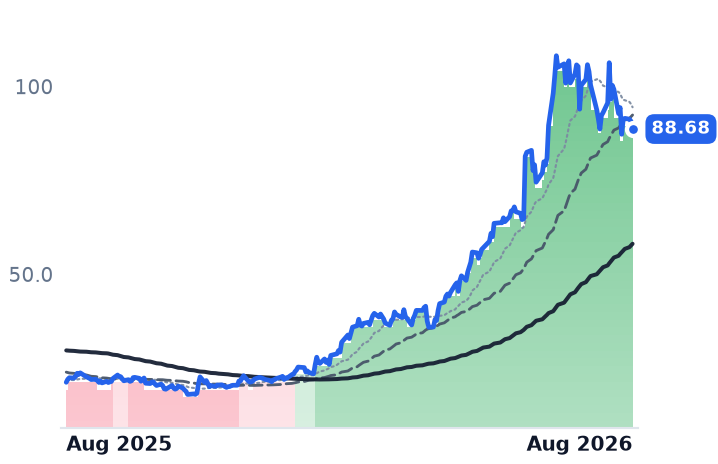
Anterix licenses 900 MHz airwaves to electric utilities building private wireless networks for the grid. Its market value climbed from roughly $0.65bn to $1.73bn over twelve months. The new business it signed across all of fiscal 2026 — three utilities plus a Washington state public utility district — came to about $25m of contracted proceeds. The gap between those two numbers is the story, and it is not resolved by the pipeline: management points to roughly $3bn of potential phased proceeds against about $400m signed to date.
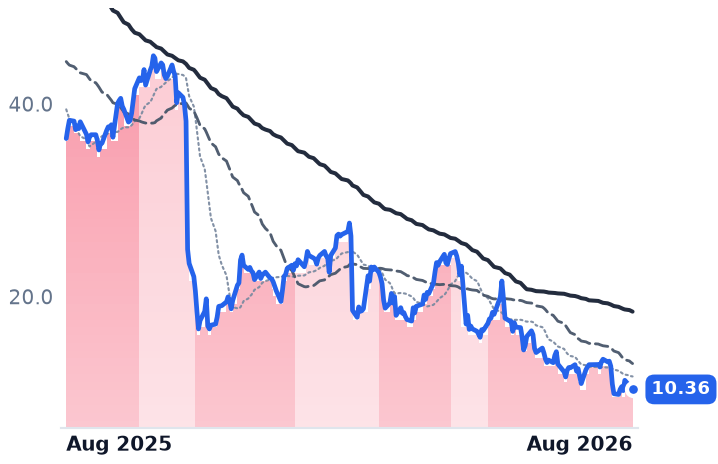
The three companies filed under the same telecom-services label share almost nothing else. Cogent Communications, an internet-transit carrier, is down about three-quarters in a year with revenue shrinking 4.3% and its dividend cut 98%. Sify, an Indian data-center builder, grew revenue 15.9% last quarter — and paid more in interest last fiscal year than it earned from operations.
| Ticker | Company | Segment | Trend · 13mo | 30D | 1Y |
|---|---|---|---|---|---|
ATEX | Anterix | Technology & Services | 🌱 Emerging Bull | −16.2% | +317.7% |
CCOI | Cogent Communications | Technology & Services | 🔴 Cont. Bear | −18.4% | −71.5% |
SIFY | Sify Technologies | Technology & Services | 🟢 Cont. Bull | −2.2% | +75.0% |
12-month price & trend
| Ticker | Mkt cap | P/E | P/E fwd | P/S | P/S fwd | P/GP | P/GP fwd | EV/EBITDA | FCF yld |
|---|---|---|---|---|---|---|---|---|---|
ATEX | $1.7B | 25.2x | — | 245.6x | 93.9x | 245.6x | 93.9x | 823.4x | 0.8% |
CCOI | $519.1M | n/m | — | 0.4x | 0.5x | 1.0x | 1.3x | 7.8x | -27.5% |
SIFY | $1.0B | n/m | — | 2.1x | — | 6.7x | — | 8.9x | 0.0% |
Consensus projections
| Ticker | FY2026E | FY2027E | FY2028E | |
|---|---|---|---|---|
ATEX | Revenue | −2.2% | +203.1% | +27.7% |
| EPS | −316.3% | −138.0% | +6.5% | |
CCOI | Revenue | −1.6% | +4.5% | +6.4% |
| EPS | −11.7% | −21.4% | −23.5% | |
SIFY | Revenue | +15.8% | +22.1% | +18.3% |
| EPS | +329.2% | −152.2% | +150.0% |
Forward fiscal years only. Blank means no analyst coverage for that year.
Anterix has 64 employees, owns no network, and holds exclusive 900 MHz spectrum across the continental United States, Alaska, Hawaii and Puerto Rico. Its business is selling or licensing slices of that spectrum to electric utilities that want private LTE networks to reach substations, reclosers and meters — the low-capital alternative to trenching fiber to every point on the grid. In its fiscal year ended March 2026 it signed new spectrum agreements with CPS Energy, Texas-New Mexico Power and NorthWestern Energy worth $23.9m of contracted proceeds, then added Benton Public Utility District in April for $0.8m.
Over roughly that same stretch the equity went from about $0.65bn to $1.73bn.
The multiple that actually applies
Conventional multiples are useless here. Trailing revenue is about $7.0m, which makes price-to-sales of 246x a number without content. Reported fiscal 2026 net income of $90.6m sits on an operating loss of $41.6m: the profit came from a $105.4m gain on exchanging narrowband for broadband licences in 219 counties and a $34.8m gain on asset sales. In the June quarter, with no such gains, net income fell 99% to $0.24m.
The honest anchor is price per megahertz-POP, the unit spectrum trades in. Management's own arithmetic puts executed utility deals at an average $1.40 per MHz-POP and the Federal Communications Commission's AWS-3 auction at $2.50, implying about $7.5bn of gross asset value against a market capitalization that implies roughly $0.60. So the shares remain below transaction comparables — while sitting at about triple the implied value of six months ago. Roughly 3 billion MHz-POPs, 85% of the holding and including the largest metros, are still unmonetized.
The demand side is real. American investor-owned utilities have proposed more than $1.4trn of capital spending for 2026-2030, a rise of over a fifth on the prior five years, as data-center load forces grid rebuilds. Anterix describes about twelve live utility opportunities spanning seven- to nine-figure deals. On 11 August it also publicly backed a SpaceX proposal to let 896-901/935-940 MHz licences meet buildout obligations via satellite direct-to-device — a third monetization path alongside utility lease and sale.
The conversion, though, is slow. Anterix collected $16m from customers in the June quarter and expects only about $10m more for the rest of the fiscal year. It ended with $116m of cash, no debt, and quarterly operating costs near $13m plus spectrum clearing — call it two years. Diluted shares rose to 19.63m from 18.70m on option exercises; the count is growing, not shrinking, and $226m of buyback authorization expires next month.
The other two are not the same trade
Cogent Communications sells internet transit, private networks and colocation from 3,035 buildings, mostly to small enterprises and bandwidth-heavy customers. Its second-quarter service revenue was $235.6m, down 4.3% from a year earlier. The acquired Sprint Wireline book has fallen from a $118m run rate to $34m, masking 29% growth in the legacy Cogent business since the deal closed. Adjusted net leverage improved to 6.23x, helped by a $225m sale of ten former Sprint data centers, and margins expanded 90 basis points — but the board holds the quarterly dividend at $0.02 after a 98% cut, and free cash flow is positive only while T-Mobile subsidy payments run, about two years more. The genuine option inside it is wavelength services, up 63.8% to $14.8m — roughly 6% of revenue, and about 3% of a North American market where Zayo is spending $4bn on AI long-haul fiber and Lumen has held Frost Radar's top ranking three years running.
Sify Technologies, a Chennai group running enterprise networks, colocation and digital services, is the cleanest growth story of the three and the most heavily financed. June-quarter revenue rose 15.9% to about $141m and operating income doubled, producing its first positive net quarter in five. But fiscal 2026 interest expense of roughly $45m exceeded operating income of about $32m, and net debt reached some $381m. It has 134 MW of revenue-generating data-center capacity against 154 MW installed, and sold just 5 MW last quarter — the ramp is back-end loaded. The International Finance Corporation has committed $371m for two AI-ready sites totalling 103 MW, into a domestic market that added 258 MW in the first half of 2026, up 59%. Trailing enterprise value to EBITDA is 8.9x.
What the shares did
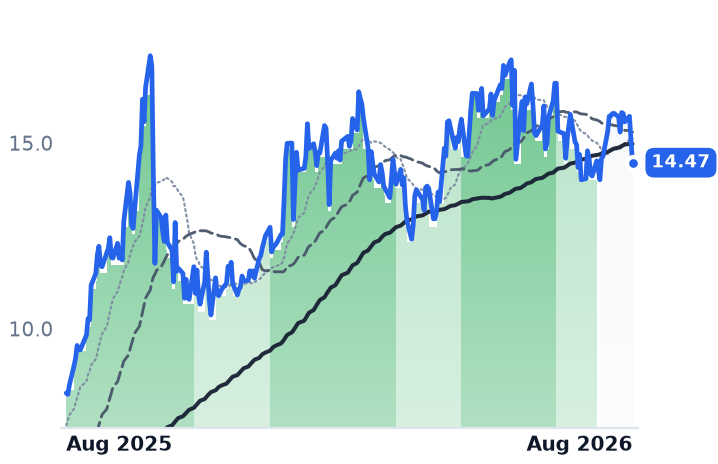
Anterix has held an uptrend since late January, its 50-day average above its 200-day every session — and unusually, it was earned gradually: strip its two best days and the year is still up 182%. It peaked on 4 August and has given back 16.6% since, including a double-digit drop the day after the June-quarter print. Cogent's fall came the opposite way, in violent single sessions of -34.9%, -29.3% and -25.9%. Sify has drifted: up 3.1% over thirty days, down 11.3% over three months, so its twelve-month gain is a late-2025 base effect rather than a live advance.
The setup
Where it stands — Anterix's re-rating rests on a $3bn pipeline, not the roughly $400m of proceeds contracted to date.
Would confirm — A signed utility agreement in the eight- or nine-figure range, at or above $1.40 per MHz-POP.
Would invalidate — Fiscal 2027 contracted proceeds finishing near the $10m of additional collections management guided to.
Watch next — The $226m buyback authorization expires in September 2026; management has said it may be renewed rather than spent.
Valuation — Roughly $0.60 per MHz-POP implied, versus $1.40 on executed deals and $2.50 at the AWS-3 auction.