

Analog Devices Raised Its Industry Growth Forecast to Double Digits. The Stock Fell.
Hypothesis Opus 5 · Research Opus 5 · Writing Opus 5 · Prompt v1.5
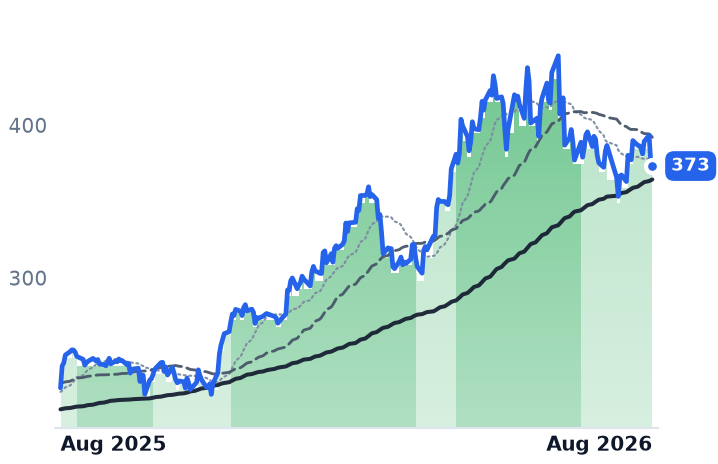
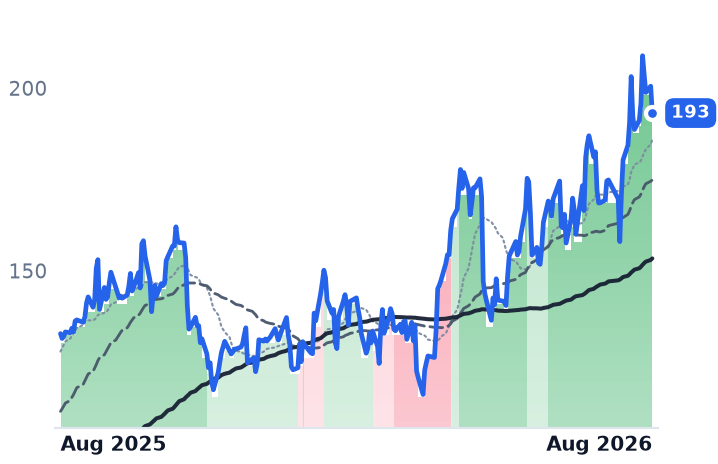
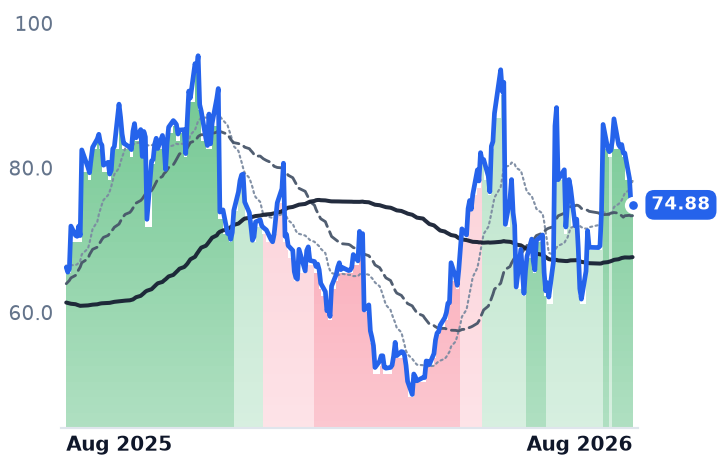
Analog Devices reported the first $4bn quarter in its history on Wednesday, beat on every line, guided the October quarter above consensus — and closed lower, leaving it 16% under its June peak. It also did something unusual: it lifted its long-run view of analog industry growth from 5-7% a year to double digits, on the arithmetic that each gigawatt of data-center capacity absorbs $1bn to $1.5bn of analog content.
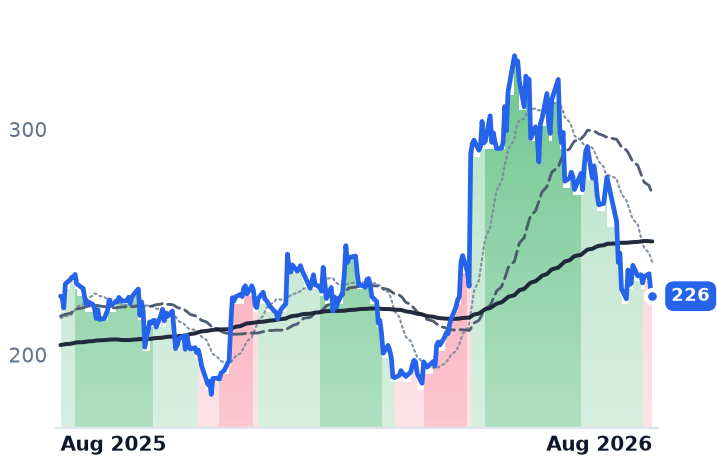
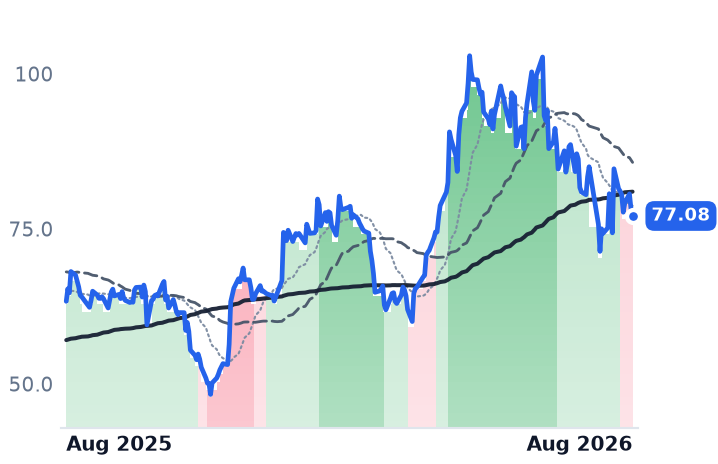
ADI is not alone. NXP and Microchip, the two big automotive-and-embedded chipmakers, peaked in the same session as ADI on 22 June and have since fallen 30% and 25%. Their results went the other way: NXP's backlog now stretches 18 months, Microchip's distributor inventory has been drawn down to 25 days and its gross margin has expanded five quarters running.
ADI, at 30.1x forward earnings after a 62% year, has the least room. NXP, at 15.0x, has the widest gap between price and print.
| Ticker | Company | Segment | Trend · 13mo | 30D | 1Y |
|---|---|---|---|---|---|
| The subject · what this brief is about | |||||
ADI | Analog Devices | Analog & Mixed-Signal | 🟢 Cont. Bull | +0.2% | +63.7% |
NXPI | NXP Semiconductors | Analog & Mixed-Signal | 🟢 Cont. Bull | −15.4% | −0.0% |
MCHP | Microchip Technology Incorporated | Analog & Mixed-Signal | 🟢 Cont. Bull | −4.3% | +21.7% |
| Compared against · context, not the story | |||||
AVGO | Broadcom | Semiconductor Subsystems | 🟢 Cont. Bull | −3.6% | +24.3% |
ANET | Arista Networks | Cloud Networking | 🟢 Cont. Bull | +11.3% | +42.0% |
TXN | Texas Instruments Incorporated | Analog & Mixed-Signal | 🟢 Cont. Bull | −5.0% | +40.6% |
ON | ON Semiconductor | Analog & Mixed-Signal | 🟢 Cont. Bull | −10.9% | +55.2% |
STM | STMicroelectronics | Analog & Mixed-Signal | 🟢 Cont. Bull | −18.2% | +97.2% |
AMBA | Ambarella | Specialty Semiconductors | 🟢 Cont. Bull | +14.0% | +13.0% |
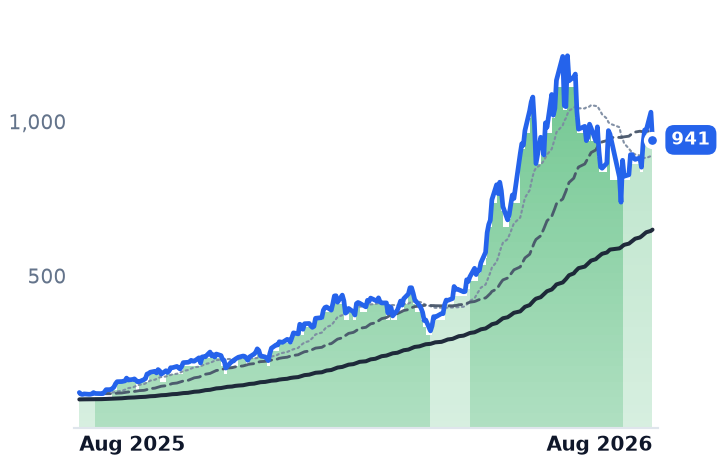
MU | Micron Technology | Memory (DRAM/NAND) | 🟢 Cont. Bull | +7.5% | +663.5% |
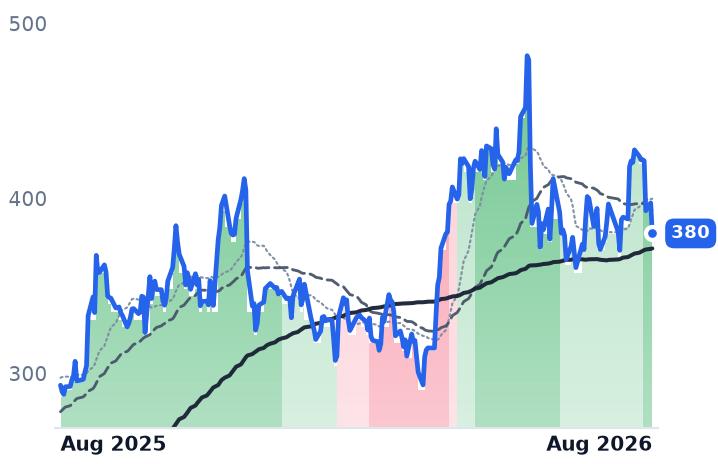
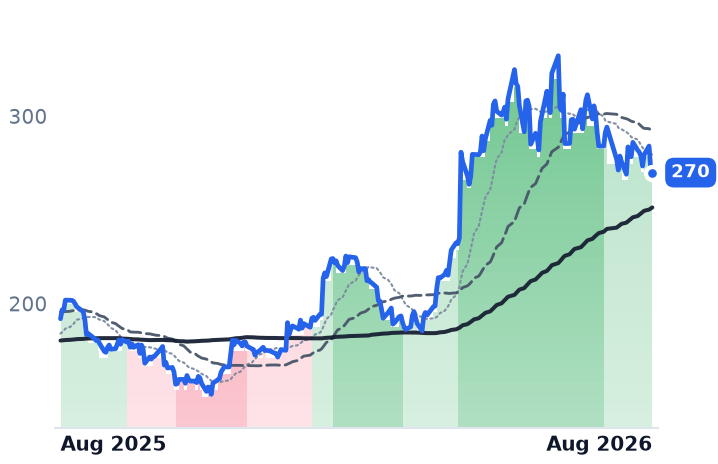
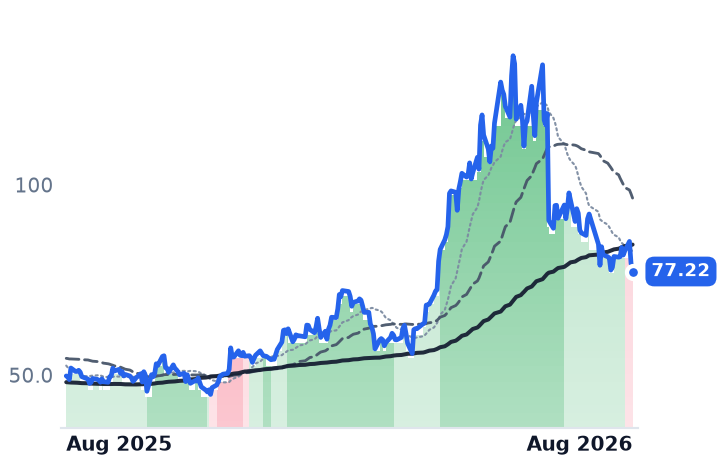
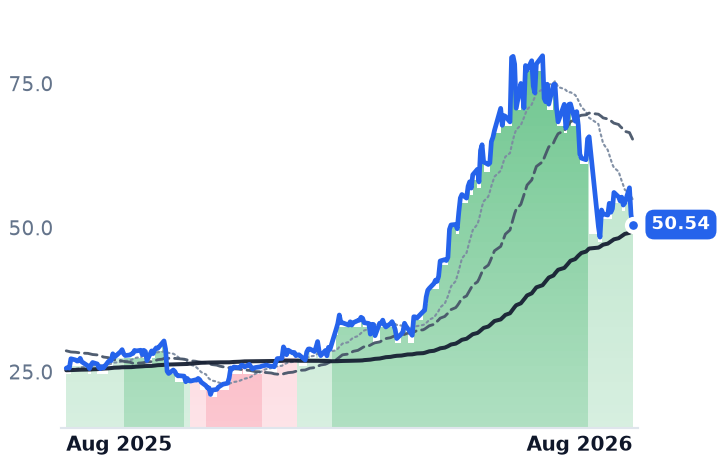
12-month price & trend
| Ticker | Mkt cap | P/E | P/E fwd | P/S | P/S fwd | P/GP | P/GP fwd | EV/EBITDA | FCF yld |
|---|---|---|---|---|---|---|---|---|---|
ADI | $181.8B | 44.1x | 30.1x | 13.1x | 12.3x | 19.9x | 18.7x | 28.9x | 2.7% |
NXPI | $57.0B | 19.2x | 15.0x | 4.3x | 4.0x | 7.7x | 7.1x | 13.2x | 5.2% |
MCHP | $41.9B | 106.8x | 24.1x | 8.2x | 6.7x | 13.6x | 11.2x | 27.9x | 2.7% |
| Ticker | Mkt cap | P/E | P/E fwd | P/S | P/S fwd | P/GP | P/GP fwd | EV/EBITDA | FCF yld |
|---|---|---|---|---|---|---|---|---|---|
AVGO | $1.7T | 58.9x | 31.4x | 23.0x | 16.4x | 34.3x | 24.5x | 42.4x | 1.9% |
ANET | $256.4B | 63.4x | 50.6x | 24.3x | 20.6x | 38.6x | 32.7x | 49.8x | 2.0% |
TXN | $258.4B | 42.8x | 33.4x | 13.3x | 11.8x | 22.8x | 20.2x | 29.5x | 2.1% |
| Ticker | Mkt cap | P/E | P/E fwd | P/S | P/S fwd | P/GP | P/GP fwd | EV/EBITDA | FCF yld |
|---|---|---|---|---|---|---|---|---|---|
ON | $32.5B | 52.8x | 26.1x | 5.2x | 5.0x | 14.0x | 13.2x | 26.4x | 5.5% |
STM | $49.8B | 107.2x | 41.7x | 3.7x | 3.5x | 10.9x | 10.1x | 22.5x | 0.8% |
AMBA | $3.3B | n/m | 94.4x | 8.1x | 7.4x | 13.9x | 12.7x | n/m | 0.8% |
| Ticker | Mkt cap | P/E | P/E fwd | P/S | P/S fwd | P/GP | P/GP fwd | EV/EBITDA | FCF yld |
|---|---|---|---|---|---|---|---|---|---|
MU | $1.0T | 19.9x | 12.2x | 11.2x | 7.8x | 15.4x | 10.7x | 14.5x | 2.6% |
Consensus projections
| Ticker | FY2026E | FY2027E | FY2028E | |
|---|---|---|---|---|
ADI | Revenue | +34.6% | +16.0% | +9.7% |
| EPS | +59.8% | +21.6% | +15.0% | |
NXPI | Revenue | +16.6% | +11.5% | +8.2% |
| EPS | +28.0% | +20.6% | +15.7% | |
MCHP | Revenue | +6.2% | +33.3% | +16.1% |
| EPS | +20.7% | +103.7% | +31.1% | |
AVGO | Revenue | +66.6% | +65.5% | +33.9% |
| EPS | +71.7% | +68.7% | +33.7% | |
ANET | Revenue | +40.0% | +27.7% | +21.9% |
| EPS | +39.6% | +25.5% | +23.9% | |
TXN | Revenue | +23.8% | +14.0% | +10.8% |
| EPS | +55.0% | +20.5% | +18.4% | |
ON | Revenue | +9.2% | +12.9% | +13.5% |
| EPS | +37.1% | +41.7% | +31.7% | |
STM | Revenue | +22.4% | +18.7% | +13.2% |
| EPS | +104.2% | +98.3% | +45.6% | |
AMBA | Revenue | +39.8% | +13.2% | +12.9% |
| EPS | −310.8% | +32.6% | +36.5% | |
MU | Revenue | +248.0% | +92.8% | +11.4% |
| EPS | +804.9% | +111.2% | +7.9% |
Forward fiscal years only. Blank means no analyst coverage for that year.
Analog Devices told investors on Wednesday that the analog chip market it has spent a decade describing as a 5-7% grower should now compound at double digits for several years. The reasoning is arithmetic, not enthusiasm: roughly 100 gigawatts of new data-center capacity between 2026 and 2031, with each gigawatt consuming $1bn to $1.5bn of the power-management, signal-conditioning and data-conversion parts the company sells. ADI supplies the analog layer around digital compute — the chips that turn physical current, voltage and radio signals into numbers — for factory automation, test equipment, cars and telecom networks.
The quarter underneath that forecast was the best in company history. Revenue reached $4.02bn, up 39.6% year on year, beating consensus and lifting October-quarter guidance to $4.2-4.4bn against $3.55 of expected earnings per share. GAAP gross margin was 67.3%, against 62.1% a year earlier. Industrial, at 49% of revenue, grew 53%. Communications grew 84%, four-fifths of it data center. The shares closed down slightly on the day and sit 16% below their 22 June high.
Three chipmakers, one peak date
That date matters, because NXP Semiconductors and Microchip Technology peaked in the same session. NXP, the Eindhoven-based supplier of automotive microcontrollers, radar and secure connectivity chips, has fallen 30.1% from its 22 June close; Microchip, the Arizona broad-line vendor of 8-, 16- and 32-bit microcontrollers alongside analog and timing parts, is down 25.0%. Both crossed from an uptrend into a downtrend in mid-August, their 50-day averages slipping under their 200-day.
Nothing in either company's results supports the move. NXP grew revenue 19.5% to $3.496bn in the June quarter, its fourth consecutive quarter of acceleration, with gross margin at 57.3% and operating income up 55.9%. On the 28 July call management said book-to-bill is above 1.0 and rising, backlog visibility now runs 18 months, and customer escalations doubled. Crucially, it attributed the growth to content per vehicle rather than restocking: Western tier-one inventories show no replenishment and ordering remains hand-to-mouth. NXP guided September revenue to $3.75bn. The stock fell 7.7% anyway.
Microchip's print was the sharpest reversal of the bear case. June-quarter revenue rose 38% to $1.485bn. Gross margin has now expanded for five straight quarters, from 51.6% to 63.2%, and the under-utilization charges from idled fabs are shrinking — about $30.5m guided for September, down from $38.5m. Distributor inventory is down to 25 days, the low end of its historical range; bookings were the strongest in four years. September revenue was guided to $1.59-1.62bn against roughly $1.55bn expected. Its competitive edge in this cycle is counterintuitive: some $450m of idle equipment and slack internal fabs at a moment when AI has crowded out external foundry, packaging and test capacity industry-wide.
What actually moved the prices
Strip each stock's two worst sessions from the last 90 days and the picture separates. Microchip's 18.0% decline becomes a 1.4% gain; ADI's 6.2% decline becomes a 10.8% gain. Both hinge on 23 and 26 June — days when the whole semiconductor complex unwound, with the VanEck semiconductor ETF down 6.5% and Micron down 11.4%. July was then the worst month for chip stocks in more than a decade, erasing over $1trn. The August leg was a discount-rate event: the 30-year Treasury yield touched 5.33% on 18 August as the Philadelphia Semiconductor index dropped 5.4%.
NXP is the exception. Its 27.1% 90-day fall only improves to 14.5% without its two worst days — a genuine, sustained drift. The company-specific news does not explain it: the succession to Rafael Sotomayor completed in October 2025, and the reported approach to Ambarella, the edge-AI vision chip maker valued near $3.3bn, is an outbound purchase.
Where the price leaves room
Against mid-May, all three multiples have compressed: NXP from about 19.5x forward earnings to 15.0x, Microchip from 28.8x to 24.1x, ADI from 33.4x to 30.1x. NXP trades below its 19.2x trailing multiple because estimates are rising — consensus has FY2026 earnings up 28% — and carries a 5.2% free-cash-flow yield. Microchip's 106.8x trailing multiple prices trough profits and says nothing; 24.1x forward sits on earnings consensus expects to double. ADI is the one where the fall looks like a re-rating of a rich stock rather than a mispricing: 30.1x forward and 18.7x forward gross profit, after gaining 62% over twelve months. NXP, over the same twelve months, is flat.