

Klarna Cut Guidance on German Retail and Currency, Not Credit. Its Loss Rate Fell.
Hypothesis Opus 5 · Research Opus 5 · Writing Opus 5 · Prompt v1.5
Klarna's shares lost 29.7% in five sessions after its 18 August results, and the obvious explanation — that buy-now-pay-later lenders are entering a bad-debt cycle — is the one the disclosure rules out. Provisions for credit losses fell to 0.52% of gross merchandise volume from 0.56% a year earlier, and the company raised its full-year transaction-margin guide even as it cut revenue by roughly $250m on currency translation and slowing German retail volumes.
The peers refused to follow. Affirm, which unlike Klarna carries its loans against warehouse lines and securitizations, saw funding costs fall about 125 basis points year over year; Remitly holds no loan book at all and raised its outlook in August. What Affirm has instead is a multiple: price to trailing gross profit went from about 8.1x in May to 9.6x, on results it has not yet updated. Its next print lands 27 August.
| Ticker | Company | Segment | Trend · 13mo | 30D | 1Y |
|---|---|---|---|---|---|
| The subject · what this brief is about | |||||
AFRM | Affirm | Consumer Fintech & Lending | 🌱 Emerging Bull | +2.5% | +4.5% |
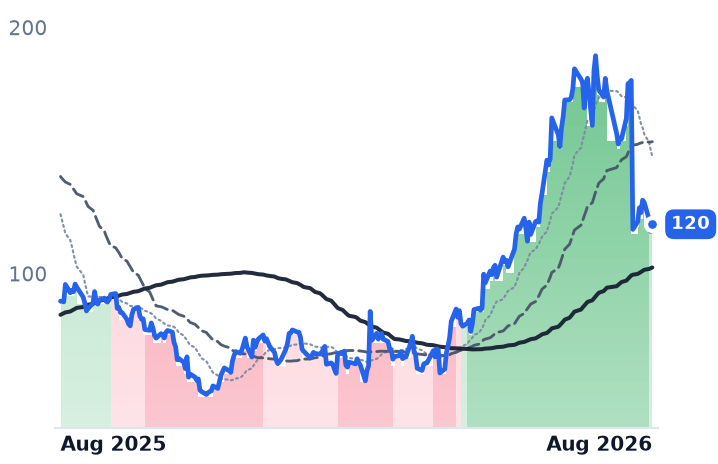
KLAR | Klarna | Consumer Fintech & Lending | 🔴 Cont. Bear | −22.1% | −65.8% |
RELY | Remitly Global | Consumer Fintech & Lending | 🌱 Emerging Bull | +5.6% | +33.7% |
| Compared against · context, not the story | |||||
PYPL | PayPal | Digital Payments & Fintech Platforms | 🔴 Cont. Bear | +8.0% | −10.7% |
SEZL | Sezzle | Digital Payments & Fintech Platforms | 🌱 Emerging Bull | −30.1% | +35.2% |
12-month price & trend
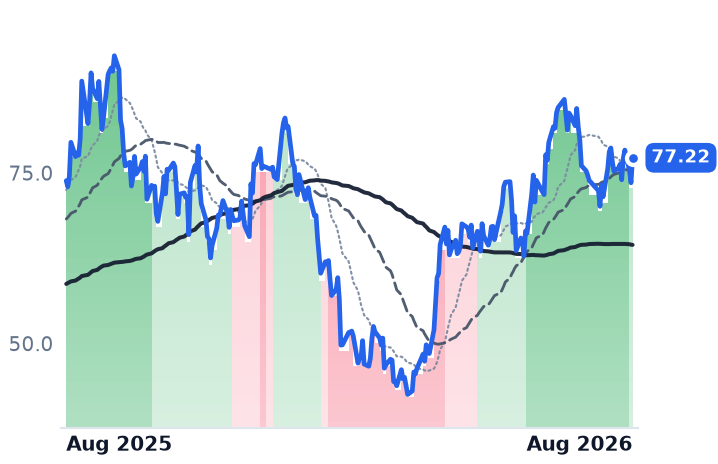
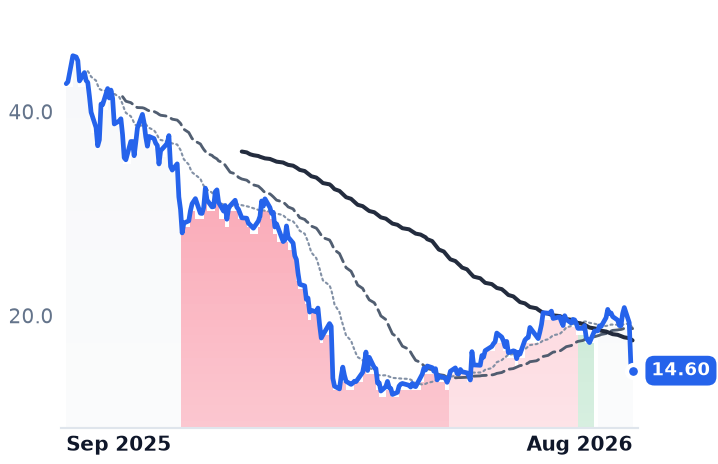
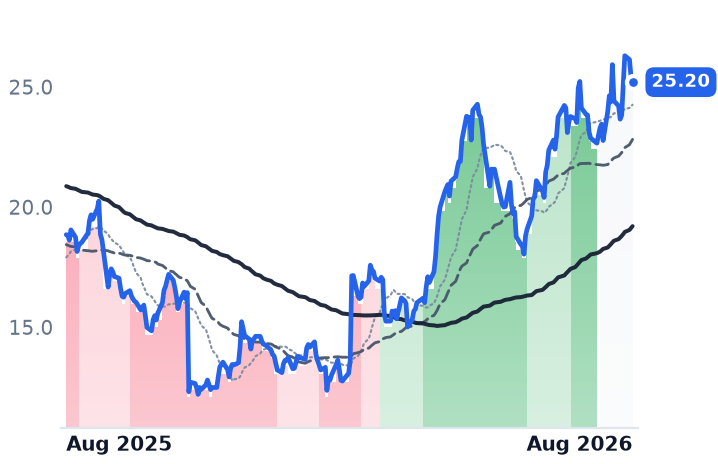
| Ticker | Mkt cap | P/E | P/E fwd | P/S | P/S fwd | P/GP | P/GP fwd | EV/EBITDA | FCF yld |
|---|---|---|---|---|---|---|---|---|---|
AFRM | $25.9B | 67.2x | 43.0x | 6.5x | 4.9x | 9.6x | 7.2x | 29.0x | 3.0% |
KLAR | $5.6B | n/m | 70.6x | 1.4x | 1.3x | 3.0x | 2.7x | 3.4x | -47.0% |
RELY | $5.3B | 17.3x | 24.6x | 2.9x | 2.7x | 4.9x | 4.4x | 22.0x | 8.3% |
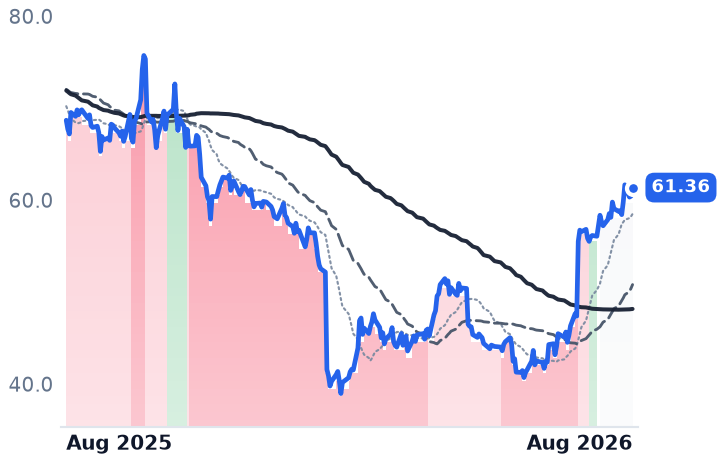
| Ticker | Mkt cap | P/E | P/E fwd | P/S | P/S fwd | P/GP | P/GP fwd | EV/EBITDA | FCF yld |
|---|---|---|---|---|---|---|---|---|---|
PYPL | $39.2B | 8.0x | 8.4x | 1.2x | 1.1x | 2.5x | 2.5x | 5.8x | 14.1% |
SEZL | $3.3B | 22.5x | 19.4x | 6.9x | 5.6x | 7.8x | 6.3x | 17.3x | 7.2% |
Consensus projections
| Ticker | FY2026E | FY2027E | FY2028E | |
|---|---|---|---|---|
AFRM | Revenue | +32.0% | +25.5% | +24.8% |
| EPS | +2239.1% | +43.9% | +43.6% | |
KLAR | Revenue | +26.1% | +19.6% | +18.1% |
| EPS | −127.5% | +292.7% | +63.2% | |
RELY | Revenue | +22.3% | +19.3% | +18.7% |
| EPS | +43.8% | −5.1% | +19.8% | |
PYPL | Revenue | +3.2% | +4.1% | +4.4% |
| EPS | −1.0% | +8.6% | +9.0% | |
SEZL | Revenue | +32.4% | +27.0% | — |
| EPS | +51.5% | +27.4% | — |
Forward fiscal years only. Blank means no analyst coverage for that year.
A cut that spared the loan book
Klarna Group, the Swedish-founded, London-headquartered payments company that lends shoppers small sums at checkout and funds itself as a licensed retail bank, delivered a good quarter and a bad year on 18 August. Second-quarter revenue was $1.042bn, up 27% and above its own guidance range, with net income of $9m against a $53m loss a year earlier — the first profit in its short life as a listed company. The stock fell 22% that session on 34.4m shares, against a normal day near 2m.
The damage came from the outlook. Klarna took full-year revenue guidance to $4.08–4.16bn from $4.34bn, against $4.42bn of consensus, and gross merchandise volume to $149–151bn from more than $155bn. Management attributed the reduction to roughly $600m of negative currency translation and a more cautious view of Germany, its largest market, where retail sales slowed. Its chief financial officer and chief marketing officer will both step down in early 2027.
What did not happen is the thing the share price implies. Provisions for credit losses were 0.52% of volume, better than 0.56% a year earlier, with provision dollars up 11% against volume up 18%. Klarna simultaneously raised its full-year transaction-margin guide to $1.62–1.65bn — the gross-profit line went up while the revenue line went down. Roughly 90% of its book is funded by consumer deposits, which is why the long end of the Treasury curve, where the 30-year touched 5.323% on the day of the crash, a 19-year high, does not reach its cost of money.
Affirm's advance was bought, not earned
Affirm, the San Francisco lender that spreads purchases over one to 48 months across some 29,000 integrated merchants and keeps the credit risk on its own balance sheet, is the direct competitor for the same American checkout. It is also, on the last comparable quarters, winning it: Affirm's volume grew 35% against Klarna's 18%, and Klarna's US volume grew 27%. Five firms account for more than 95% of US buy-now-pay-later volume, with banks including JPMorgan now bolting on their own instalment features.
Affirm's credit is flat to better. At 31 March, 30-day-plus delinquencies on US monthly installment loans stood at 2.8% versus 2.7% in December, and the 90-day-plus rate improved to 0.7%. Revenue less transaction costs — the company's own gross-profit measure — grew 41% to $498.2m, faster than volume, lifting the take rate to 4.3%. Funding got cheaper rather than dearer: costs fell about 125 basis points year over year, and the 2026-2 securitization was upsized to $750m from $500m and more than twice oversubscribed.
The soft spot is price. Affirm has risen 18.3% in three months on a trailing gross-profit base that has not changed since the 7 May report, taking price to trailing gross profit from roughly 8.1x to 9.6x, or 7.3x forward. Forward earnings sit at 43x. Nothing in the business deteriorated; the shares simply got more expensive per dollar of the same profit. The company guided fiscal fourth-quarter volume of $13.15–13.45bn and reports on 27 August.
The one with no borrowers
Remitly, the Seattle app immigrants use to send money home across nearly 150 countries, is grouped with these two and shares almost nothing with them: it earns a foreign-exchange spread and a fee per transfer, and holds no consumer loans. Second-quarter revenue was $495.2m, up 20%, on send volume of $23.5bn and 10.2m active customers. It raised full-year guidance. The new US remittance tax, widely read as a threat, pushed senders toward digital channels and produced a record quarter of customer acquisition. Its trailing price/earnings ratio of 17.3x flatters: second-quarter net income included a $140.6m one-off tax benefit, which is why forward earnings, at 24.6x, are more expensive than trailing.
The macro backdrop does not carry a credit story either. The New York Fed's 11 August report showed 4.7% of household debt delinquent, a slight improvement, with credit-card delinquency transitions easing to 8.6%. On the crash session, Affirm traded roughly flat and PayPal higher; Affirm closed 5.0% higher the next day. Klarna now trades at 1.26x forward sales against Affirm's 4.91x and Remitly's 2.66x — a gap that is either a verdict on European volumes or a mispricing of the same instalment product.
The setup
Where it stands — Klarna's break was a currency-and-Germany volume event; its credit metrics and gross-profit guide both improved, and neither peer followed it down.
Would confirm — Affirm's 27 August print landing revenue less transaction costs inside its $535–550m guide with 30-day-plus delinquencies at or below 2.8%.
Would invalidate — Klarna's third-quarter provisions rising above 0.56% of volume, or Affirm's take rate falling below 4.0%.
Watch next — Affirm fiscal fourth-quarter results, 27 August 2026; Klarna guided third-quarter revenue of $940–980m.
Valuation — Affirm 9.6x trailing and 7.3x forward gross profit, against about 8.1x in May; Klarna 1.26x forward sales.