

Ericsson's Radio Sales Fell 8% While AI Data Centers Bid Away Its Memory Chips
Hypothesis Opus 5 · Research Opus 5 · Writing Opus 5 · Prompt v1.4
Three companies filed under wireless and mobile networks have gained roughly 16% in a month, a move that reads as a revival in carrier spending. Taken apart, it is nothing of the kind.
Ericsson is the only one of the three that actually sells radio gear to mobile operators, and its Networks sales fell 8% last quarter — the fourth straight quarter of declining company revenue. Consensus now models 2026 earnings of SEK5.46 a share against SEK8.00 delivered in 2025. Its month looks positive only because the window opens the day after a 13.5% earnings-day crash. Motorola Solutions is genuinely accelerating, at 13.3% revenue growth, but the raise came from military mesh radios sold to NATO members, not public-safety budgets. Ondas grew revenue thirteen-fold and diluted its share count 234% doing it.
Strip each name's two best sessions and the month is about +1.5%.
| Ticker | Company | Segment | Trend · 13mo | 30D | 1Y |
|---|---|---|---|---|---|
ERIC | Telefonaktiebolaget LM Ericsson (publ) | Wireless & Mobile Networks | 🟢 Cont. Bull | +7.1% | +38.0% |
MSI | Motorola Solutions | Wireless & Mobile Networks | ⚠️ Emerging Bear | +13.7% | +2.0% |
ONDS | Ondas | Wireless & Mobile Networks | ⚠️ Emerging Bear | +34.5% | +130.4% |
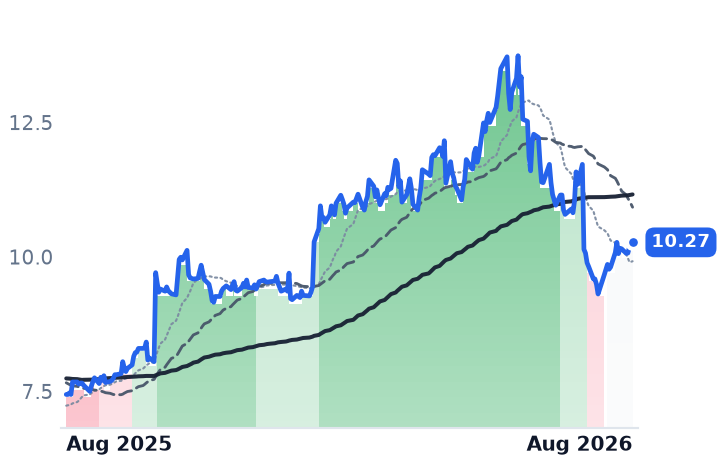
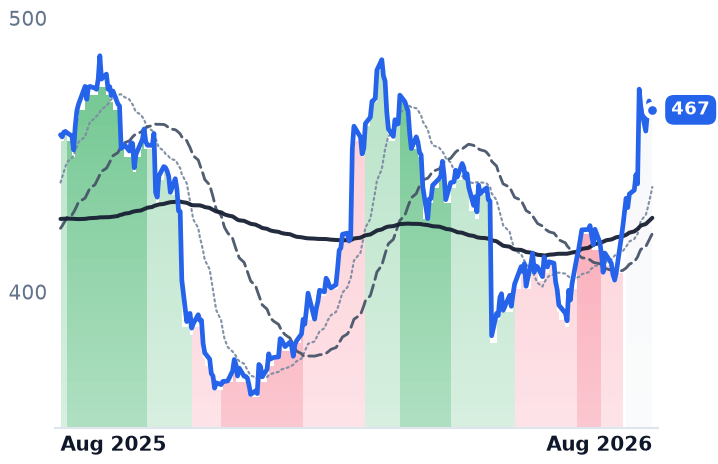
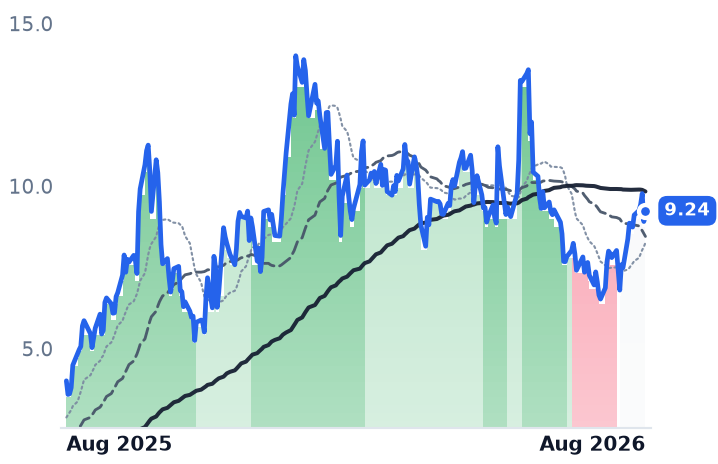
12-month price & trend
| Ticker | Mkt cap | P/E | P/E fwd | P/S | P/S fwd | P/GP | P/GP fwd | EV/EBITDA | FCF yld |
|---|---|---|---|---|---|---|---|---|---|
ERIC | $33.7B | 13.2x | — | 1.4x | — | 2.9x | — | 6.9x | 9.7% |
MSI | $77.4B | 36.3x | 26.7x | 6.3x | 6.0x | 12.7x | 12.0x | 22.7x | 3.5% |
ONDS | $5.3B | 96.0x | 18.6x | 30.2x | 10.0x | 69.2x | 22.9x | 79.0x | -3.2% |
Consensus projections
| Ticker | FY2026E | FY2027E | FY2028E | |
|---|---|---|---|---|
ERIC | Revenue | −2.3% | +1.8% | +2.7% |
| EPS | −30.9% | +16.7% | +10.3% | |
MSI | Revenue | +11.1% | +6.6% | +6.4% |
| EPS | +15.4% | +8.2% | +10.8% | |
ONDS | Revenue | +989.3% | +81.8% | +37.3% |
| EPS | −300.2% | −133.7% | −88.1% |
Forward fiscal years only. Blank means no analyst coverage for that year.
The category label says wireless and mobile networks. Only one of the three companies inside it sells equipment to mobile-network operators, and that business is contracting. The other two are, in substance, a defense-radio maker and a drone company that happen to move data over private radio spectrum.
The one that sells to carriers
Ericsson, the Stockholm supplier of radio access network hardware, software and services to mobile operators, reported second-quarter sales of SEK54.3bn, down 1.3% year over year. That is the fourth consecutive quarter of decline. Networks — the largest and highest-margin segment, and the one that would register any capital-spending inflection — fell 8% to about SEK33bn, an organic drop of 4%, with declines across Europe, the Middle East, Africa and the Americas and growth only in Asia.
The industry backdrop agrees. Dell'Oro Group, which tracks telecom equipment shipments, has worldwide RAN revenue growing at roughly a 1% compound annual rate over five years as operators prioritize capital efficiency. Operator spending has not turned.
What has turned is Ericsson's cost of parts. Management guided third-quarter Networks adjusted gross margin down to 48-50% from 50.4% and warned that component cost inflation will build through 2027, with no automatic pass-through in long-term contracts. The cause sits outside telecom: server memory prices could double by the end of 2026 as Samsung, SK Hynix and Micron shift wafer capacity toward high-bandwidth memory for AI accelerators, with data centers expected to absorb 70% of global output. Equipment makers are at the back of that queue.
Ericsson's shares are cheap on delivered numbers — 13.2x trailing earnings, 6.9x EV/EBITDA and a 9.7% free-cash-flow yield. But consensus has 2026 earnings per share at SEK5.46 against SEK8.00 in 2025, a 31% cut, with no revenue growth until 2027. Per Narvinger, the current Networks head, takes over as chief executive on 1 October, replacing Borje Ekholm, who conceded on the July call that the shares had underperformed the Nasdaq-100 by 67% since 2017.
The one that is accelerating
Motorola Solutions sells land mobile radios, video security and command-center software to police, fire and government customers. Revenue of $3.13bn grew 13.3% last quarter, up from 7.4% in the first — acceleration, not the deceleration the sector implies. Gross margin reached 53.6% from 51.1%, and backlog hit a record $15.6bn, up 11%. Full-year guidance went to about $12.975bn of revenue and $17.62-$17.72 of adjusted earnings per share.
The composition matters. Silvus military mesh radios were lifted to $850m for the year on NATO, German, Ukrainian and Indo-Pacific demand; international revenue grew 25% against 9% in North America. The recurring software and services segment grew 10%, slower than the 15% in hardware — the subscription mix is being diluted, not enriched. Motorola also flagged a $150m memory-cost headwind, the same squeeze hitting Ericsson, and agreed to buy counter-drone specialist D-Fend Solutions for $1.5bn.
At 26.7x forward earnings against 36.3x trailing, the stock is below the roughly 30x it carried a year ago on then-forward numbers — the price is 1.1% higher than twelve months ago while consensus earnings moved from $15.16 to $17.49. Still, the guidance raise lifted the earnings midpoint about 4.7% while the shares rose 14.6% in a month; two-thirds of that is investors paying more for the same dollar.
The one that printed shares
Ondas Holdings, a Massachusetts maker of private wireless radios and autonomous drone systems for rail, energy and defense customers, reported revenue of $83.8m against $6.3m a year earlier. Pro forma backlog reached $757m from $68m at end-2025, and full-year guidance went to $525-550m against 2025 revenue of $50.7m.
The funding tells the other half. Diluted shares went from 150.7m to 503.6m in a year, a 234% increase, after a $1bn registered direct offering and a shareholder vote lifting authorized stock to 1.2bn shares. So the 17.6% fall in the share price over three months is not a shrinking company or a cheaper one. Adjusted EBITDA loss widened to $50.6m from $5.8m, with company-wide profitability guided only to late 2027, and consensus models net losses again in 2027 and 2028. Forward price-to-sales is 10.0x on revenue never yet delivered.
The arithmetic
The month decomposes to Ericsson +2.0%, Motorola +14.6% and Ondas +31.1%. Remove each name's two best sessions — Motorola's 7.9% jump the day after earnings, three Ondas sessions near 11.5% — and the group's month falls to about +1.5%, with Ericsson negative. Ericsson's window begins one day after the ADR dropped 13.5% on a Q2 miss; it remains 12% below the pre-earnings price. Over three months the three are down about 6.6% together, and the 57% twelve-month gain is Ondas at +135% against Motorola's +1.1%.
The setup
Where it stands — One month of gains, authored by two earnings sessions and a micro-cap, with carrier spending still falling. Would confirm — Ericsson Networks organic sales returning to growth, or third-quarter adjusted gross margin holding above the guided 48-50%. Would invalidate — Motorola's software and services growth reaccelerating past hardware, restoring recurring mix rather than diluting it. Watch next — Ericsson's third-quarter report in October, Per Narvinger's first as chief executive; Ondas guided to $140-155m of Q3 revenue. Valuation — Motorola 26.7x forward against 36.3x trailing and roughly 30x a year ago; Ericsson 13.2x trailing on earnings guided down 31%.