

Calix Grew 21% and Fell 31%: an AI Memory Shortage Is Eating Its Margin, Not Demand
Hypothesis Opus 5 · Research Opus 5 · Writing Opus 5 · Prompt v1.4
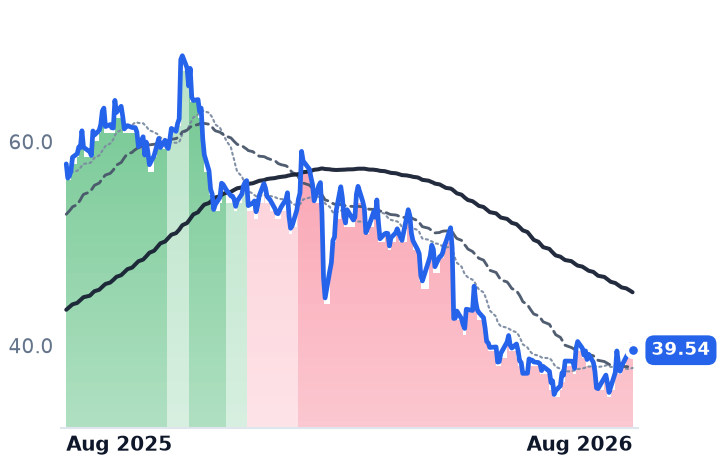
Calix sells the access boxes and cloud software that small and rural internet providers use to run fiber networks. Its June quarter was the best in two years — revenue up 21.3%, a record $386m of contracted backlog, and real operating profit for the first time since 2024. The shares fell about 7% that day and are down roughly 31% over twelve months.
What broke is an input, not demand. An AI-driven shortage of memory chips cut appliance gross margin 460 basis points in a single quarter, and management guided the next one to a 52% midpoint.
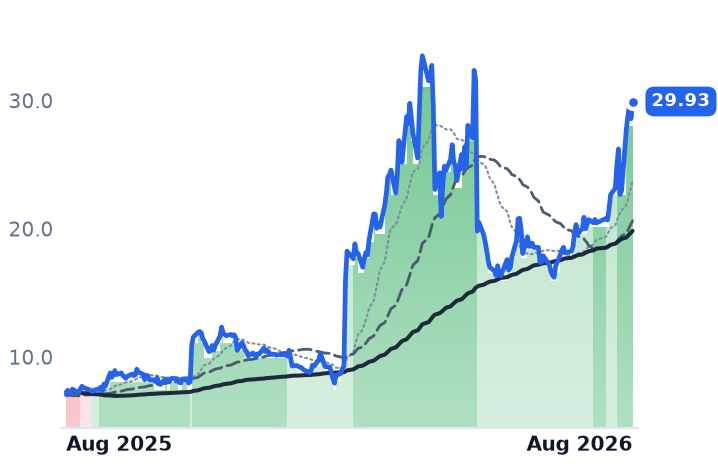
Calix is grouped with three other cloud and software names whose 15% month is almost entirely Fastly, up 49.7% in 30 sessions on traffic-based billing. Strip each name's two best sessions and the four average about -1%. Fastly's forward price-to-sales has gone from roughly 3.6x in May to 6.34x.
| Ticker | Company | Segment | Trend · 13mo | 30D | 1Y |
|---|---|---|---|---|---|
CALX | Calix | Cloud Infrastructure & Platform | 🔴 Cont. Bear | +1.0% | −31.6% |
FSLY | Fastly | Cloud Infrastructure & Platform | 🟢 Cont. Bull | +44.4% | +322.7% |
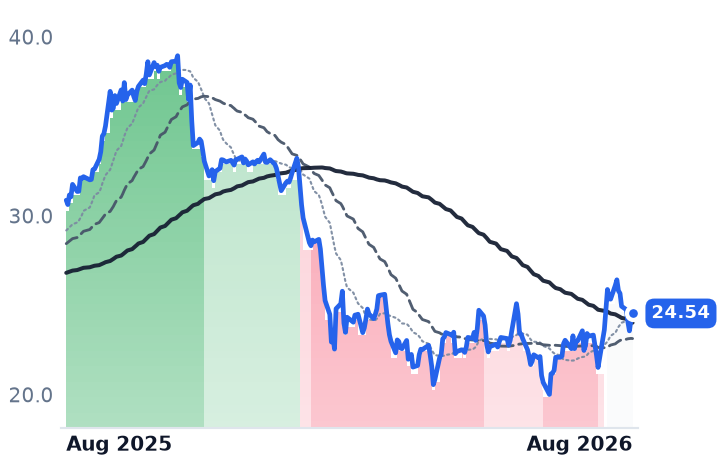
OTEX | Open Text | Cloud Infrastructure & Platform | ⚠️ Emerging Bear | +5.5% | −20.5% |
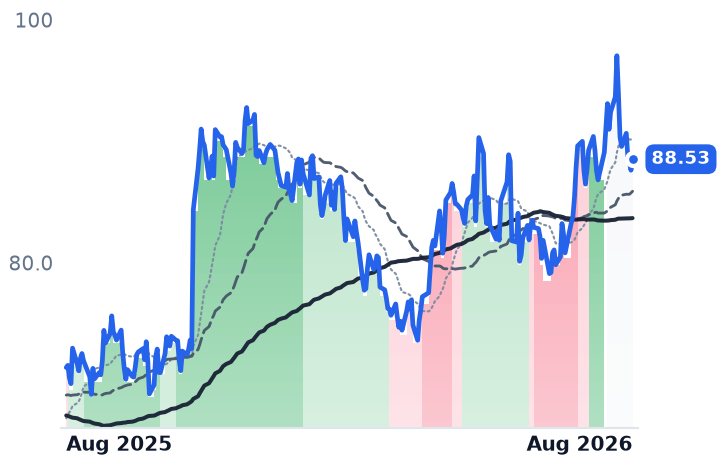
PLUS | ePlus | Cloud Infrastructure & Platform | 🟢 Cont. Bull | −0.8% | +24.0% |
12-month price & trend
| Ticker | Mkt cap | P/E | P/E fwd | P/S | P/S fwd | P/GP | P/GP fwd | EV/EBITDA | FCF yld |
|---|---|---|---|---|---|---|---|---|---|
CALX | $2.5B | 50.1x | 23.0x | 2.2x | 2.1x | 4.0x | 3.7x | 27.4x | 3.4% |
FSLY | $4.7B | n/m | 58.7x | 6.8x | 6.3x | 11.1x | 10.3x | n/m | 0.9% |
OTEX | $6.0B | 5.4x | 5.6x | 0.7x | 1.1x | 0.9x | 1.6x | 3.5x | 25.0% |
| Ticker | Mkt cap | P/E | P/E fwd | P/S | P/S fwd | P/GP | P/GP fwd | EV/EBITDA | FCF yld |
|---|---|---|---|---|---|---|---|---|---|
PLUS | $2.3B | 18.4x | 16.2x | 0.9x | 0.9x | 3.8x | 3.7x | 9.4x | 2.4% |
Consensus projections
| Ticker | FY2026E | FY2027E | FY2028E | |
|---|---|---|---|---|
CALX | Revenue | +19.4% | +15.6% | +14.4% |
| EPS | +27.8% | +33.8% | +45.1% | |
FSLY | Revenue | +20.6% | +11.9% | +10.6% |
| EPS | +870.1% | +11.5% | +13.1% | |
OTEX | Revenue | −1.7% | +2.0% | +1.4% |
| EPS | +11.3% | +6.3% | +5.6% | |
PLUS | Revenue | +16.0% | +5.2% | +4.9% |
| EPS | +18.1% | +5.0% | +8.8% |
Forward fiscal years only. Blank means no analyst coverage for that year.
The memory chips inside a broadband access box are the same commodity that artificial-intelligence data centers are now buying by the pallet. That is the single most important fact about Calix this year, and it explains a share price that has moved in the opposite direction to the business for seven months.
The record quarter nobody rewarded
Calix supplies access systems and premises equipment to broadband service providers — mostly small, regional and rural operators — alongside a subscription cloud platform that those operators use for marketing, support and network operations. Its June quarter produced revenue of $293.3m, up 21.3% from a year earlier, the fourth straight quarter above 20%. Operating income came in at $21.8m against $0.4m a year ago. Remaining performance obligations, the contracted revenue not yet recognized, reached a record $386m. Software and services revenue hit a record $50m. Management raised full-year guidance toward the top of its 15-20% growth range and bought back $69m of stock in the quarter.
The shares fell about 7% on the day, to roughly $35.78. The reason sat one line below the beat: third-quarter gross margin guided to 50.5-53.5%, with appliance gross margin already down 460 basis points sequentially on memory costs that customer surcharges only partly offset. Reported gross margin has fallen from 57.7% in the December quarter to 54.6% in June.
That pressure is not a Calix decision. Gartner expects prices for dynamic random-access memory (DRAM) to rise 47% in 2026, with roughly 70% of memory production allocated to AI data centers. Anyone building a box with memory in it is paying. ePlus's chief executive, Mark Marron, named the same shortage as the cause of shipment delays in his own June quarter.
Calix shares have traded below both their 50-day and 200-day averages continuously since 13 January, 146 sessions — the longest such run among the four names it is grouped with. The stock is down 30.6% over twelve months while earnings turned positive. It changes hands at 22.97x forward earnings against 50.05x trailing, and against roughly 31x implied at February's $53.32 price. Consensus has earnings per share going from $1.72 this year to $2.30 next. Management's own caution is the counterweight: it told investors 2027 could be "harder than 2026," and flagged satellite broadband as a threat to 5-10% of its addressable market.
One stock is the whole group
The four companies filed together under cloud infrastructure share no business model — and Calix is classified by data vendors as communication equipment, not software at all. Over the 30 sessions to 14 August, Fastly rose 49.7%, OpenText 7.9%, ePlus 2.4% and Calix 0.2%. Remove each name's two best sessions and the average turns slightly negative. Over twelve months Fastly is up 330.6%; the median of the four is roughly -0.8%.
Fastly runs an edge network billed by traffic delivered and requests served. Its June-quarter revenue grew 23.3% to $183.3m, the fastest in four years, gross margin climbed from 58.4% to 63.3% over four quarters, and gross profit grew 51.9%. Net revenue retention — spending by existing customers against a year earlier — reached 117%, from 104%. It raised full-year revenue guidance to $732-746m. It also remains loss-making under standard accounting, at -$15.6m. Growth is narrow: the top 10 customers, 37% of revenue, supplied 87% of sequential growth, and management called roughly $10m of the quarter episodic, noting three-quarters of World Cup matches fell in the June period. Its biggest single day, a 20.9% gain on 10 August, followed target hikes rather than any new disclosure. Forward price-to-sales is 6.34x, against roughly 3.6x implied at May's $17.00 close.
OpenText, which licenses enterprise information-management software to large corporations and governments, is the cheapest of the four at 5.56x forward earnings with a trailing free-cash-flow yield of 25.0% — and the reason is on the page. Fiscal 2026 revenue grew 1.5%, and fiscal 2027 is guided to $5,135-5,185m, a decline of 1-2%, with adjusted margin falling from 36.3% to 32-33% as it hires 300-plus salespeople.
ePlus, which resells other vendors' hardware and software for a gross-profit spread, is the mirror image of Calix. Revenue growth fell from 23.4% a year ago to 1.9% in the June quarter, gross margin narrowed to 23.3%, and net income dropped 19.7% to $30.3m. Its forward multiple went the other way, from roughly 13.4x a year ago to 16.17x.
The setup
Where it stands — Calix is growing above 20% with record backlog while memory costs have cut gross margin 310 basis points in two quarters. Would confirm — Third-quarter gross margin printing at or above the 53.5% top of guidance. Would invalidate — Third-quarter revenue below the $301m low end, or full-year growth guided back under 15%. Watch next — Calix's third-quarter report in late October, against a 52% gross-margin midpoint and $301-307m revenue guide. Valuation — 22.97x forward earnings versus 50.05x trailing and roughly 31x implied at February's $53.32 price.