

Corning's Optical Business Accelerated While Its Multiple Compressed
Hypothesis Opus 5 · Research Opus 5 · Writing Opus 5 · Prompt v1.3
Corning told investors on 28 July that its optical communications division — the fibre, cable and connectors that wire data centres — sold $2.07bn in the June quarter, up 32%, with the enterprise half up 65% and segment profit up 77% to a record 21% margin, on contracted multi-year orders from Meta, Nvidia and Amazon. It then guided the September quarter to $4.9-5.0bn against roughly $5bn expected, and the shares halved from their peak before rebounding on a reported US move to bar Chinese optical transceivers.
The business explains almost none of the drop. Corning now trades at 50.7x forward earnings, down from about 59x in May, and 23.1x gross profit against 26.3x three months ago — cheaper on every measure while growth accelerated. Universal Display is the opposite case: revenue fell 11.4% and material sales 26%, and its de-rating is deserved.
What is unresolved is whether 50x forward is a discount or still a price.
| Ticker | Company | Segment | Trend | 30D | 1Y |
|---|---|---|---|---|---|
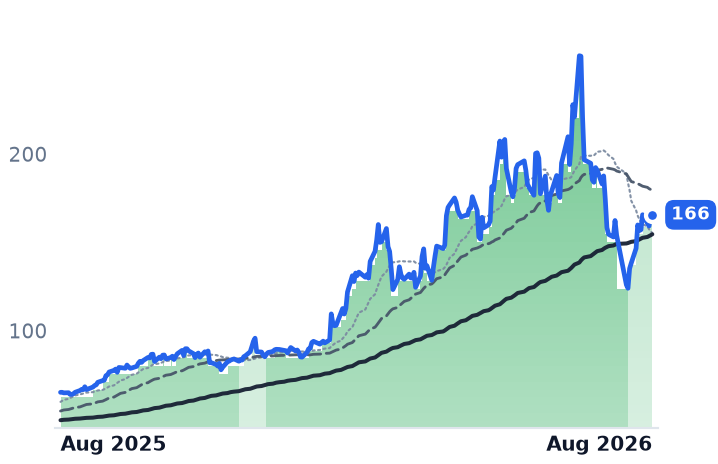
GLW | Corning | Display & Optical Materials | 🟢 Cont. Bull | −11.7% | +154.3% |
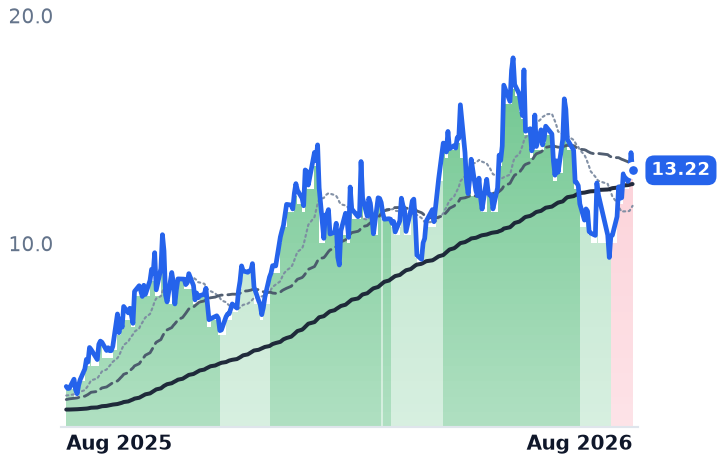
LPTH | LightPath Technologies | Display & Optical Materials | 🟢 Cont. Bull | +14.7% | +254.3% |
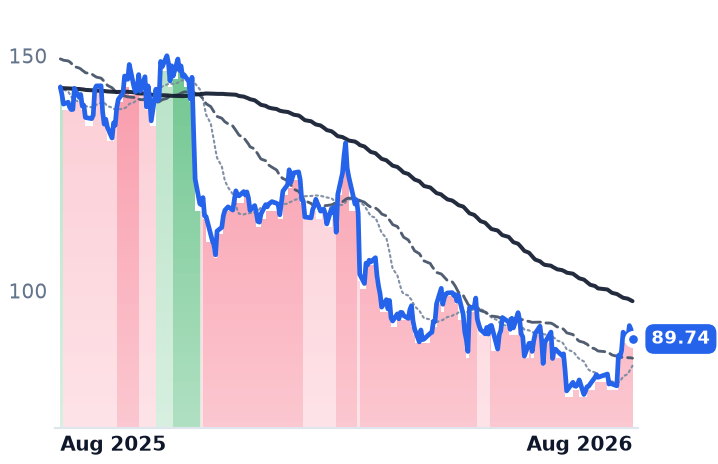
OLED | Universal Display | Display & Optical Materials | 🔴 Cont. Bear | +14.1% | −37.4% |
12-month price & trend
| Ticker | Mkt cap | P/E | P/E fwd | P/S | P/S fwd | P/GP | P/GP fwd | EV/EBITDA | FCF yld |
|---|---|---|---|---|---|---|---|---|---|
GLW | $142.7B | 74.9x | 50.7x | 8.4x | 7.4x | 23.1x | 20.4x | 38.3x | 1.7% |
LPTH | $830.1M | n/m | 480.9x | 13.2x | 7.9x | 41.2x | 24.6x | n/m | -1.2% |
OLED | $4.1B | 21.6x | 21.3x | 6.8x | 6.5x | 9.0x | 8.6x | 15.6x | 4.1% |
Consensus projections
| Ticker | FY2026E | FY2027E | FY2028E | |
|---|---|---|---|---|
GLW | Revenue | +17.5% | +18.7% | +21.0% |
| EPS | +29.6% | +31.7% | +36.5% | |
LPTH | Revenue | +91.2% | +47.8% | +32.5% |
| EPS | −7.6% | −113.3% | +1754.5% | |
OLED | Revenue | −2.7% | +7.4% | +11.7% |
| EPS | −14.8% | +12.9% | +21.0% |
Forward fiscal years only. Blank means no analyst coverage for that year.
The order book grew; the guidance did not
Corning, the New York company founded in 1851 that draws optical fibre and cable, makes the glass substrates inside televisions and phones, and supplies ceramic filters for vehicle exhausts, told investors on 28 July that its optical communications division sold $2.07bn in the June quarter, up 32% from a year earlier. The enterprise half — the fibre and connectors that go inside data centres rather than under streets — rose 65% to $1.27bn, and sales tied to artificial-intelligence build-outs came close to doubling. Segment net income rose 77% to $438m, a record 21% margin. Carrier sales, the telecom half, grew 1%.
That demand is contracted rather than hoped for. Meta signed a roughly $6bn multi-year fibre, cable and connectivity agreement; Nvidia signed a multi-year optical partnership in May under which Corning expands its US optical connectivity manufacturing capacity tenfold and its US fibre capacity by more than half; Amazon signed a multi-billion-dollar data-centre agreement in June. Management raised its Springboard plan, which sets annualised revenue run-rate targets, to $20bn by end-2026, $30bn by 2028 and $40bn by 2030.
The September-quarter guide — $4.9-5.0bn of sales, up 16%, and core earnings of $0.85-0.89 a share, up 28% — landed at or below the roughly $5bn consensus. The stock fell 51.5% from a $255.69 peak to $124.05 on 29 July, taking LightPath down 48.3% with it. It has since recovered 33.5% in eleven sessions to $165.63, the rebound dated to a 4 August report that the Federal Communications Commission (FCC) is drafting an import ban on new Chinese optical transceiver models for AI data centres. Two Chinese firms, Innolight and Eoptolink, control over 60% of the 800-gigabit-and-above segment, and Western capacity would take 12-24 months to scale.
Verdict on Corning: the business CONFIRMS the demand story and CONTRADICTS the de-rating. Since a May reading, price-to-gross-profit has compressed from 26.3x to 23.1x trailing and 20.4x forward, and forward earnings from about 59x to 50.7x, while growth accelerated. On valuation the verdict is INCONCLUSIVE: 50.7x forward is expensive in absolute terms and rests on consensus of $3.27 in FY2026 earnings and $4.30 in FY2027 — two straight years of 30%-plus growth, or 38.5x the later figure. Post-earnings targets average roughly $187, with Bank of America at $243 and Morgan Stanley at $165, level with the price. Corning's own display half is a drag: glass innovations sales of $1.46bn grew 1%, and management expects handheld unit volumes down mid-teens percent in 2026 as memory prices squeeze phone makers.
The micro-cap is leading, on defence rather than data centres
LightPath Technologies, an Orlando maker of moulded glass and infrared lenses and optical assemblies for defence, medical and industrial customers, is the strongest business in the group and the least proven. March-quarter revenue rose 108.9% to $19.15m, gross margin widened from 29.1% to 36.3%, and the operating loss narrowed to $0.86m. Backlog hit a record $110.6m, up 196% since the fiscal year began, with 85% tied to defence, surveillance and public safety and roughly 70% due to ship in calendar 2026. CONFIRMS on operations. Valuation CONTRADICTS the comfort: at 24.6x forward gross profit it is dearer than Corning's 20.4x while still losing money, and the diluted share count rose 48% in six quarters, to 58.6m from 39.6m. Earnings multiples are noise here — consensus has earnings per share turning positive only in fiscal 2027, at $0.03.
The emitter licensor is being marked down for volume, not price
Universal Display, the New Jersey firm that licenses organic light-emitting diode (OLED) patents and sells the phosphorescent emitter chemicals that make the pixels glow, reported June-quarter revenue down 11.4% to $152.2m. Material sales fell 26% to $66m, with green emitters at $51m against $64m; operating margin slipped to 35.3% from 39.9%. Full-year revenue was guided to the low end of $630-670m, below 2025's $650.6m. Management denied any price or royalty-rate erosion, citing five-year contracts, and the market data agrees: OLED's smartphone share is rising while panel shipments are forecast to fall 3% on high memory prices — the same input-cost shock hitting Corning's cover glass. CONFIRMS a justified de-rating, one that has largely done its work: 21.3x forward against 21.6x trailing prices in no growth at all, alongside a 4.12% free-cash-flow yield and $855m of cash, 21% of the $4.13bn market value. Brokers cut hard after the print — Citigroup to $85 from $100, Susquehanna to $90 — leaving the price at or above the more cautious ones.
The tape has inverted since late July: over the past 30 sessions Corning is down 11.7% while Universal Display is up 14.1% and LightPath 14.7%. Trend signals have not caught up — Corning's 50-day average slipped below its longer trend on 29 July and LightPath's on 30 July, both while prices rose, and Universal Display has registered a downtrend every session since 14 May despite a 15% bounce off its July low.
The setup
Where it stands — Corning's optical business is accelerating into contracted hyperscaler orders while its multiple compresses; the display-linked names move on smartphone volumes. Would confirm — Corning hitting the $20bn annualised revenue run-rate in the September quarter, as the guide midpoint implies. Would invalidate — Optical communications growth falling below 20% year on year, or enterprise revenue declining sequentially. Watch next — LightPath's fiscal fourth-quarter and full-year results, due within about a month; consensus implies roughly $20.7m of quarterly revenue. Valuation — Corning: 74.9x trailing, 50.7x forward earnings, 38.5x FY2027 consensus; 23.1x gross profit against 26.3x in May.