

Micron's Chip Sales Hit Records as Stock Falls 20%; Everspin's Drop Is a Different Story
Hypothesis Opus 5 · Research Sonnet 5 · Writing Sonnet 5 · Prompt v1.1
Micron's memory-chip business posted record guidance and raised capital spending even as its stock fell roughly 20% in July on a sector-wide AI-chip selloff — a case where the tape moved but the numbers didn't. Everspin, a much smaller defense-focused memory maker lumped into the same category, fell just as hard with no shared business exposure at all.
| Ticker | Company | Segment | Trend | 30D | 1Y |
|---|---|---|---|---|---|
MU | Micron Technology | Memory (DRAM/NAND) | 🟢 Cont. Bull | −16.4% | +664.8% |
MRAM | Everspin Technologies | Memory (DRAM/NAND) | 🟢 Cont. Bull | −25.9% | +136.6% |
12-month price & trend
Valuation & fundamentals
| Ticker | Mkt cap | P/E | P/E fwd | P/S | P/S fwd | P/GP | P/GP fwd | EV/EBITDA | FCF yld |
|---|---|---|---|---|---|---|---|---|---|
MU | $929.5B | 18.4x | 11.2x | 10.3x | 7.2x | 14.2x | 9.9x | 20.3x | 2.8% |
MRAM | $340.7M | — | — | 6.0x | 4.9x | 11.5x | 9.4x | 87.9x | -0.3% |
Consensus projections
| Ticker | FY2026E | FY2027E | FY2028E | |
|---|---|---|---|---|
MU | Revenue | +248.0% | +92.8% | +11.4% |
| EPS | +804.9% | +111.2% | +7.9% | |
MRAM | Revenue | +26.8% | +12.4% | +8.2% |
| EPS | −140.0% | +1266.7% | +97.6% |
Forward fiscal years only. Blank means no analyst coverage for that year.
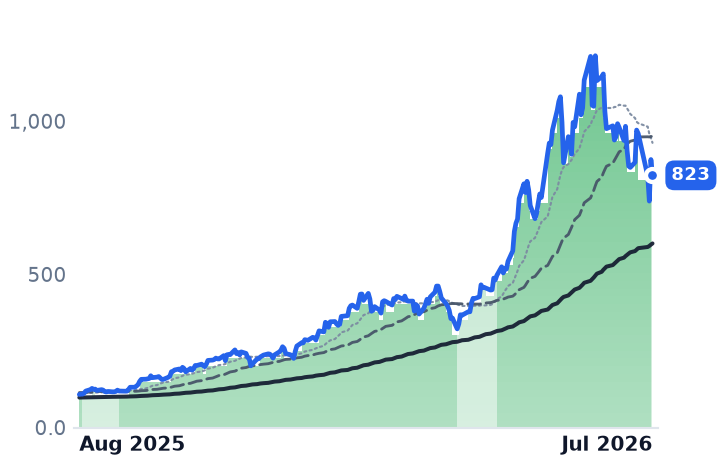
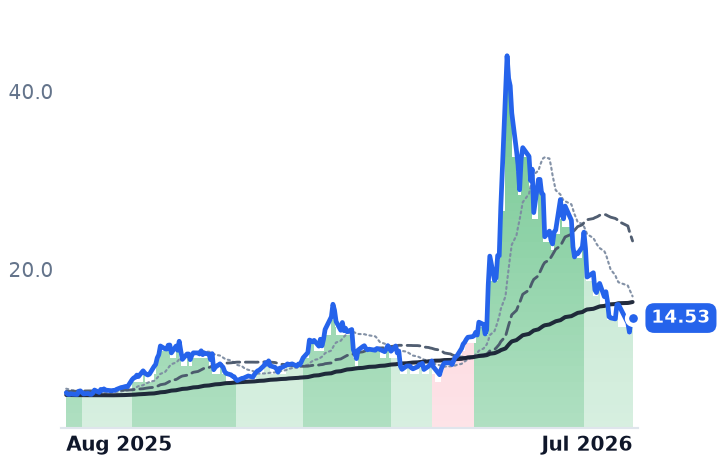
The two publicly traded companies in the "memory chip" corner of the semiconductor market just delivered a textbook case of a stock price moving faster than the business behind it — but only for one of them. Micron Technology, which makes the DRAM and NAND memory chips found in every server and PC and, increasingly, the High Bandwidth Memory (HBM) chips that feed AI processors, told investors its current quarter will be a record on every measure: roughly $50 billion in revenue, gross margins near 86%, earnings near $31 a share, and capital spending raised to about $27 billion for the fiscal year. Its stock still fell about 20% in July, and as much as 39% peak-to-trough. Everspin Technologies, a far smaller company that makes MRAM (magnetoresistive memory) chips mostly for defense, aerospace and industrial customers, fell nearly as hard over the same stretch — despite reporting 13% revenue growth and landing a new $40 million defense subcontract. The two stocks are grouped together as "memory" chipmakers, but the evidence shows only one of them is actually riding the AI memory cycle.
Micron: the business kept accelerating into the drop. Micron's entire 2026 HBM output is sold out under non-cancellable multi-year contracts, and analyst Vijay Rakesh at Mizuho estimates 2026 contract pricing — not just spot prices — could rise as much as 355% for DRAM and 510% for NAND. Management told investors on its latest earnings call that memory-market tightness should persist beyond 2027, and new capacity — a fab in Idaho and an expansion in Hiroshima, Japan — won't produce its first wafers until mid-2027 at the earliest, meaning the near-term supply picture stays tight regardless of the stock's July slide. No guidance was cut ahead of the drop; instead, the decline tracked a broader AI-chip reset that also hit rival SK Hynix, down about 47% from its June peak after a Chinese competitor, ChangXin Memory Technologies, went public and stirred future-competition worries. On the fundamentals, this desk's own numbers CONTRADICT the price action: nothing in Micron's operating results argues for a 20-39% haircut.
Valuation is murkier. Micron's headline forward price-to-earnings ratio, often cited near 7-8x, looks statistically cheap, but this desk's own prior research on the name flagged that figure as "cyclically misleading at peak margins" — memory earnings run hottest right before they roll over. More tellingly, Wall Street's own 12-month consensus price target sat near $483 when the stock traded near $720 in mid-May, already implying the Street saw the shares ahead of its models; at Micron's end-July close of $823, the stock remains well above even that target. That combination — accelerating fundamentals, but a price the Street's own estimates already viewed as extended — reads as a justified de-rating of an ahead-of-itself multiple, not a business breaking down. Call the valuation verdict INCONCLUSIVE, tilted toward "expensive on consensus, cheap on trailing peak margins."
Everspin: riding the label, not the cycle. Everspin's MRAM chips serve data centers, industrial automation, medical, automotive and aerospace customers — a persistent-memory niche structurally separate from the DRAM, NAND and HBM chips that define the AI memory story. Its latest quarter showed $14.87 million in revenue, up 13% year over year, with gross margin near 53% and a near-breakeven net loss — no deterioration whatsoever. Its roughly 35-40% July decline came with no negative company news; if anything, it followed a fresh $40 million, 2.5-year defense subcontract announcement. This desk's own research on Everspin states plainly that AI-related demand for MRAM "remains speculative" and that the real AI memory stack is HBM plus conventional DRAM — not MRAM. With Micron up roughly 654% over twelve months against Everspin's roughly 140%, the category's eye-catching +401% average return is a Micron story wearing a segment label.
The tape confirms an orderly, not violent, pullback. Trend signals for both stocks cut from a strong uptrend to a milder one across every trailing window at once — Micron's on July 30-31 across the 7-, 30-, 90- and 365-day views simultaneously, Everspin's a month earlier, on June 30, across the 90-, 180- and 365-day views. Neither stock appeared among the market's most extreme 30-day movers, consistent with a broad, gradual reset rather than a single-name shock.
The setup
Where it stands — Micron's fundamentals are accelerating into record guidance while its stock and trend signal have downgraded together; Everspin's decline shares no business link to Micron's. Would confirm — DRAM/NAND contract ASPs keep rising and Micron's next quarterly report shows gross margin still near or above 86%. Would invalidate — Customer inventory days rise or Micron guides capital spending up while contract pricing flattens or falls. Watch next — Micron's fiscal Q4 2026 earnings report, due around late September 2026, against its $50B revenue and 86% margin guide. Valuation — MU trades near 7-8x forward earnings, below its own ten-year range, but above the Street's ~$483 consensus target set at a lower price.