

AI Data-Center Power Suppliers Fall Together, but Vicor and Bel Fuse Keep Growing
Hypothesis Opus 5 · Research Sonnet 5 · Writing Sonnet 5 · Prompt v1.1
Six companies that make power chips, converters and magnetics for AI data centers have all declined over the past three months, but Vicor and Bel Fuse are posting accelerating data-center sales even as their stocks drop, while Navitas and Ultralife face company-specific problems that better explain their steeper falls.
| Ticker | Company | Segment | Trend | 30D | 1Y |
|---|---|---|---|---|---|
NVTS | Navitas Semiconductor | Other | 🟢 Cont. Bull | −28.7% | +34.9% |
VICR | Vicor | Other | 🟢 Cont. Bull | −27.3% | +350.0% |
BELFB | Bel Fuse | Connectors & Interconnect Systems | 🟢 Cont. Bull | −2.0% | +107.0% |
BELFA | Bel Fuse | Hardware, Equipment & Parts | 🟢 Cont. Bull | −5.9% | +92.5% |
ULBI | Ultralife | Electrical Equipment & Parts | 🔴 Cont. Bear | −15.1% | −36.7% |
IPWR | Ideal Power | Semiconductors | 🌱 Emerging Bull | −25.3% | −13.3% |
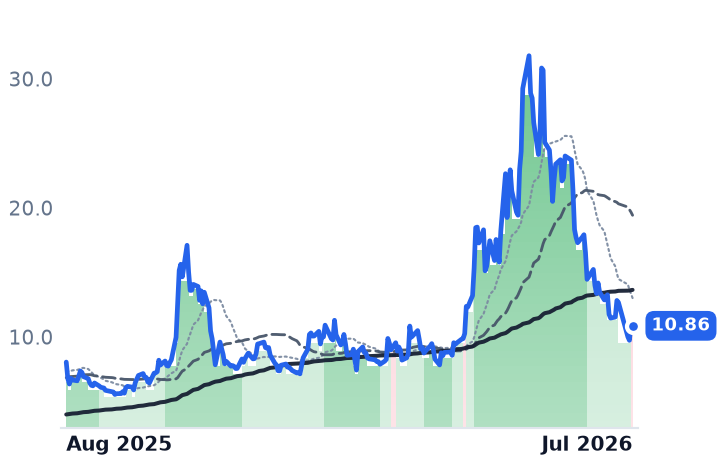
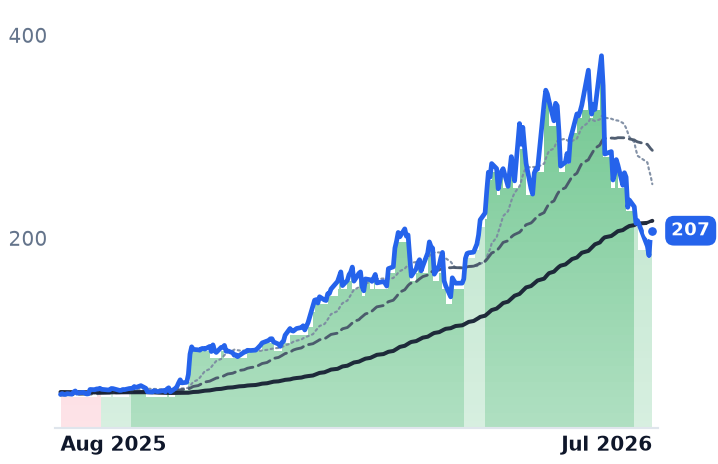
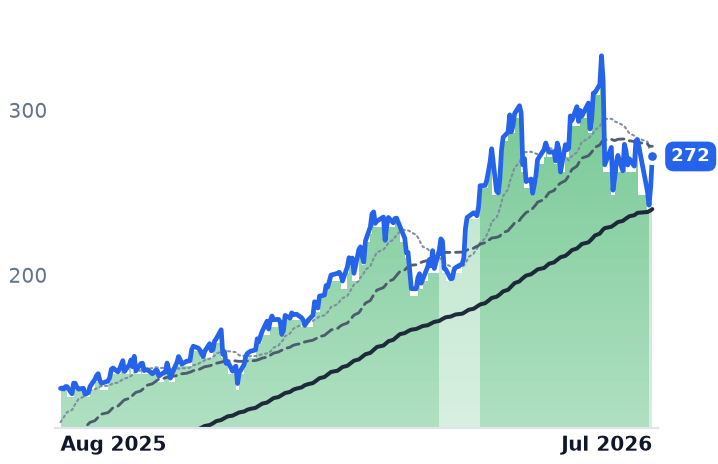
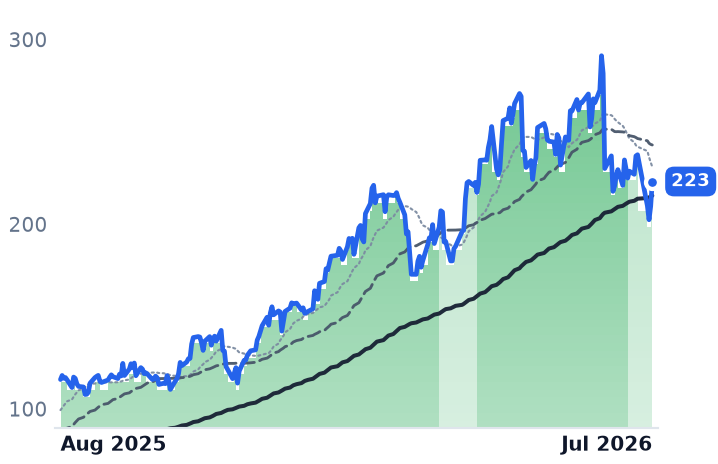
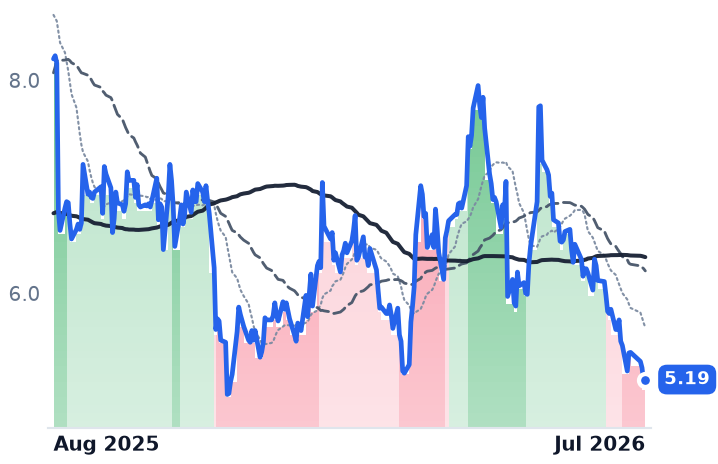
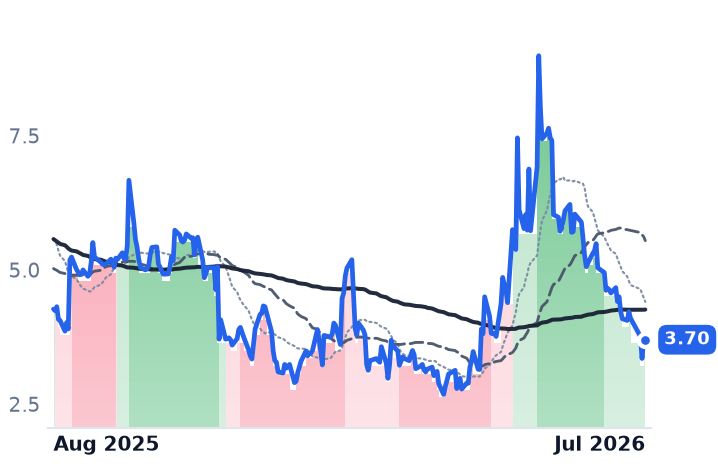
12-month price & trend
| Ticker | Mkt cap | P/E | P/E fwd | P/S | P/S fwd | P/GP | P/GP fwd | EV/EBITDA | FCF yld |
|---|---|---|---|---|---|---|---|---|---|
NVTS | $2.8B | n/m | — | 77.6x | 60.3x | 250.1x | 194.3x | n/m | -2.4% |
VICR | $9.4B | 65.0x | 60.4x | 19.8x | 15.6x | 35.0x | 27.5x | 70.2x | 0.5% |
BELFB | $3.3B | 68.0x | 28.6x | 4.4x | 4.1x | 11.1x | 10.4x | 23.3x | 2.2% |
| Ticker | Mkt cap | P/E | P/E fwd | P/S | P/S fwd | P/GP | P/GP fwd | EV/EBITDA | FCF yld |
|---|---|---|---|---|---|---|---|---|---|
BELFA | $3.3B | 68.0x | 23.8x | 4.4x | 4.1x | 11.1x | 10.4x | 23.3x | 2.2% |
ULBI | $86.4M | n/m | 6.0x | 0.5x | 0.4x | 2.2x | 1.8x | n/m | 7.1% |
IPWR | $31.7M | n/m | — | — | 39.7x | — | — | n/m | -29.7% |
Valuation & fundamentals
Consensus projections
| Ticker | FY2026E | FY2027E | FY2028E | |
|---|---|---|---|---|
NVTS | Revenue | +3.3% | +57.9% | +66.9% |
| EPS | −26.5% | −10.2% | −51.3% | |
VICR | Revenue | +33.1% | +55.6% | +22.2% |
| EPS | +58.9% | +73.2% | +33.0% | |
BELFB | Revenue | +20.5% | +8.0% | +13.3% |
| EPS | +41.6% | +13.7% | +30.4% | |
BELFA | Revenue | +20.3% | +7.6% | +12.6% |
| EPS | +39.7% | +13.2% | +34.5% | |
ULBI | Revenue | +6.2% | — | — |
| EPS | +22.9% | — | — | |
IPWR | Revenue | +1500.0% | +275.0% | +186.7% |
| EPS | −21.8% | −17.5% | −11.3% |
Forward fiscal years only. Blank means no analyst coverage for that year.
Data centers built for artificial-intelligence computing are outgrowing the electrical wiring that powers them. As AI chips draw more current, data-center operators are shifting from today's 48-volt or 54-volt power-distribution systems toward an 800-volt design that Nvidia is pushing for its next generation of server racks, because higher voltage means less energy lost as heat and less copper needed to carry it. That shift requires new power converters, connectors and magnetic components — the products sold by six companies whose stocks have all fallen over the past three months. But the group's shared decline masks a split: two of the six are growing sales to data-center customers faster than ever, while the others face problems that have little to do with the 800-volt transition at all.
All six names were down over the three months from May 1 to July 31 — Navitas Semiconductor, which makes gallium-nitride (GaN) and silicon-carbide power chips, fell 37.7%; Ultralife, a battery and military-communications maker, fell 24.3%; Vicor, which builds high-density power-conversion modules, fell 22.8%; Bel Fuse's two share classes fell 12.9% and 4.1%; and Ideal Power, a pre-revenue chip developer, fell 1.6%. Over the trailing year the group's headline gain is dominated by one name: Vicor is up 373%, while Ultralife and Ideal Power are actually lower than a year ago.
Vicor, whose modules convert power for AI servers and industrial equipment, reported second-quarter revenue of $143.4 million, up 26.9% from the prior quarter, with backlog rising 26% to $379.7 million and bookings running ahead of shipments — what the industry calls a book-to-bill ratio above 1.0, meaning more orders are coming in than are being filled. Gross margin rose to 58%. About $15 million of that quarter's revenue came from a new patent-licensing agreement, with roughly $10 million a quarter expected going forward — a growing, semi-recurring slice of results tied to litigation rather than product sales. The stock still trades at a trailing price-to-earnings ratio near 109 times, up from about 86 times in May even as the price fell, and a forward multiple near 68 times — pricing that leaves little room for a stumble.
Bel Fuse, which sells magnetics, connectors and power modules to data centers as well as aerospace, defense and rail customers, posted second-quarter sales up 25% year over year to $210.7 million, with its data-solutions segment up 31% and data-center-specific revenue rising to about $58 million from $38 million a year earlier, aided by a March acquisition. A $442 million equity raise erased the company's debt. Yet its stock barely moved over the past 30 days, and it trades at an enterprise-value-to-EBITDA ratio of roughly 9-10 times — about half the multiple of the dedicated AI-power names in this group.
Navitas, a pure-play GaN and silicon-carbide chipmaker named by Nvidia as an 800-volt collaborator, grew second-quarter revenue 22% sequentially to $10.5 million and guided to 28% further growth next quarter, with AI and grid revenue up more than 50% year over year. But its stock entered a downtrend on July 30, and two events explain much of the damage: Wolfspeed sued Navitas on July 7 over its entire GaN and silicon-carbide product line, reportedly seeking a U.S. sales ban, and the company launched a $500 million stock-sale program in June that can dilute existing shareholders. Its revenue base remains small — under $45 million annualized — against a price-to-sales ratio near 77 times.
Ultralife, whose core business is military and commercial batteries and communications gear, has only a speculative link to 800-volt power. Its stock posted the group's worst technical breakdown, and on July 16 Zacks initiated coverage at Underperform, citing profitability challenges — a case where the business and the stock agree on the downside. Ideal Power, developing a bidirectional switch called B-TRAN, remains pre-revenue with a quarterly net loss of $3.63 million; it has signed partnership agreements for future circuit-protection products but no booked production orders.
Timing matters here: a SemiAnalysis report around July 6 said Nvidia's Kyber rack — the vehicle for 800-volt architecture in its Rubin Ultra chip generation — has slipped from a 2027 to a 2028 rollout, a report Nvidia disputes; that timing lines up closely with the start of the group's slide. High-volume 800-volt shipments were already targeted for 2027, not 2026, even before any delay. A broader, unrelated chip selloff in late July erased more than $1 trillion in sector market value on memory-supply and AI-spending-return worries, hitting AMD and TSMC too. And Nvidia's own 800-volt supplier list names Infineon, onsemi, Monolithic Power Systems and Texas Instruments alongside Navitas — Navitas is one of many chip suppliers, not an exclusive one.
The setup
Where it stands — All six stocks fell over three months, but only Vicor and Bel Fuse show data-center sales accelerating while their share prices declined. Would confirm — Vicor's book-to-bill stays above 1.0 and Bel Fuse's data-center revenue growth holds above 25% year over year in Q3 2026. Would invalidate — Vicor's backlog shrinks quarter over quarter or Bel Fuse's data-solutions growth falls below 15% year over year. Watch next — Navitas' Q3 2026 results, guided to roughly $13.5 million revenue, and any ruling or settlement in the Wolfspeed lawsuit. Valuation — Vicor trades near 109x trailing and 68x forward earnings; Bel Fuse near 9-10x EV/EBITDA, about half the AI-power group's typical multiple.