

Memory-Interface Bucket's 30-Day Slide Reads as Reset, Not Rollover
Hypothesis Opus 5 · Research Sonnet 5 · Writing Sonnet 5 · Prompt v1.0
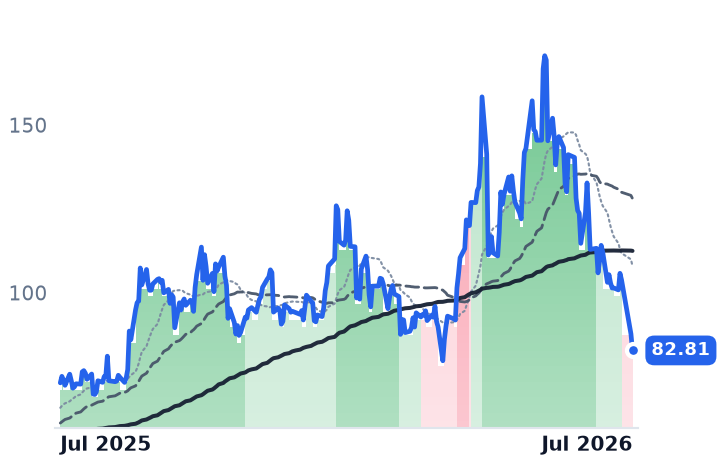
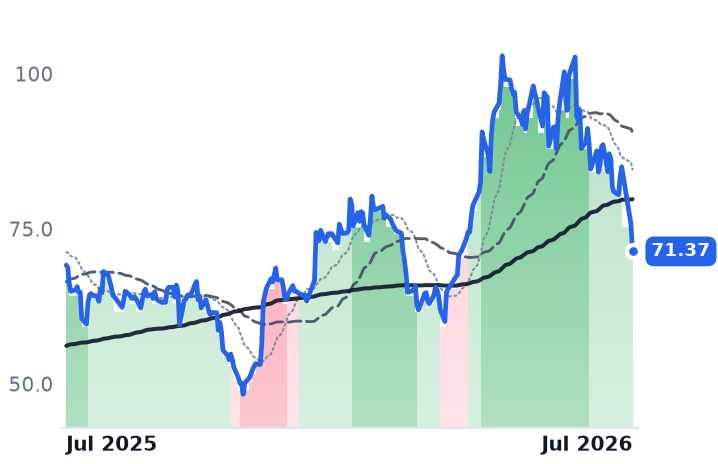
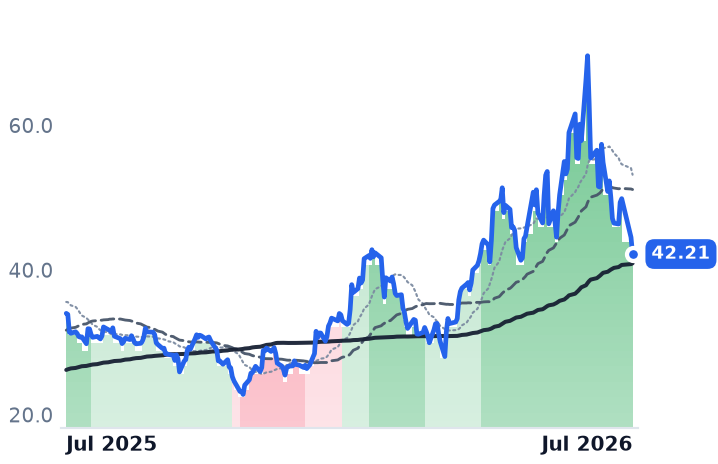
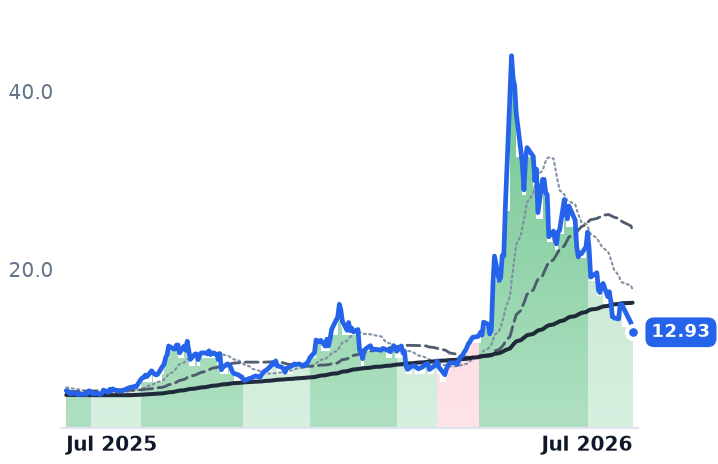
RMBS/MCHP/ALGM/MRAM have fallen roughly 15-50% over 30 days, but trend-band data show only Rambus actually crossed out of a bull posture — and that break came in the final week alongside a broad, sector-wide AI-chip selloff, not a cohort-specific breakdown in memory-interface or CXL fundamentals.
| Ticker | Company | Segment | Trend · 13mo | 30D | 1Y |
|---|---|---|---|---|---|
RMBS | Rambus | Interconnect & Storage IP | 🟢 Cont. Bull | −33.2% | +13.2% |
MCHP | Microchip Technology Incorporated | Analog & Mixed-Signal | 🟢 Cont. Bull | −19.9% | +3.2% |
ALGM | Allegro MicroSystems | Other | 🟢 Cont. Bull | −36.4% | +24.1% |
MRAM | Everspin Technologies | Memory (DRAM/NAND) | 🟢 Cont. Bull | −42.6% | +103.0% |
12-month price & trend
| Ticker | Mkt cap | P/E | P/E fwd | P/S | P/S fwd | P/GP | P/GP fwd | EV/EBITDA | FCF yld |
|---|---|---|---|---|---|---|---|---|---|
RMBS | $10.2B | 42.2x | 30.9x | 13.4x | 12.3x | 17.2x | 15.7x | 31.6x | 2.9% |
MCHP | $42.5B | 108.3x | 24.5x | 8.3x | 6.8x | 13.8x | 11.3x | 28.2x | 2.6% |
ALGM | $7.3B | 486.3x | 38.2x | 7.8x | 6.7x | 16.4x | 14.1x | 71.8x | 1.2% |
| Ticker | Mkt cap | P/E | P/E fwd | P/S | P/S fwd | P/GP | P/GP fwd | EV/EBITDA | FCF yld |
|---|---|---|---|---|---|---|---|---|---|
MRAM | $432.6M | n/m | — | 6.9x | 5.9x | 13.2x | 11.3x | 939.0x | -1.2% |
Consensus projections
| Ticker | FY2026E | FY2027E | FY2028E | |
|---|---|---|---|---|
RMBS | Revenue | +17.3% | +19.6% | +24.8% |
| EPS | +21.5% | +23.6% | +25.3% | |
MCHP | Revenue | +6.2% | +33.3% | +16.1% |
| EPS | +20.7% | +103.7% | +31.1% | |
ALGM | Revenue | +23.0% | +24.5% | +17.2% |
| EPS | +131.1% | +93.9% | +45.5% | |
MRAM | Revenue | +33.0% | +14.6% | +4.2% |
| EPS | +340.0% | −218.2% | +161.5% |
Forward fiscal years only. Blank means no analyst coverage for that year.
What the bands actually show
The user's ⚡3 "AI2: Memory Disaggregation & CXL" bucket — Rambus (RMBS), Microchip (MCHP), Allegro (ALGM), Everspin (MRAM) — has indeed given back double-digit percentages over the trailing 30 days on a gradual, non-artifact basis: Allegro fell from $69.62 to $44.52, Microchip from $102.71 to $75.71, Everspin from roughly $30.11 to $13.97, and Rambus from roughly $145.48 to $87.75. But the sma-crossover trend bands tell a more selective story than a synchronized cohort rollover. Allegro has held strongly bullish continuously since April 22 despite the price collapse. Microchip and Everspin only softened from strongly bullish to mildly bullish — still bullish bands, not neutral or bear. Rambus is the sole name that actually crossed into bear territory, moving strongly bullish to mildly bullish on July 6, then mildly bullish to mildly bearish on July 22, and that break sits entirely inside the trailing week of the window rather than tracking the group.
Fundamentals look intact, not broken
Rambus posted record Q2 2026 revenue of $207.4 million, up 20% year-over-year, with product revenue up 22% YoY and non-GAAP EPS ahead of guidance, plus a new HBM4E controller design win with a Tier-1 U.S. hyperscaler. The stock still dropped roughly 9% on the print and fell further into July 28 on margin-mix and valuation concerns, not a demand miss. Microchip's book-to-bill sat at 1.06 with bookings up 10% sequentially, consistent with continued inventory normalization. Allegro's FY2026 revenue grew 22.8% with automotive still expanding and data-center hitting a record share of sales, undercutting the idea that its auto exposure is simply dead weight. Everspin's quarterly revenue grew low-teens year-over-year, though it remains operating-loss-making, and carries a near-term governance overhang from a board resignation ahead of its August 5 print.
The real driver looks macro, not micro
The drawdown lines up with a documented chip-sector rout that wiped out more than $1 trillion in market value, tied to SK Hynix's HBM capacity-expansion pullback, a hawkish Fed, and China competition fears, described elsewhere as "AI debt jitters" hitting Korean memory makers and AI-hardware suppliers alike. Notably, DRAM contract prices are still projected up 13-18% in Q3 with HBM sold out for 2026, and CXL adoption in 2026 is described as gradual but not stalling — the physical memory upcycle this desk has tracked remains intact even as sentiment on the equities reversed sharply.