

Space Stations & Tourism's "Emerging Bull" Read Is Already Stale
Hypothesis Opus 5 · Research Sonnet 5 · Writing Sonnet 5 · Prompt v1.0
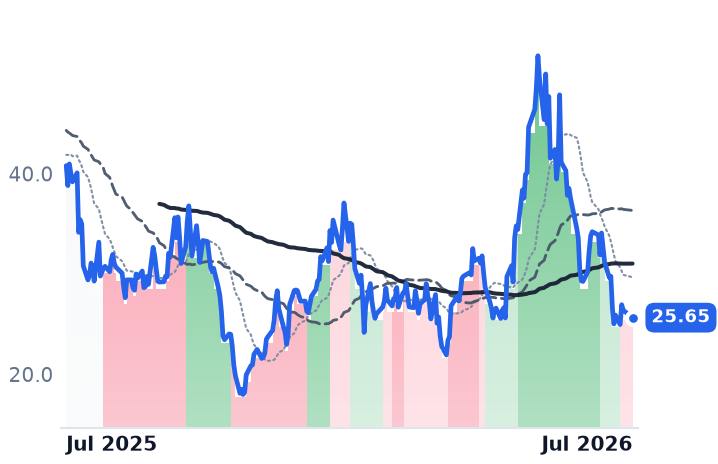
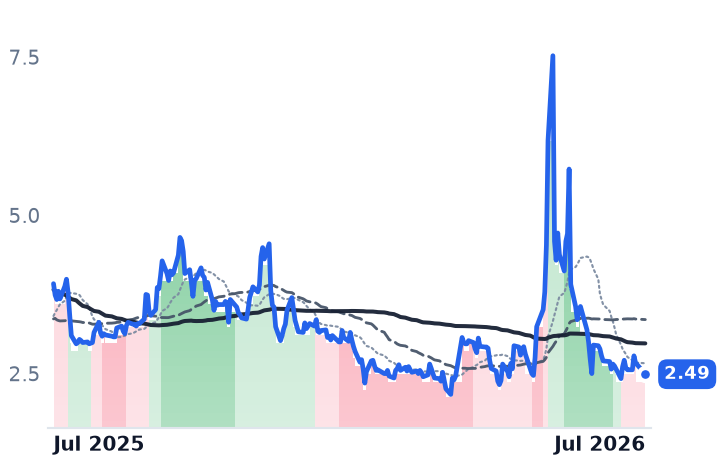
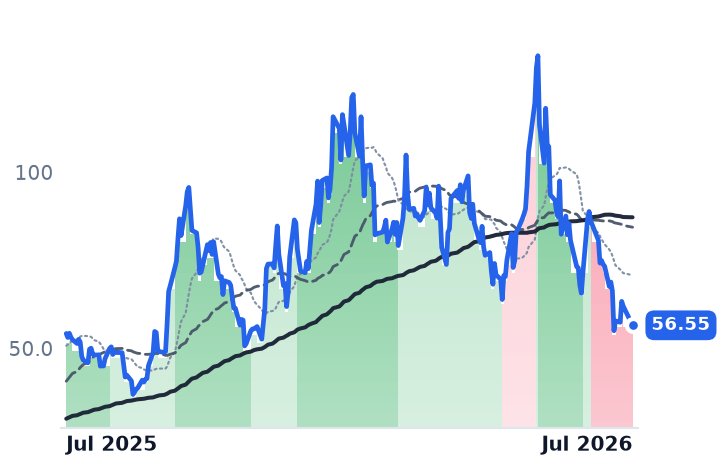
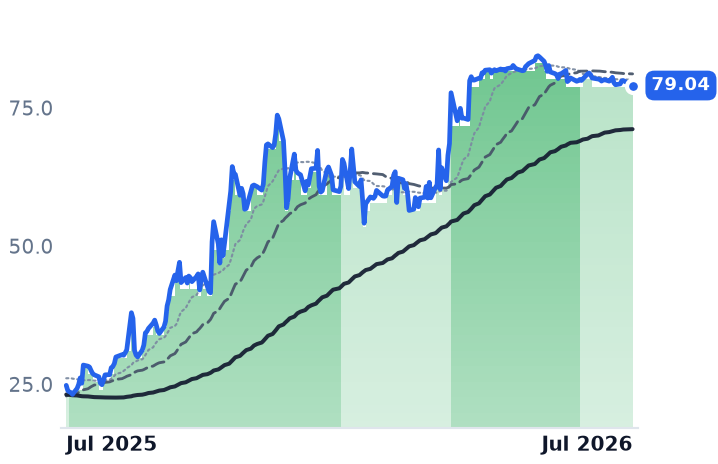
VOYG and SPCE did exit strongly bearish together in April–May 2026 and rallied hard into strongly bullish by early July, but both have since round-tripped back to mildly bearish as of 2026-07-28 — the bullish inflection the category label implies has already come and gone. Meanwhile the adjacent Direct-to-Device leg isn't moving as one trade either: ASTS cratered into strongly bearish on fundamentals while GSAT stays propped up by deal-arb mechanics, not sector sentiment.
| Ticker | Company | Segment | Trend · 13mo | 30D | 1Y |
|---|---|---|---|---|---|
| The subject · what this brief is about | |||||
VOYG | Voyager Technologies | Missiles, Weapons & Fire Control | 🌱 Emerging Bull | −15.0% | −37.1% |
SPCE | Virgin Galactic | Aerospace & Defense | 🌱 Emerging Bull | −15.3% | −36.5% |
| Compared against · context, not the story | |||||
ASTS | AST SpaceMobile | Satellite & Broadband Services | ⚠️ Emerging Bear | −34.8% | +4.3% |
GSAT | Globalstar | Specialty & Small Carriers | 🟢 Cont. Bull | −2.6% | +218.7% |
12-month price & trend
| Ticker | Mkt cap | P/E | P/E fwd | P/S | P/S fwd | P/GP | P/GP fwd | EV/EBITDA | FCF yld |
|---|---|---|---|---|---|---|---|---|---|
VOYG | $2.0B | n/m | — | 12.2x | 8.5x | 151.0x | 104.6x | n/m | -12.5% |
SPCE | $182.0M | n/m | — | 139.0x | 4.6x | — | — | n/m | -225.0% |
ASTS | $29.1B | n/m | — | 252.4x | 183.2x | — | — | n/m | -5.6% |
| Ticker | Mkt cap | P/E | P/E fwd | P/S | P/S fwd | P/GP | P/GP fwd | EV/EBITDA | FCF yld |
|---|---|---|---|---|---|---|---|---|---|
GSAT | $10.5B | n/m | — | 37.2x | 35.9x | 74.4x | 71.7x | 96.7x | -0.7% |
Consensus projections
| Ticker | FY2026E | FY2027E | FY2028E | |
|---|---|---|---|---|
VOYG | Revenue | +43.8% | +54.2% | +97.8% |
| EPS | +38.8% | −59.4% | −47.4% | |
SPCE | Revenue | +2035.8% | +762.0% | +57.7% |
| EPS | −49.9% | −92.9% | −439.0% | |
ASTS | Revenue | +172.1% | +330.7% | +167.9% |
| EPS | +37.1% | −48.4% | −180.2% | |
GSAT | Revenue | +8.0% | +15.6% | +36.4% |
| EPS | −350.5% | −209.4% | +380.3% |
Forward fiscal years only. Blank means no analyst coverage for that year.
What the bands actually show
Trend-band history for the two names in this bucket tells a cleaner story than the current "turning bullish" tag suggests. VOYG flipped out of strongly bearish/mildly bearish into mildly bullish on 2026-04-24 and ran to strongly bullish by mid-May, holding that band through 2026-07-06 before sliding to mildly bullish and then mildly bearish since 2026-07-20. SPCE followed a similar arc — mildly bearish from 2026-04-13, a brief re-test of strongly bearish in late May, mildly bullish from 2026-05-29, strongly bullish from 2026-06-08 through early July, then a drop to mildly bearish by 2026-07-13. As of the latest data available (2026-07-28), both names sit in mildly bearish, not neutral or mildly bullish. The bull leg was real for roughly six to eight weeks; it has already fully unwound.
Price action backs this up: VOYG fell from $34.57 (2026-06-22) to $25.65 (2026-07-28), a ~26% decline, while SPCE slid from $2.95 to $2.49 over a similar window, about 15.6% — both consistent with the roughly -15% 30-day category average cited in the hypothesis, though VOYG's leg down is the sharper of the two.
The catalysts have turned into headwinds
The binary catalyst underpinning Starlab/VOYG — NASA's Commercial LEO Destinations Phase 2 award — was placed on hold on January 28, 2026 as NASA restructured its acquisition approach, and a March 2026 strategy shift now points toward private modules feeding a government-anchored hub rather than fully independent stations, with awards still pending sometime in 2026. Competing bidders are moving on their own clocks: Vast's Haven-1 has completed cleanroom integration for a 2027 launch and Axiom targets a two-module station by 2028, while Starlab's own target launch of 2029 trails both. Layered on top, Morgan Stanley downgraded VOYG to Underweight on July 15, assigning only about a 33% probability to the Starlab joint venture's DCF-implied value — a downgrade that drove a 7.3% single-day drop that lines up with the band's rollover.
SPCE's Delta-class program is progressing on schedule — structural assembly is complete and glide tests are targeted for Q3 2026 with rocket-powered flight in Q4 — but the company is funding that progress through dilution, having completed a $30.5M debt-for-equity swap and filed a $40.21M shelf while guiding to negative $87-92M quarterly free cash flow. Curated notes flag Virgin Galactic's runway as roughly three to four quarters against ~$338M cash and burn near $90-95M/quarter — a gap the recent financing only partially closes.
Not one space trade, but two divergent ones
The adjacent Direct-to-Device & Spectrum leg underscores that "space" isn't a single cohort right now. ASTS collapsed from strongly bullish to strongly bearish within days at the end of June, falling roughly 22.7% from $73.19 to $56.55 after a botched New Glenn satellite insertion and heavy insider selling. GSAT, by contrast, has held mildly bullish/strongly bullish nearly continuously and was essentially flat (-1.0%) over the same window — but that stability reflects Amazon's pending $90-cash/0.3210-share acquisition spread compressing, not sector fundamentals reasserting themselves.
Taken together, the Space Stations & Tourism "turning bullish" tag reads as a lagging snapshot of a completed round-trip rather than a live inflection, and the fundamental catalysts that drove the spring rally — CLD Phase 2 timing and Delta-class flight progress — currently sit closer to headwind than tailwind for both names.