

NOC's -20% Slide Is Idiosyncratic, Not a Defense-Sector Crack
Prompt v1.0
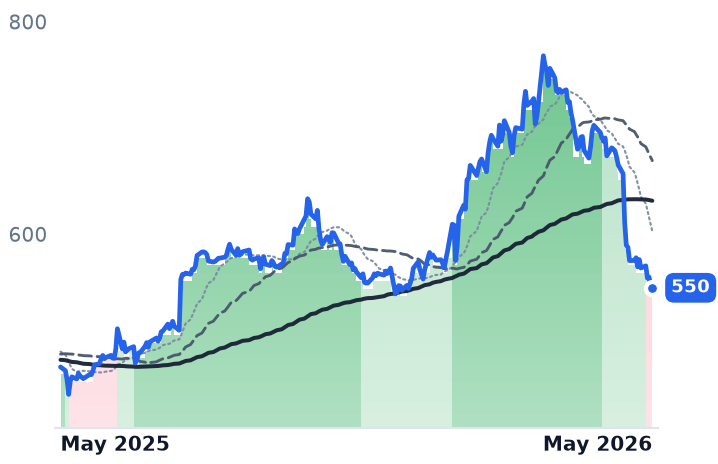
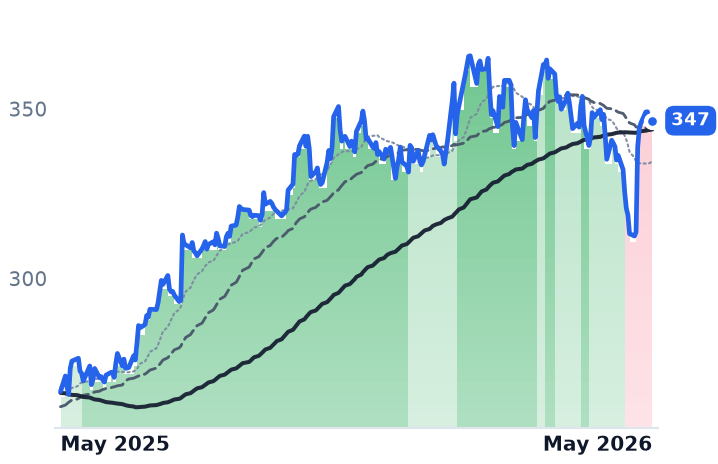
Northrop Grumman has shed roughly 20% since late March — from ~$687 to ~$550 — driven by an earnings-day reset on capex guidance, not a broad legacy-prime de-rating. Peers LMT and RTX have held up, the backlog is a record $96B, and forward valuation has compressed to historically attractive levels.
| Ticker | Company | Segment | Trend · 13mo | 30D | 1Y |
|---|---|---|---|---|---|
NOC | Northrop Grumman | Large Diversified Primes | 🟢 Cont. Bull | −20.4% | +15.7% |
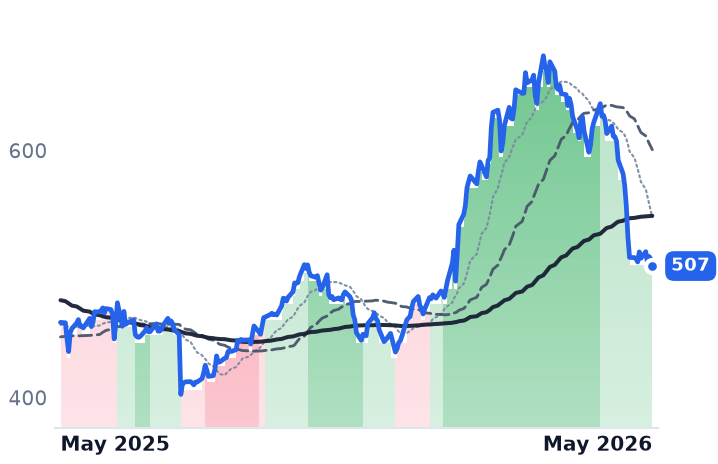
LMT | Lockheed Martin | Large Diversified Primes | 🟢 Cont. Bull | −18.8% | +9.9% |
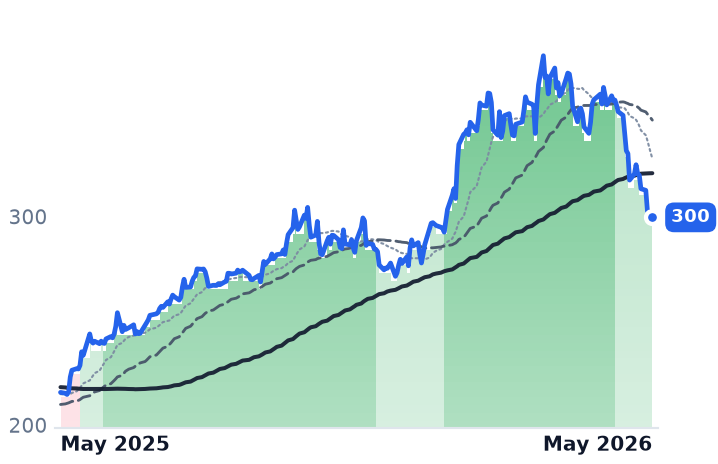
LHX | L3Harris Technologies | Avionics & Electronic Systems | 🟢 Cont. Bull | −16.3% | +38.9% |
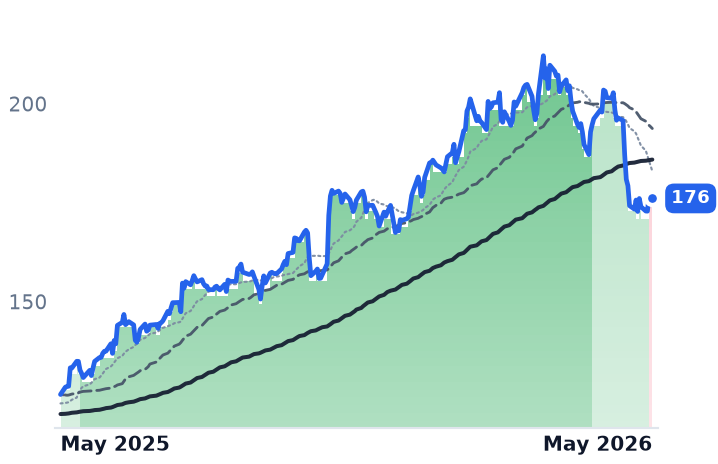
RTX | RTX | Large Diversified Primes | 🟢 Cont. Bull | −13.3% | +39.2% |
GD | General Dynamics | Large Diversified Primes | 🟢 Cont. Bull | +1.2% | +30.0% |
12-month price & trend
| Ticker | Mkt cap | P/E | P/E fwd | P/S | P/S fwd | P/GP | P/GP fwd | EV/EBITDA | FCF yld |
|---|---|---|---|---|---|---|---|---|---|
NOC | $76.8B | 16.8x | 19.3x | 1.8x | 1.7x | 8.8x | 8.5x | 12.2x | 4.3% |
LMT | $119.0B | 24.8x | 17.2x | 1.6x | 1.5x | 16.1x | 15.3x | 17.0x | 4.8% |
LHX | $56.5B | 32.7x | 26.1x | 2.5x | 2.4x | 10.3x | 9.8x | 16.1x | 4.6% |
| Ticker | Mkt cap | P/E | P/E fwd | P/S | P/S fwd | P/GP | P/GP fwd | EV/EBITDA | FCF yld |
|---|---|---|---|---|---|---|---|---|---|
RTX | $230.5B | 31.8x | 24.7x | 2.6x | 2.5x | 12.6x | 12.1x | 19.0x | 3.6% |
GD | $90.5B | 20.8x | 20.1x | 1.7x | 1.6x | 11.0x | 10.7x | 15.2x | 6.9% |
Consensus projections
| Ticker | FY2026E | FY2027E | FY2028E | |
|---|---|---|---|---|
NOC | Revenue | +5.1% | +6.7% | +6.1% |
| EPS | +7.2% | +7.9% | +8.6% | |
LMT | Revenue | +6.1% | +5.4% | +5.5% |
| EPS | +38.4% | +7.1% | +6.2% | |
LHX | Revenue | +3.2% | +7.2% | +8.0% |
| EPS | −18.5% | +9.1% | +16.9% | |
RTX | Revenue | +8.1% | +7.0% | +6.8% |
| EPS | +11.5% | +9.8% | +10.5% | |
GD | Revenue | +6.4% | +4.6% | +4.2% |
| EPS | +7.9% | +9.5% | +7.9% |
Forward fiscal years only. Blank means no analyst coverage for that year.
What happened
NOC's drawdown traces almost entirely to its April 21 Q1 2026 earnings print. The headline numbers were actually fine — revenue up 4.4%, EPS of $6.14 beat the $6.05 consensus, and net income jumped 82% year-over-year. Management also reaffirmed FY26 guidance. Yet the stock fell ~7% on the day and kept sliding because of three specific disappointments embedded in the report:
- Capex guide raised by $200M to $1.85B for FY26, with a multi-year commitment of roughly $2.5B concentrated in 2027–2028 to support a 25% ramp in B-21 Raider production rates.
- FY26 EPS guidance of $27.40–$27.90 landed below the $28.01 street consensus — a modest but symbolically significant miss.
- Space Systems took a $71M unfavorable EAC adjustment on the GEM 63XL program, adding another single-name overhang.
The market's interpretation: near-term free cash flow will be penalized while the capex investment matures — and the payoff is back-end loaded into 2028–2029.
Is this sector-wide or idiosyncratic?
The evidence leans toward single-name, with a partial sector overlay. L3Harris (LHX) is also down roughly 17% over the same window, suggesting some shared concern about fixed-price program risk and a modest trimming of geopolitical risk premium following Iran ceasefire headlines. But LMT and broader defense names have held up materially better, which weakens the thesis that this is the leading edge of a coordinated legacy-prime de-rating. The NOC move is primarily its own story.
Program backdrop
The B-21 and Sentinel programs sit at the heart of the debate. The B-21 production ramp is capital-intensive and the timeline is long — first delivery to Ellsworth AFB is targeted for 2027, with program milestones still stretching well into the next decade. Sentinel (the ICBM replacement, formerly GBSD) has its Milestone B decision expected later in 2026. Both programs carry execution risk under fixed-price structures — the same dynamic that has periodically punished Boeing's defense unit.
Valuation reset
After the drawdown, NOC's multiples have compressed meaningfully from their prior highs near $774:
- Forward P/E: ~19.7x (down from richer levels)
- EV/EBITDA: ~12.4x
- FCF yield: ~4.2%
- Trailing P/E: ~17x
Against that backdrop, the $96B record backlog provides long-duration revenue visibility. Near-term catalysts include the F/A-XX fighter down-select expected in August 2026 and the Sentinel Milestone B later this year.
Morgan Stanley reiterated a constructive view with a $745 price target, framing the selloff as a case where investors are marking down near-term capex pain without giving credit for the medium-term FCF recovery — the bank models 2028E FCF of roughly $3.64B rising to ~$4.16B in 2029.
Why it matters
The NOC drawdown is a textbook capex-cycle de-rating: the market is penalizing a company for investing heavily in programs that won't generate peak returns for 2–3 years. Whether that reset has gone far enough depends on one's confidence in B-21 production execution and defense budget durability. What the evidence does not support is reading NOC's slide as a warning signal for the entire defense prime complex — LMT and RTX's relative stability argues against that interpretation. The story is NOC's own.