

HubSpot's -64% Drawdown Hits an Inflection: Earnings Reveal Pricing Pivot Risk
Prompt v1.0
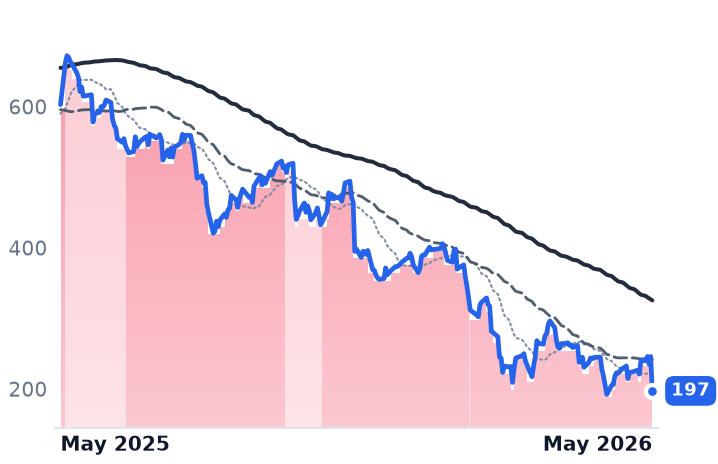
HubSpot's -19% single-day collapse on May 8, 2026 — triggered by a deliberate shift to outcome-based AI agent pricing and a Q2 'slow start' warning — has pushed the stock -64% off its July 2025 peak and back to near April tariff lows. The core business remains healthy (23% revenue growth, 300K customers, raised margin guidance), but a structural pricing model transition is compressing near-term monetization and creating an estimate-cut cycle risk heading into summer.
| Ticker | Company | Segment | Trend · 13mo | 30D | 1Y |
|---|---|---|---|---|---|
HUBS | HubSpot | Customer Experience & CRM | 🔴 Cont. Bear | −3.8% | −67.3% |
12-month price & trend
| Ticker | Mkt cap | P/E | P/E fwd | P/S | P/S fwd | P/GP | P/GP fwd | EV/EBITDA | FCF yld |
|---|---|---|---|---|---|---|---|---|---|
HUBS | $11.5B | 79.1x | 17.0x | 3.3x | 3.1x | 4.0x | 3.7x | 37.9x | 6.7% |
Consensus projections
| Ticker | FY2026E | FY2027E | FY2028E | |
|---|---|---|---|---|
HUBS | Revenue | +18.5% | +14.9% | +14.0% |
| EPS | +37.2% | +22.5% | +18.5% |
Forward fiscal years only. Blank means no analyst coverage for that year.
What Happened
HubSpot's five-day decline of roughly -18% is not a quiet, technically-driven slide — it is almost entirely attributable to a single violent session. On May 8, 2026, the stock crashed -19% to $197.34 despite a Q1 earnings beat, landing within dollars of its April 10 intraday low of $192.26 set during the tariff panic.
Q1 FY2026 results from Business Wire show revenue of $881M (+23% YoY, +18% constant currency), beating the $863M consensus, with non-GAAP EPS of $2.72 versus the $2.47 estimate. Non-GAAP operating margin expanded 4 points YoY to 17.8%, and full-year margin guidance was actually raised to 21%. The headline numbers were not the problem.
The Structural Concern That Spooked Markets
The selloff was driven by management's disclosure of a sweeping go-to-market reset. As the Boston Globe reported, HubSpot cut the price of its Customer Agent, pivoted to outcome-based pricing for Customer and Prospecting Agents, introduced 28-day free trials, and spent the entirety of April retraining its salesforce — all of which slowed sales-cycle velocity entering Q2. Management said on the Q1 earnings call transcript that Q2 "got off to a slow start" due to these Spring Spotlight transitions.
The guidance miss was significant: full-year 2026 revenue guidance of $3.700–3.708B came in ~$70M below the ~$3.772B street consensus, while Q2 guidance of $897–898M missed by ~$20M.
The deeper anxiety: HubSpot is cannibalizing its own credit-based AI revenue before it has scaled. Only ~9,000 of nearly 300,000 customers are using the Customer Agent, and ~14,000 are using the Prospecting Agent — AI monetization is at sub-5% customer penetration even as the pricing architecture is being restructured around it. Needham analyst Joshua Reilly noted that "multiple pricing and packaging changes led to a sales slowdown as customers take longer to evaluate new AI products."
Multi-Leg Drawdown in Context
The 12-month decline from $552.16 (July 24, 2025) to $197.34 is not a single-event story — it is a four-act compression: a Q3 2025 earnings leg (-17% on November 5–6), a Q4 2025 earnings reset (-14% on February 11–12), an April tariff/macro selloff (intraday low $192), a partial recovery to $246, and now this Q1 2026 catalyst leg. Each leg has been triggered by a distinct negative signal, arguing against a simple mean-reversion recovery thesis.
This pattern fits squarely within the broader SaaS de-rating documented in research on application-layer software, where marketing/CRM platforms — systems of engagement — have been the hardest hit category. Salesforce is down -37% YTD in 2026 on similar "seat compression" from AI agents, confirming the HubSpot decline is not purely idiosyncratic.
What the Bulls Can Point To
The profitability story remains intact. HubSpot raised non-GAAP EPS guidance to $13.04–13.12, well above the prior $12.38–12.46, and targets 25% non-GAAP operating margins long-term per its agentic platform growth roadmap.
Customer growth remains healthy: Q1 added 10,800 net new customers to reach nearly 300,000, up 16% YoY. Upmarket momentum is accelerating — deals over $60K ARR grew 37% YoY and deals over $120K ARR grew 64% YoY per the Q1 deep-dive from Globe and Mail, the same source noting that active core seat users grew 90% YoY and total AI agent credits consumed rose 67% QoQ. NRR held at 103%. The company also repurchased $211M in shares during Q1, with $789M remaining under its $1B authorization, and ended Q1 with $1.8B in cash and $198.8M in operating cash flow.
Analyst Dispersion Is Extreme
The post-earnings analyst community is sharply divided. Citigroup downgraded from Buy to Neutral at $230; Bank of America reaffirmed Underperform with a $180 target. But bulls remain: Morgan Stanley and RBC both carry $350 price targets (Overweight/Outperform), while Canaccord sits at $335; Piper Sandler and BMO cut targets to $250 and $230 respectively but maintained Outperform ratings; Cantor downgraded to Neutral at $200. The consensus target of ~$315–320 implies roughly 60% upside from the $197 close, but that consensus will likely compress as analysts cut estimates through the summer.
Two insider sales — Director Brian Halligan sold 8,292 shares on April 21 and Erika Ashley Fisher sold 915 shares on May 4 — add a modest additional headwind to sentiment heading into Q2.
The Structural Question
HubSpot is attempting to transition its monetization model from seat-based SaaS to outcome-based AI credits at exactly the moment when AI-native substitution risk is highest and the salesforce is being retrained. The risk is not that the product is failing — AI engagement metrics suggest the opposite — but that the pricing transition compresses near-term revenue recognition while extending sales cycles, creating a window where estimate cuts and multiple compression can coexist with actually improving product fundamentals. BofA's concern that "end-market readiness for broad-based agent adoption remains unproven" captures this precisely.